

A small, witnessed spill of clean water can probably evaporate by itself, provided you catch it quickly, there’s no continuous leak, and there is no electrical risk or reason to believe there is soaked padding or flooring under the affected area. Otherwise, you should get professional water damage assessment and remediation. I wouldn’t let the situation “dry down” and then decide later if the area was really dry.
If you rent and suspect a building or appliance leak, tell management now rather than waiting to see whether a fan solves it. Photograph the patch and record when you found it, the suspected source, and what you’ve done. Reporting procedures vary by location; NYC311, for example, directs tenants to contact the landlord, managing agent, or superintendent before filing an apartment-leak complaint.
Where did the water come from, and what did it touch?
Water from a supply line of a washing machine is not the same as wash water that is soiled with detergent and other contaminants. Drying will not remove all contamination from sewage or flood water.
| What you know | What I’d do next |
|---|---|
| A small, witnessed spill of clean drinking water, addressed promptly | Try limited household drying if there’s no sign of deeper saturation or electrical exposure. |
| A clean-water supply leak | Stop the source if safely accessible. Seek assessment if the amount, duration, spread, or affected layers are uncertain. |
| Dishwasher or washing-machine discharge, sewage, or outdoor floodwater | Keep people and pets out of the affected area and arrange qualified cleanup assessment. Don’t treat it as an ordinary spill. |
| An unexplained patch, recurring wetness, or a leak through building materials | Report or investigate the source promptly and arrange assessment; a small visible patch doesn’t reveal the full problem. |
Imagine I’m moving a chair so I can blot a damp patch before dinner, with a towel in one hand and nowhere convenient to put the chair. I’m annoyed about losing the room for the evening. Then I realize nobody spilled anything. I’d put the fan plan on hold and report the unexplained wetness: getting the room back matters, but first I need to know why it’s wet.
Your hand can’t check the whole floor
You can’t reach the padding or subfloor with your hand, and they could be just as wet as the carpet backing. The EPA recommends drying all three and the subfloor. Even if padding is not installed, carpet is still backed and is always installed on a surface.
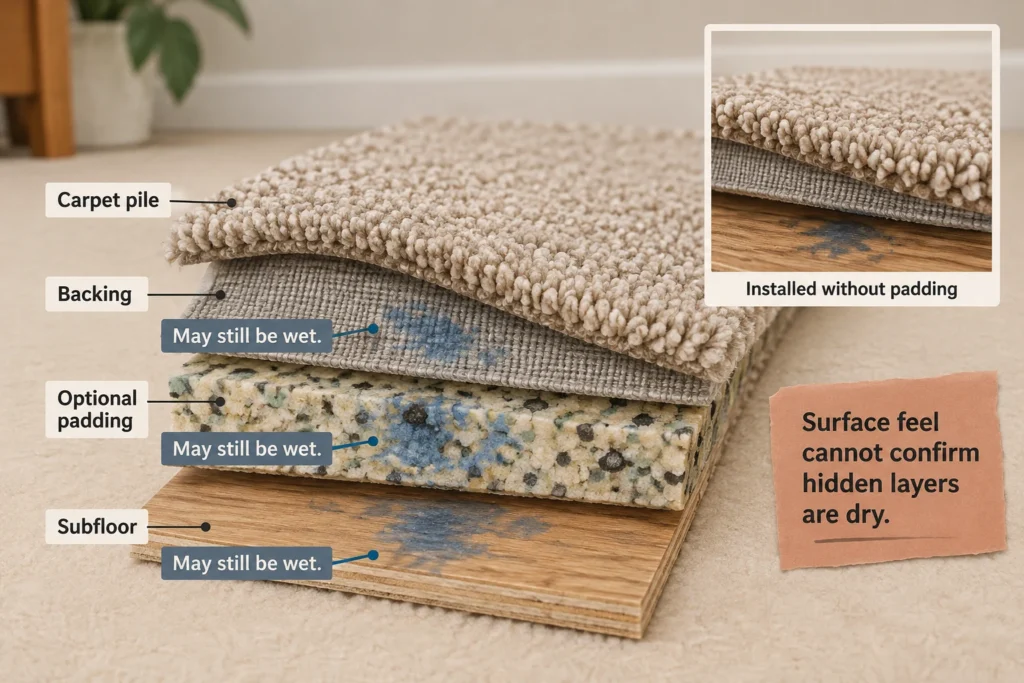
There are some conditions that would change my mind, like water that won’t stop seeping back up, wetness that reaches walls and adjacent surfaces, or a large saturated area. Those conditions would definitely warrant a call to the professionals.
There is no hard and fast rule that says if a certain amount of water spills, it's a household job and if it is a larger amount, it's automatically a professional's responsibility.
You don't have to take any of the tools into your own hands to call the professionals, especially if you think there could be hidden layers that are still wet and you can't tell if they are drying.
For an ordinary spill, remove water without adding more
For minor, known, clean-water spills, press clean, white absorbent towels into the patch, and replace them as they get wet. Blot, don’t scrub. Shaw’s carpet care guide suggests that scrubbing can damage the carpet. I would avoid using shampoo at this point, you’re trying to remove water not clean the carpet.
Extraction equipment should always be used to remove water; do not use a standard, dry, vacuum. Air movers and a dehumidifier are allowable options; EPA includes both of these in their guidance as allowable methods for drying. Do not run fans across contaminated water, including mold.
A fan running is not evidence of progress. A shrinking, damp patch is evidence of progress drying the spill. If the patch spreads and/or shows no improvement over time, consider the drying efforts unsuccessful, and a assessment should be scheduled.
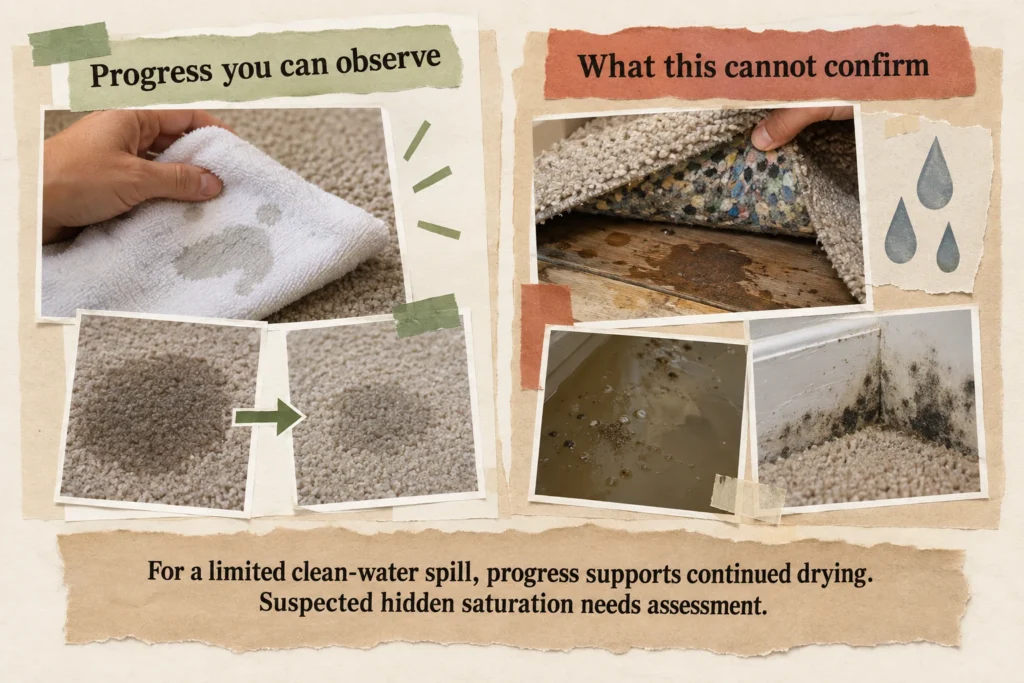
The 24-48-hour guidance is a prompt, not a waiting period
EPA emphasizes drying water-damaged materials within 24-48 hours to help prevent mold. That’s a reason to act now, not to watch soaked carpet for two days before calling. If you don’t know when the leak began, finding it today doesn’t restart the clock.
If the time the water damage occurred is unknown, it is unlikely the time is restarted due to a more recent observation of water damage.
Click here to see the full input text and additional information.
There’s more to evaluating mold than the 48-hour window. The EPA table states that mold can develop even with drying within that timeframe and can take longer to develop after that timeframe. Obviously mold can’t be diagnosed by timing alone, and drying within 48 hours can’t guarantee mold won’t develop. The EPA states that flooded buildings can take several days to weeks to fully dry. This generally refers to the drying process of a building and not how long you can take to assess the situation and make a decision to take action.
Ask for an assessment of the layers, not just extraction
Look for people who have worked with water damage and have relevant training, not just people who do carpet cleaning. The EPA says you should check the contractors’ qualifications; the EPA does not validate or certify flood cleanup contractors. Make sure the contractor is aware of where the water came from, when the water started, how far it spread, if it has come back, what you have already done.
I would ask what layers of the carpet and padding are affected and where they would check for hidden moisture. Also ask what the readings mean and if the water and the situation would require the material to be removed instead of dried.
Drying something that is wet with clean water doesn’t always mean it can’t be saved.
You need to know what the situation is and what is wet. Make sure you get an answer about the layers, and not another hand pressed against the carpet.
Sources and references
- US Environmental Protection Agency: Table 1: Water Damage, Cleanup and Mold Prevention
- US Environmental Protection Agency: Mold Course Chapter 3
- Centers for Disease Control and Prevention: Safety Guidelines: Reentering Your Flooded Home (2026-08-24)
- NC State Extension: Water-Damaged Carpets and Rugs (2014-06-11)
- Shaw Floors: Carpet Care
- US Environmental Protection Agency: Flood Cleanup to Protect Indoor Air and Your Health
- NYC311: Water Leak in a Building