

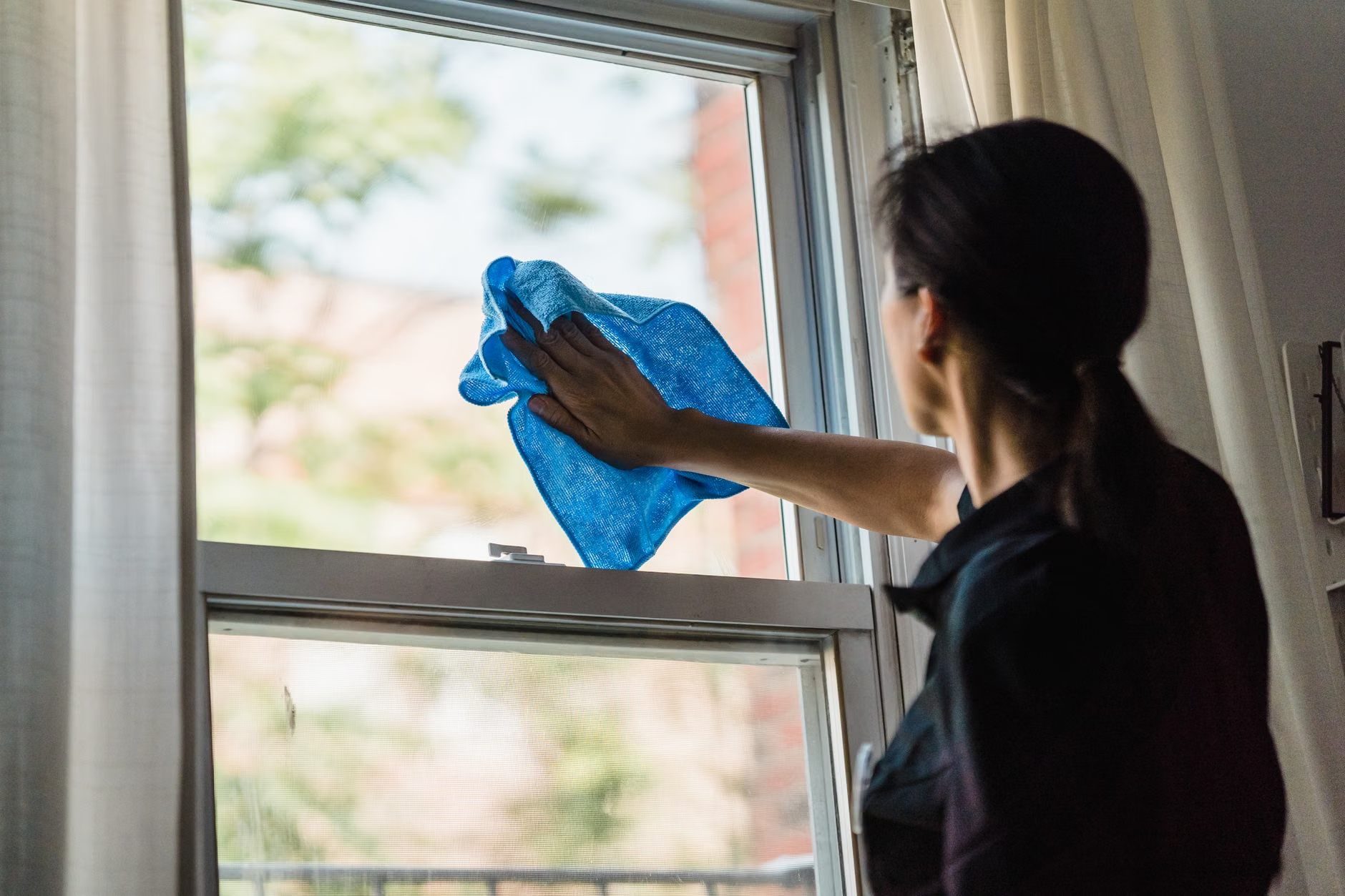
Make sure the microfiber cloths are washed with the right amount of washer-safe detergent and dried without softeners and dryer sheets. If your microfiber cloths are now smearing or pushing water around, investigate before replacing them. Many things can wear down the effectiveness of a microfiber cloth. Try not to automatically increase the washing temperature or use more cleaner.[1][2][3][4][5]
Imagine I’m wiping a greasy cabinet and the cloth leaves a shiny trail just where I’ve cleaned. My hand goes toward the cleaner bottle, apparently this cabinet wants a second shift. Annoyed, I stop and turn the cloth to a fresh face instead. Before adding anything, I want to know whether I’m fighting the surface or simply wiping it with a loaded patch of cloth.
Did it fail during cleaning or after washing?
If the cloth works at first and then smears as you clean, try an unused face or a clean cloth. Folding gives you fresh sections without repeatedly dragging the same collected soil over the surface. That’s different from several cloths all losing pickup immediately after one laundry load: then I’d look at what they shared in the washer or dryer.[3][4][5]
| What you notice | What I’d check next |
|---|---|
| Smearing mainly after greasy work | Whether grease remained after washing; a rinse alone is not a grease-removal wash. |
| Several cloths changed after one load | Softener or dryer-sheet exposure, detergent dose, washer crowding, and rinsing. |
| Lint on glass or polished surfaces | Lint-shedding laundry companions and debris caught in the cloth. |
| Poor results only on one kind of task | Whether that cloth’s construction and wetness suit dusting, scrubbing, absorbing, or polishing. |
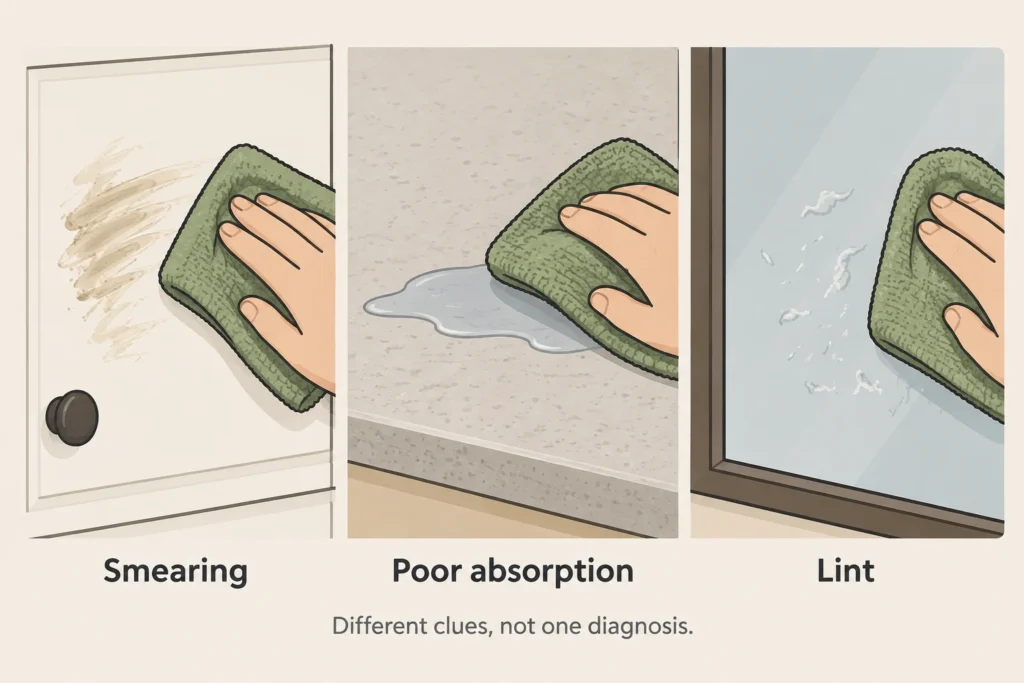
Many cleaning microfibers have split fibers with lots of surface area for collecting soil. Useful, until grease or care-product films interfere with contact and absorption, or caught lint spoils the finish. That gives you plausible explanations, not a diagnosis: water beading or a stiff feel alone can’t tell you what’s on the fibers.[2][3][5]
A useful wash, not a stronger one
For ordinary household soil, match the cloth’s permitted temperature, detergent, additives, and drying method with what your washer requires. Use HE detergent if required, and measure the dose for the load size, soil level, water conditions, and detergent concentration. A few cloths don’t need a full-load dose. Equally, an arbitrarily tiny dose may leave greasy cloths poorly cleaned. Give the load room to move and rinse.[1][3][4]
Here’s where the history of the washes earns its keep. If you overdosed the detergent or crowded the washer, use an extra rinse if the cloth and washer care permits it. If the cloth carried grease, it needs a compatible detergent wash not a rinse. And accidental exposure to softener needn’t mean immediate disposal; E-Cloth permits a rinse without softener, and this may help.[1][2][3][4]
Really advice on temperature varies. E-Cloth’s general US washing page lists up to 140°F, while its General Purpose Cloth page permits up to 90°C, or 194°F. Those public instructions conflict; I wouldn’t silently choose the hotter one. Use the instructions provided for your specific cloth, and don’t choose the higher limit for a generic microfiber cloth. Without knowing the care limit, hotter washing, boiling, and chemical stripping are a gamble not troubleshooting.[1][2]
E-Cloth and Rubbermaid’s HYGEN prohibit the use of bleach, but give commercial permission to use it under controlled conditions. That commercial permission does not extend to other cloths. Stay with your cloth’s prescribed drying method and heat, don’t use dryer sheets, and allow it to dry completely before storage. Don’t dry cloths in the dryer with lint-bearing cloths or you’ll get lint on your glass.[1][2][3][7]
Don’t use a cloth for dusting and then for mopping up grease; that doesn’t apply the same load to the cloth. If your cloth picked up a cleaner or a disinfectant, don’t mix them to remove a film. This will make the film more difficult to remove. Keep cloths separate to avoid transfer of soil; two cloths will do the job.[3][5]
Contaminated cloths need a different answer
If a cloth contacted vomit or feces during suspected norovirus illness, stop ordinary performance troubleshooting. CDC advises gloves, careful handling without shaking, washing with detergent and hot water at the maximum available cycle length, and machine drying at the highest heat setting. That exposure-specific advice is not routine microfiber care. If the cloth cannot tolerate that treatment, a gentler recovery wash isn’t an equivalent substitute; keep it out of use and discard it rather than reassigning it.[8]
Sewage or unknown hazardous chemical contact also falls outside this ordinary wash advice. Keep the cloth out of household use while you identify the applicable handling and disposal requirements. Good absorption and a fresh smell cannot tell you whether hazardous contamination has been resolved.
Is it useful again?
Test a small area of the cloth by using a known, working cloth of the same type. I would rather find out something on a small area of a surface than in the middle of a room to find nothing has improved.
- Check absorption by using a smooth, hard, nonporous surface. Use equal small quantities of distilled water on each cloth. Use the same passes, and see which left more water. Be sure to start both cloths dry.
- To test dusting ability, use an adjacent, equally dusty area, and use the cloths in the way they were designed to be used. See if dust was left behind, or if it was pushed to a line.
- Streaking can be tested by using a surface and cleaning solution, as designed. Be sure to use the same pass and amount of cleaner on each area. Compare the haze left behind after both areas are dry.
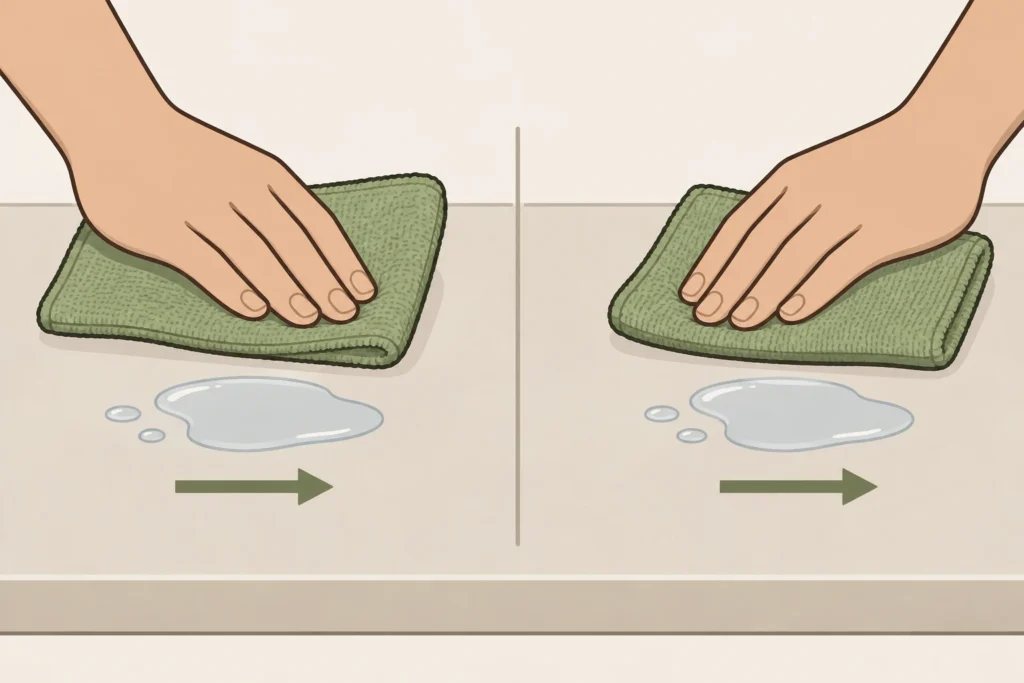
You are testing utility, not validating the reason for the test. Better dusting and picking up won’t tell you if the wash removed grease, softener, or detergent. None of these tests measure biologic safety.
Inspect the cloth for holes, thinning, hardened patches, and trapped grit, especially if you’re going to clean a delicate surface. Any of those conditions may make a cloth unusable, but the absence of those conditions doesn’t rule out fiber damage. How old a cloth is may not tell you much: one study of the performance of clothes to remove microorganisms from surfaces showed that the performance may not be declining steadily with each washing. So, there is no definitive household replacement date.[3][6]
I would give recovery one justified correction and then judge the result. That's a limitation on effort, not a scientifically established limitation on recovery. So, hold on to a cloth that does its job. A normally soiled, cleaned cloth can be reassigned to do a less demanding job, if it does that job and doesn't spread residue and pose a risk of scratches; otherwise replace it.
Sources and references
- E-Cloth USA: General Purpose Cloth
- E-Cloth USA: How To Wash Microfiber Cloths
- Microfiber Tech / Super Detail, Inc.: Microfiber Care Instructions (2015-10-28)
- Maytag: Preventing Detergent from Re-depositing on Clothing
- Western States Pediatric Environmental Health Specialty Unit, University of California, San Francisco: What’s so great about microfiber?
- Journal of Hospital Infection; Smith, Gillanders, Holah, and Gush: Assessing the efficacy of different microfibre cloths at removing surface micro-organisms associated with healthcare-associated infections (2011-07)
- Rubbermaid Commercial Products: HYGEN Microfiber Laundry Guide (2024-06)
- Centers for Disease Control and Prevention: How to Prevent Norovirus (2025-01-13)