

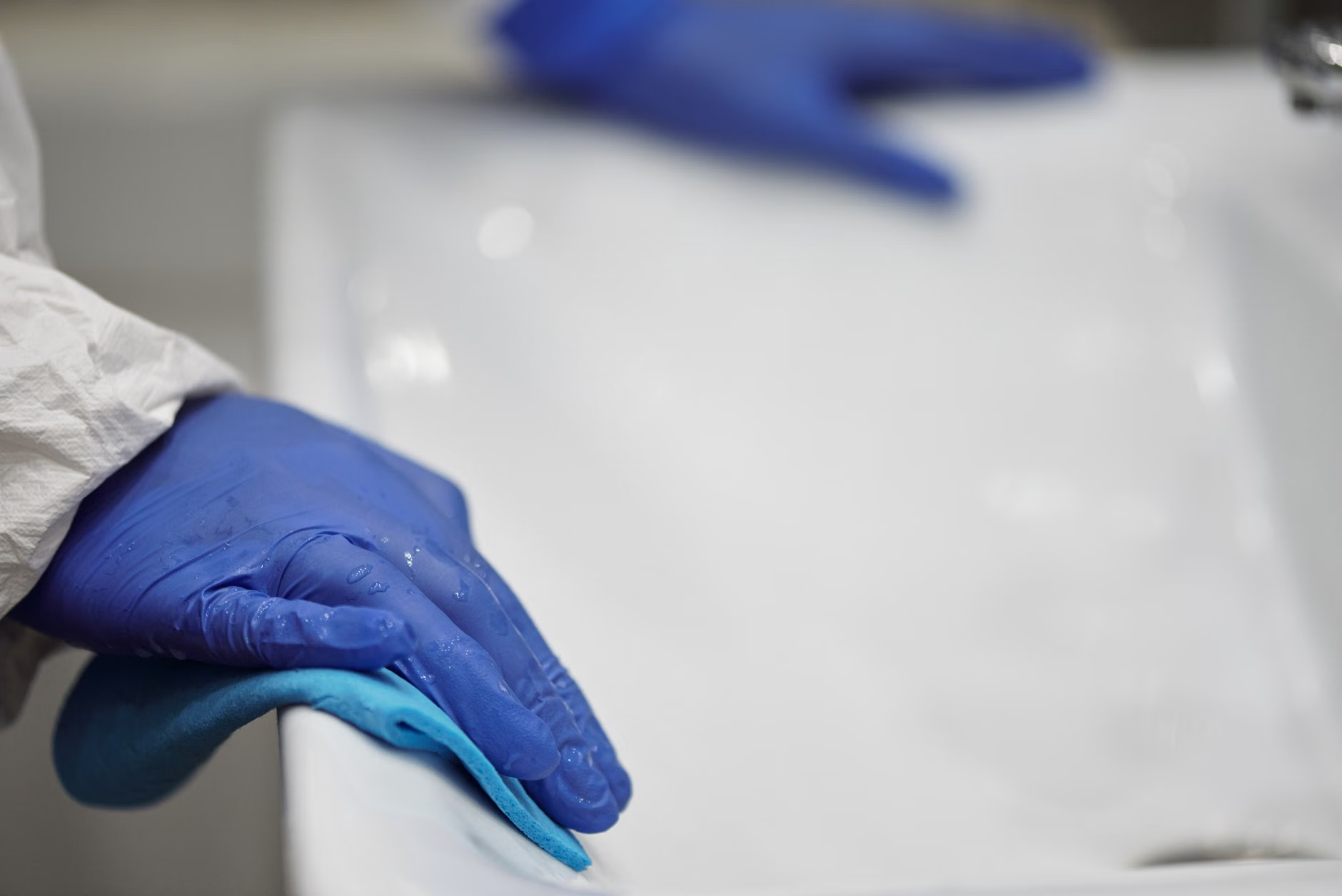
Wear gloves, collect the soiled laundry without shaking it, and set it aside. Gently remove as much solid material as possible, and decide on a treatment to launder the fabric without exceeding the fabric care guidelines. Clean the surfaces you touched and the container you used. You may not always need to perform an empty washer-disinfection cycle. CDC’s household norovirus guidance does not require this.[1][2][6]
I’d focus on the fabric, what you touched while moving it, and what may be left in the washer. You have plenty to do without taking on the added task of a deep house cleaning.
Get the laundry contained before choosing a cycle
- Wear gloves and lift gross vomit or liquid stool and place towels in a bag to dispose. Do not rub it in.
- Fold the dirty area inward and collect the fabric without shaking it. Do not set it on clean surfaces and do not set it near waiting laundry.
- Directly carry to the washer in a leak proof bag or container. If you must set it down, do so only in a leak proof bag and out of the reach of children and pets.
Draping a sheet over a hamper gives you a cleanup before the wash begins. Sorting settings can wait. University of Minnesota Extension and NHS norovirus guidance advise keeping the soiled load separate from regular laundry.[2][6]
Use the illness instructions, but don’t hide a fabric conflict
Vomiting and diarrhea do not always indicate norovirus. If norovirus is confirmed or suspected, the CDC suggests that people in the same house as an infected person to wash their clothes in hot water and on the longest cycle their washer allows. The CDC also suggests air drying the clothes on the highest heat setting. The CDC does not specify a temperature on the household wash webpage. Depending on what illness is diagnosed, people may receive different laundry instructions. Assuming all stomach illnesses require the same laundry treatment is incorrect.[1]
Please check each care label for washing and drying instructions independently. The maximum wash and dry temperatures may differ. Also, CDC states that the laundered fabric should be cleaned with detergent not bleach.[1][3]
Imagine I’m beside the washer with a sheet whose label permits the hot wash and high-heat drying, plus cold-wash-only pajamas. I want one load and one finished task. The pajamas’ label puts an unwelcome snag in that plan, so I load the compatible sheet and leave the pajamas contained. Turning the dial higher would shorten my laundry queue, but it wouldn’t resolve the fabric conflict.
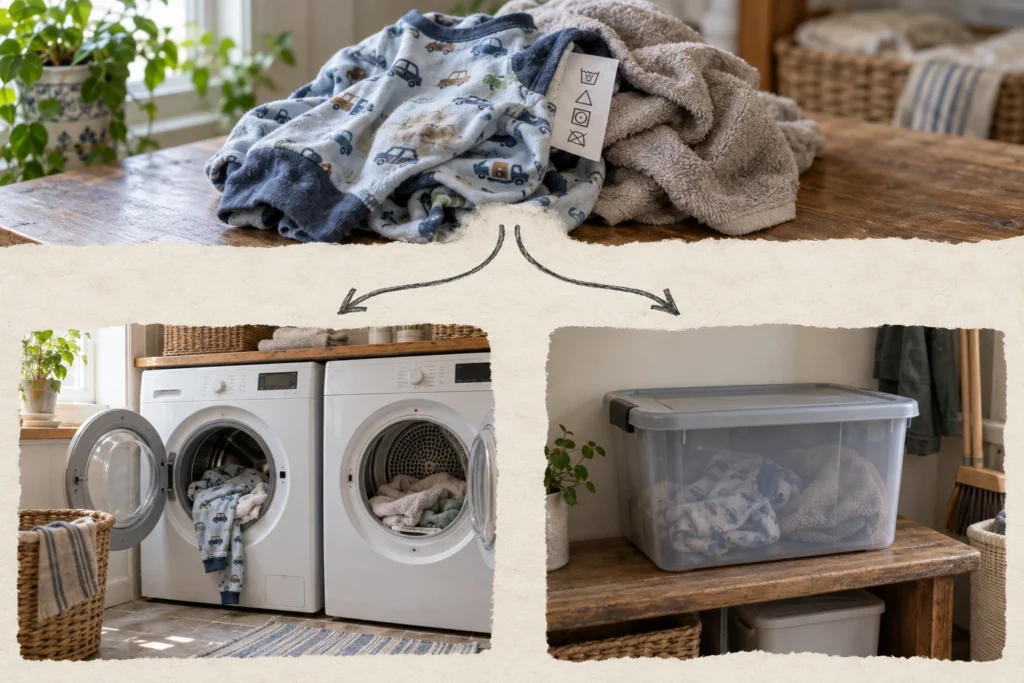
I wish there were one easy substitute here. The guidance doesn’t establish a gentler wash as equivalent to CDC’s norovirus process, or offer a validated alternative for every cold-wash-only or non-tumble-dry item. Protecting the fabric and treating the contamination are different questions.[1][3]
Look for label directions covering norovirus and the intended laundry or textile use, with a claim for a concentration, treatment time and contact material restrictions. A hard-surface norovirus claim or the word “sanitizer” does not cover this. If you can’t identify a supported treatment that is appropriate for the fabric, contain the item while you decide on treatment or disposal. Don’t assume you can treat it or return it to normal laundry.[1][3][4]
While the load runs, clean what you touched
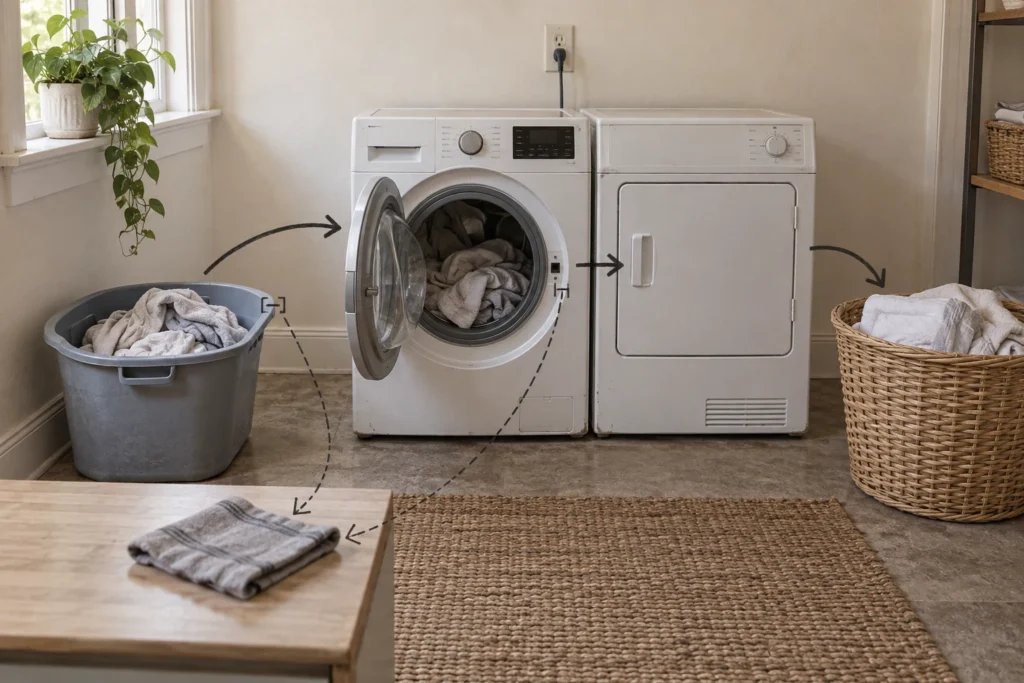
Retrace your handling route: from the hamper or transport container, to a spill on the floor, to the washer controls, which you may have touched while wearing soiled gloves. Clean up visible contamination. Suspected or confirmed norovirus requires disinfection of the affected area with a labeled product. Norovirus can be spread by contaminated surfaces, and the exterior of the washer, and its internal components, are not the same surface.[1][4][5]
EPA’s List G will help you identify products that contain claims for norovirus, however, make sure to read the actual package directions and verify the EPA registration number. Surfaces must be disinfected by the specified contact time, with the required surface type and dilution. Don’t assume a hard surface disinfectant is ok to use to line a fabric hamper. Never mix bleach with other cleaners.[1][4][5]
Once the dirty handling and surface cleanup are finished, remove your gloves and wash your hands with soap and water for at least 20 seconds. Do this before transferring washed laundry or touching the clean receiving basket. For norovirus, hand sanitizer alone is not an adequate substitute. Gloves help during the messy part; they don’t finish the handwashing part for you.[1]
What actually needs attention inside the washer?
After the wash, look for retained material in the drum, on the door, and in accessible gasket folds. If you find any, remove it before another load. A lump caught in the seal needs removal, not another hopeful rinse with the lump still there.[2][5]
For that cleanup, the exact washer model matters: which cleaner it permits, how much, where it goes, whether the procedure calls for wiping or an empty cycle, and whether rinsing follows. I wouldn’t borrow a bleach dose from someone else’s machine. The Whirlpool manual reviewed here separates seal cleaning from interior cleaning and restricts bleach formulations and added chemicals. Those are model-specific cleaning instructions, not proof of norovirus disinfection.[5]
When it’s finished drying, remove laundry and place in a clean basket. Wash your hands, as gross material has been removed from the washer. This is not proof of sterility. Keep separately care-conflict items that have not been treated in accordance with the textile care label. Repeated empty cycles are not allowed.[1][2][5]
Sources and references
- Centers for Disease Control and Prevention: How to Prevent Norovirus (2025-01-13)
- University of Minnesota Extension: Step-by-step guide to norovirus cleanup
- Federal Trade Commission: ASTM Guide to Care Symbols
- US Environmental Protection Agency: EPA's Registered Antimicrobial Products Effective Against Norovirus [List G]
- Whirlpool: Whirlpool Owner's Manual W11355369 Rev. F
- National Health Service: Norovirus (vomiting bug)