

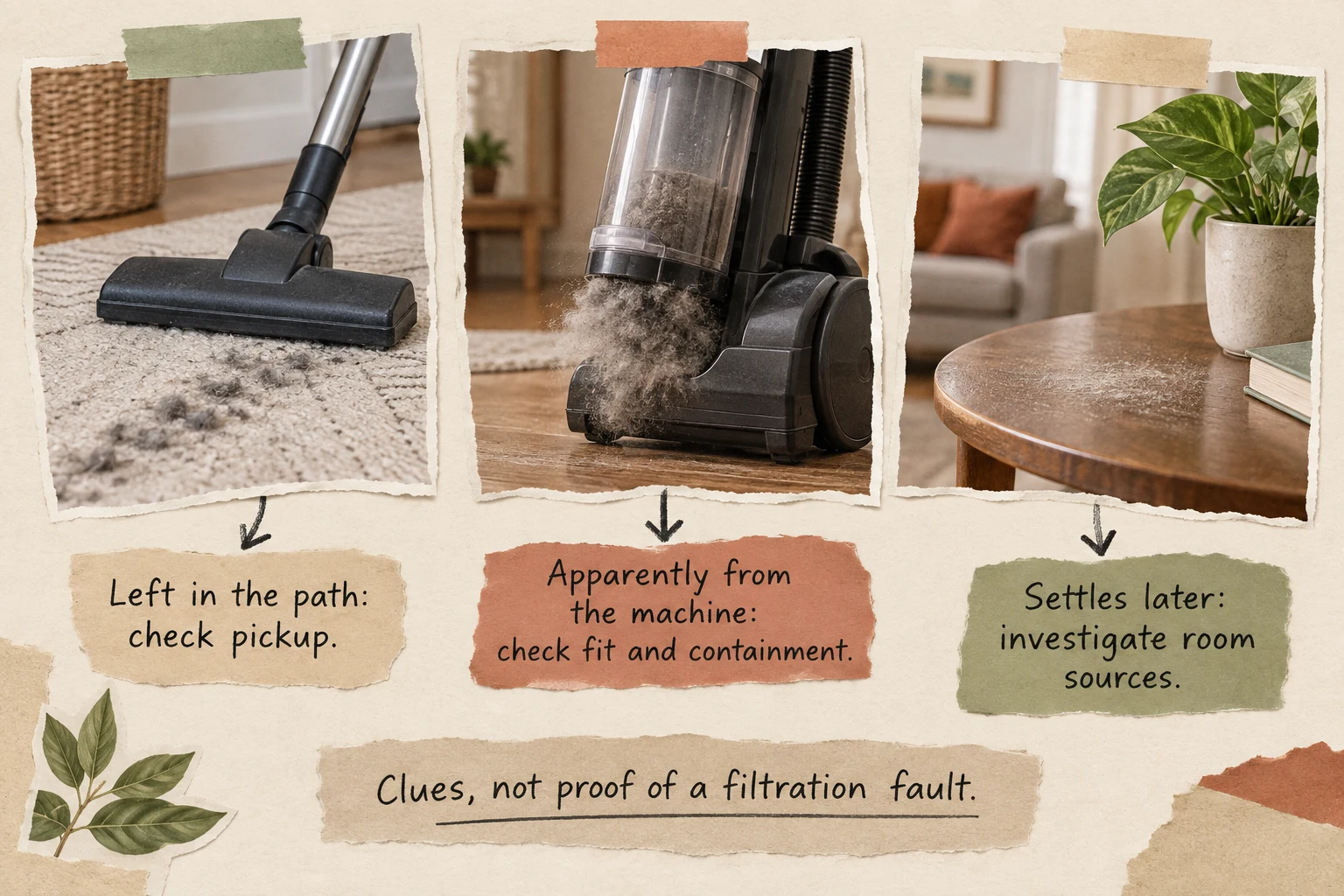
Most people start looking for a solution with a new filter. The debris still on the floor may indicate that the vacuum cleaner isn’t picking up all of the dirt. The dust puffing out of the vacuum cleaner means that you need to stop the machine and check if the collection parts are fitted together properly.
Rather than send you on a wild goose chase around the room again, I'd like to help you narrow this down. The EPA states that vacuuming can resuspend settled dust and that outdoor and indoor particles can be contributing factors. Dust doesn't mean the vacuum cleaner put it all back.
Picture me in an imagined example, winding up the cord with ten minutes left before dinner, then spotting lint along the rug’s edge. I’m annoyed enough to reach for the plug again. Cleaning has apparently assigned me more cleaning. Instead, I leave the rest of the room alone and watch one patch during a pass: did the lint stay put, get pushed aside, or disappear?
Watch one small patch, not the whole room
Choose a small spot with ordinary debris like crumbs or lint. Look closely, then make a slow pass with the vacuum cleaner. Did the debris get picked up? Don't scatter baking soda or flour to test. The point is to see what is normally there and make sure the vacuum can pick it up.
If you have a model that can be adapted to collect existing debris, I would try that.
First, I would try to see if the floorhead can collect what is left by the existing debris. The head and its settings or the connection between the head and the passage are where I would look next. If neither of those are capable of collecting it, I would look at a restricted airflow path between the two. Neither of those prove a part is broken. This is simply a comparison of ability.
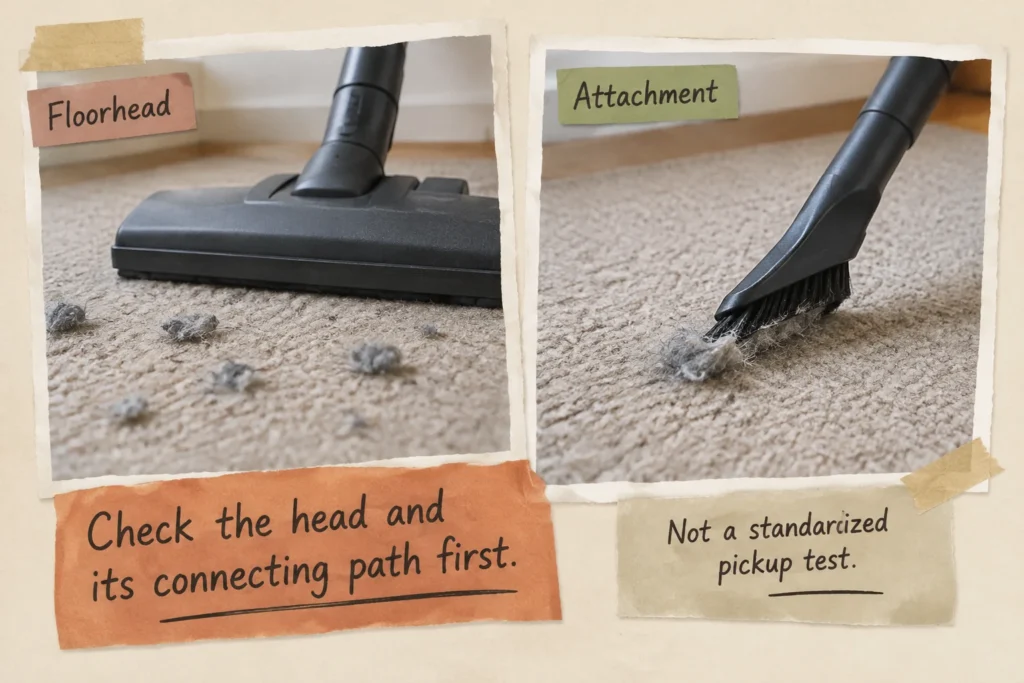
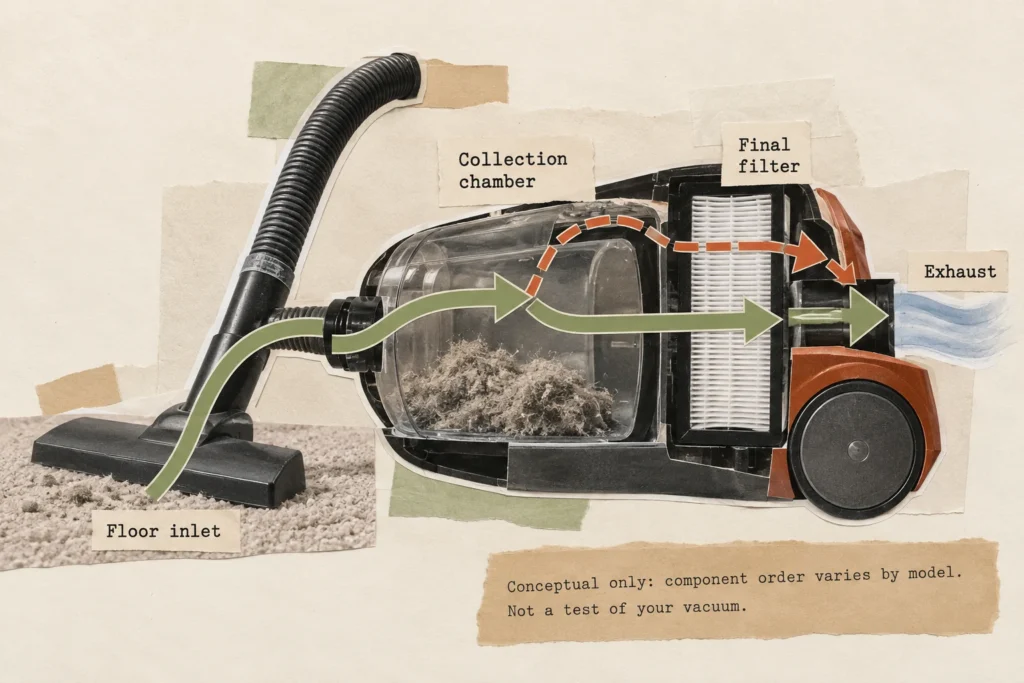
A motor running can give the illusion of suction; however, if very little air is making it through the system, that means very little if any dirt is being collected. Loose dirt needs to be carried by air; on carpet, a powered brush helps to free dirt from the carpet pile. That's why I recommend to check the final filter first.
Give the head and airflow path separate attention
I’d suggest that you first confirm your settings are correct for the floor type. For example, the head should be as low as it can go, and if it has an adjustable height, it should be as high as it can go. The suction should be turned off before you engage the brush. The Shark NV360 is an example of a model where you would have to ensure that the handle is in the back position for the brush to engage. Other models may have different mechanisms or controls.
For corded vacuums, unplug it and for cordless, disconnect the battery if it’s allowed in the manual. Check accessible openings for blockages. Trapped debris can also be in the wand, inlet and other places accessible to the user. Leave the motor and other seals closed.
An apparently not-full bag can also obstruct airflow. According to the Miele Complete C3 manual, fine dust can clog the bag’s pores even before it looks fully stuffed. Also, check the bag’s seating and bag change indicator. For that model, the indicator check uses the standard floorhead, the highest suction setting, and the head lifted slightly off the floor, not an arbitrary rule about replacing every bag when it’s half full.
For bagless machines, empty the cup when the level reaches the limit, check that the lid and connection close fully, and check the base for blockages. A clean filter does not unblock the wand. Keeping the filters and other seals closed, I’d keep all the other components clean and hope one of them was blocked.
Identify your exact model and filter position before washing filters. The Dyson V8 SV10 model allows washing filters and specifies complete drying for at least 24 hours before using it again. The Miele filters require replacement.
Still damp after 24 hours means it stays out longer. Don’t borrow another model’s care schedule, or run the vacuum without its required filters to see whether suction improves. The Shark NV360 manual specifically prohibits operation with missing or wet filters.
After correct reassembly, repeat the small pickup comparison. If the same kind of debris now disappears under normal passes with the appropriate head setting, the pickup problem is resolved. That’s a useful place to stop. It doesn’t certify filtration, but later dust on a shelf doesn’t erase that pickup result, either.
A HEPA label answers only part of the question
EPA says HEPA filters capture at least 99.97% of particles 0.3 microns in size. That does not verify that the dust-laden air in your home that your vacuum picked up actually goes through that filter.
EPA’s guidance for renovation firms distinguishes a vacuum that has been engineered to route its exhaust through HEPA filtration from one that has been simply fitted with a HEPA filter. EPA makes the distinction, but the guidance is not an EPA certification for your household vacuum. I would not replace a filter just because dust appeared in the room again.
If dust appears to be coming from the vacuum, stop it and disconnect power as described above. Remove the vacuum bag or cup, and/or filter, and determine if the dust is coming from the connection to the bag or cup. Make sure all latches are secured and, if possible, check the seals. Reattach all parts that are supposed to be attached. A torn seal or cracked housing cannot be fixed by seating. Leave the machine off and contact the manufacturer’s service representative. Damage may allow dust to escape.
Machine-origin dust may also continue to be a problem even if all parts are attached correctly. In this case, stop using the vacuum and contact the manufacturer service representative to service the vacuum. I would not fix the problem by buying another filter. Owner inspection can reveal obvious fit problems, but it cannot verify that the entire machine is sealed.
When pickup works, look at what the room is doing
Once the floorhead picks up the debris, dust will settle again. In this case, focus on the room. Find a small, moisture-compatible surface to damp-wipe nearby the previously cleaned floor and notice where deposits return. Determine what kinds of activities happened in the room. Did people walk through? Was bedding handled? Was a window open? Was something cooked or candles burned? The EPA identifies indoor activities, outdoor entry, and resuspension as potential particle sources.
Dirt that’s tracked into the room by people gives you a reason to address tracked-in dirt. Deposits will return to previously cleaned areas, likely because the dust hasn’t had a chance to fully settle. A visibly clean floor doesn’t mean no airborne particles are present and a defective vacuum can’t be guaranteed.
If pickup is restored but later deposits remain, the vacuum is collecting that dust and you’ve learned something. Leave the vacuum alone and observe something in the room that likely relates to the returning dust. I would want to know something before buying a new filter.
Sources and references
- US Environmental Protection Agency: Sources of Indoor Particulate Matter (PM)
- US Environmental Protection Agency: EPA RRP guidance on selecting a HEPA vacuum
- US Environmental Protection Agency: What is a HEPA filter?
- Miele: Complete C3 Brilliant/HomeCare+ operating instructions
- Dyson: Dyson V8 SV10 pinch-filter operating manual
- Shark / Euro-Pro: Shark NV360 Owner's Guide