


If the power is still out, keep the refrigerator and freezer doors closed. Before the refrigerator’s roughly four-hour cold-holding window ends, move perishables into an ice-filled cooler that holds them at 40°F or below. For refrigerated perishables, I use USDA’s conservative discard limit: two hours above 40°F. Without reliable temperature records, discard those perishables after four hours without power, not everything in the refrigerator.[1][2][3][5]
If power returned while you were away, cold food now doesn’t prove it stayed cold earlier. I know that leaves you with an expensive decision and an unhelpfully normal-looking refrigerator. But you can still save the chart’s specific exceptions, including whole produce and some cheeses and condiments. This guide covers temperature exposure, not floodwater or other contamination.[1][4]
Four hours without power is not four hours of warm food
The four-hour estimate assumes your refrigerator started cold and its doors stayed closed. The two-hour limit measures something different: time the susceptible food actually spent above 40°F. You don’t get six hours by adding them together.[2][3][5]
If you know the outage lasted less than four hours and the initially cold refrigerator stayed closed, the agency estimate supports keeping the food. Reliable temperature records give you a more direct answer: keep food held at 40°F or below, and discard susceptible refrigerated food after two hours above that temperature. At four hours without power and no reliable cold-storage evidence, use the discard column below. If you can’t establish the outage duration or temperature history, discard affected perishables rather than guessing it was brief. The keep exceptions still apply.[1][3][5][6]
A control setting isn’t necessarily an actual temperature reading. Even a continuous record only helps for the time and storage area it covers; one cold sensor can’t speak for every shelf. Keep food you’re saving chilled while you sort. Perishables left at room temperature need disposal at two hours, or one hour if the surroundings exceed 90°F.[2][6]
You may find conflicting wording: FDA’s main outage page allows four hours above 40°F, while its refrigerator-thermometer page uses two hours. I’m following USDA’s more conservative two-hour limit and FoodSafety.gov’s detailed chart here, not claiming the agencies all say the same thing. Neither warm-exposure limit is the four-hour closed-refrigerator estimate.[1][2][3][6]
The refrigerator foods you can save, and the ones you can’t
Once the time-and-temperature evidence calls for disposal, sort by the actual food, not just its shelf. A block of cheddar and a bag of shredded cheddar get different answers, which is welcome news if you’re trying to avoid needless waste. These keep exceptions cover temperature exposure only; they don’t rescue spoiled food or food contaminated by leaking meat juices.[1]
| Food group | Discard | Keep exceptions |
|---|---|---|
| Meat, seafood, eggs, and leftovers | Raw or cooked meat, poultry, fish, seafood, shell eggs, egg dishes, soups, stews, and leftovers | No keep exception for these listed foods |
| Milk and dairy | Milk, cream, yogurt, sour cream, and buttermilk | Butter and margarine |
| Cheese | Soft cheeses such as cream cheese, ricotta, cottage cheese, Brie, and mozzarella; shredded cheeses; low-fat cheeses | Hard cheeses such as cheddar, Swiss, and Parmesan; processed cheese; grated Parmesan or Romano in a can or jar |
| Fruit and vegetables | Cut fruit or vegetables, cooked vegetables, packaged greens, and opened vegetable juice | Whole uncut fruit and vegetables; opened fruit juice |
| Starches and baked foods | Cooked rice, pasta, and potatoes; fresh pasta; cream-filled pastries; pies with egg or milk filling | Bread, rolls, muffins, tortillas, and fruit pies |
| Condiments and dressings | Creamy dressings, opened spaghetti sauce, oyster sauce, and fish sauce | Ketchup, mustard, pickles, olives, relish, soy sauce, barbecue sauce, and vinegar-based dressings |
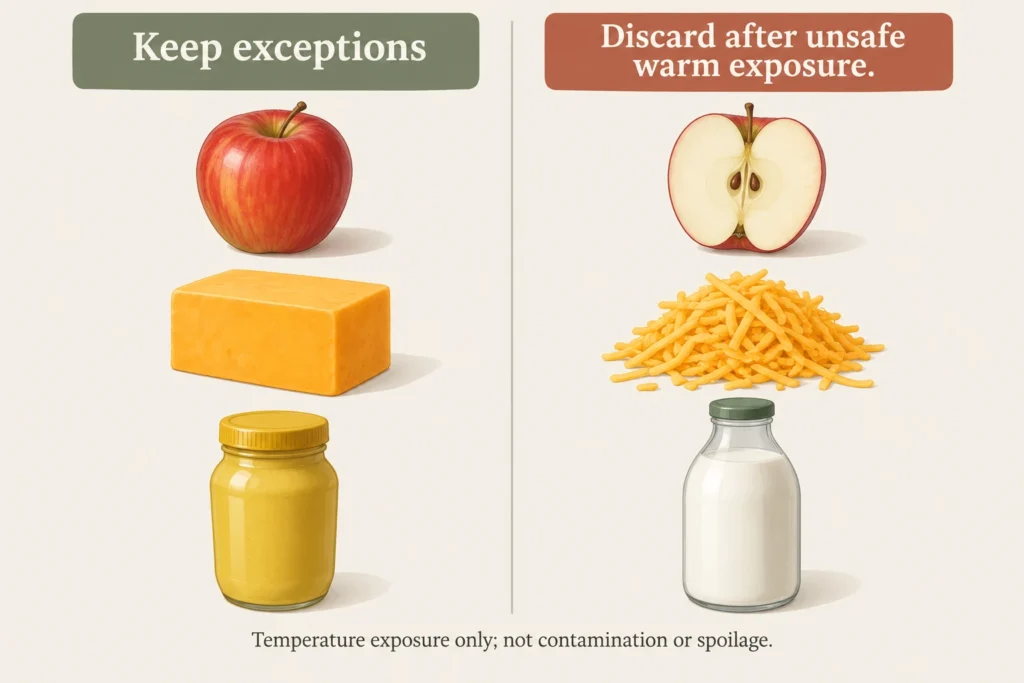
Opened mayonnaise, tartar sauce, and horseradish have a separate chart limit: discard them if they were above 50°F for more than eight hours. If the exposure is unknown, you can’t assume they stayed within that allowance. And this exception belongs to the condiment, not to chicken salad, potato salad, or another prepared dish containing it.[1]
For an unfamiliar refrigerated sauce or specialty product, use its exact FoodSafety.gov chart entry and any stricter storage requirement on the label. I wouldn’t stretch “mustard keeps” into “all condiments keep.” The specific exceptions are what prevent waste without guessing.[1]
When you discover the outage after everything has cooled again
Imagine I’m coming home to a working refrigerator and groceries I can’t comfortably replace. The milk feels cold, exactly the answer I want, until I realize I don’t know when power returned. I’m reluctant to lose it, but that missing interval changes my decision: I set aside the whole apples and mustard to keep, rather than using their fate to justify saving the milk and leftovers too.
Food can warm during an unattended outage and cool again after the refrigerator restarts. A later 38°F reading answers “How cold is it now?” It cannot tell you the earlier maximum temperature or how long the food stayed warm. An outage notice with both failure and restoration times, or a representative continuous temperature record, may change the answer. A blinking clock or restored control setting cannot supply that missing history.[4][6]
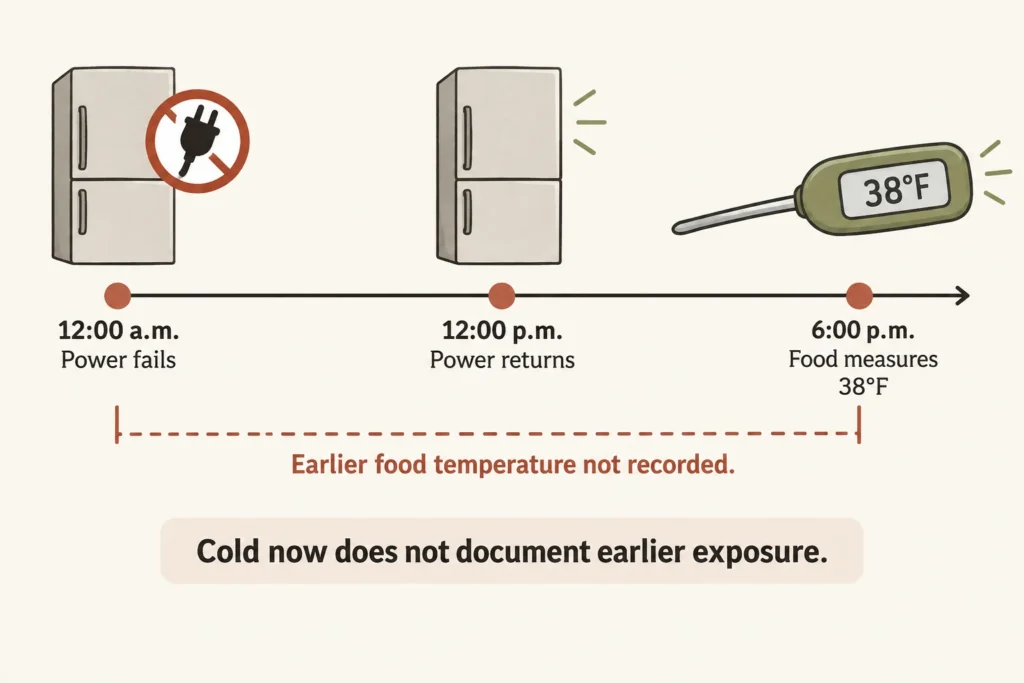
Don’t taste food to settle the question. Normal smell and appearance can’t clear it either, and cooking isn’t a dependable rescue: some toxins produced during unsafe holding can survive cooking. Rechilling or freezing doesn’t erase that exposure.[3][6]
Treat the freezer as a separate decision
A full freezer buys you more time: about 48 hours unopened, compared with about 24 hours for a half-full freezer. Both estimates assume it started properly frozen and stayed closed. I’d use those numbers to plan, then assess the food when power returns, not after it has had hours to freeze again.[2][3][4]
- Most frozen foods can be refrozen or cooked if they still contain ice crystals or are 40°F or below when assessed at restoration. Refreezing may reduce quality.
- Discard thawed meat, poultry, seafood, frozen meals, and other susceptible foods after two hours above 40°F.
- Ice cream and frozen yogurt are exceptions: the chart says to discard them even in its ice-crystals/40°F-or-below column.
- Plain frozen vegetables have a longer allowance: discard after more than six hours above 40°F. That allowance does not apply to mixed meals containing vegetables.
- Frozen fruit can generally be refrozen, including after thawing. Discard it if mold, a yeasty smell, or sliminess develops, and expect possible quality loss.
If the freezer restarted while you were away, newly formed ice crystals don’t prove the food stayed cold during the outage. With that history missing, discard susceptible foods whose exposure you can’t establish. Apply the fruit and vegetable exceptions only when their particular conditions are met.[1][4][6]
Bag discarded food so it can’t leak onto what you’re keeping. If raw meat juices escaped, clean the contaminated area before returning saved groceries. I wouldn’t let the loss of milk and leftovers turn into a reason to throw away the apples, butter, and mustard too.[1][6]
Sources and references
- FoodSafety.gov: Food Safety During Power Outage
- US Food and Drug Administration: Food and Water Safety During Power Outages and Floods
- USDA Food Safety and Inspection Service: Keeping Food Safe During an Emergency
- University of Illinois Extension: Power Outages
- Centers for Disease Control and Prevention: Discarding Food After a Power Outage (2024-05-15)
- US Food and Drug Administration: Refrigerator Thermometers, Cold Facts about Food Safety