

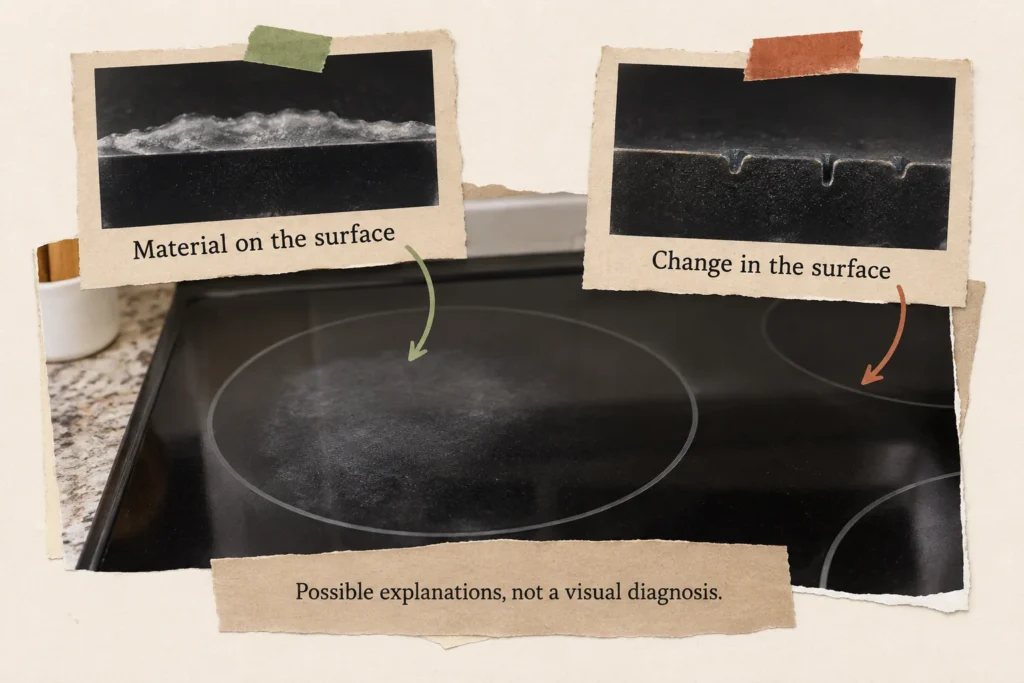
A cloudy mark isn’t proof that your glass-ceramic cooktop is permanently damaged. Mineral deposits, cookware transfer, and surface wear can look surprisingly similar. I’d try one cleaning comparison permitted for your exact model, remove the cleaner completely, and inspect the dry result. Improvement supports removable material. No change is a reason to stop escalating, not proof of etching.[1][2][3]
A visible crack or broken glass is different: stop using the cooktop and arrange qualified service through the manufacturer. Don’t try the cleaning comparison. GE warns that cleaning solutions and spills can penetrate broken glass and create an electrical-shock risk.[1]
The mark’s appearance is a clue, not a verdict
Think about what happened there. A boil-over or water drying on the surface makes deposits plausible. A mark following a pan’s movement makes cookware transfer worth considering: GE notes that aluminum or copper residue can look like scratches. Fine lines can also be actual scratches, while a dull patch may reflect surface change. Color and shape alone don’t settle which explanation fits.[1][2][3][6]
Neither texture or appearance of the surface provides an absolute answer as to what is causing the damage. A smoothed area does not mean that’s etched. I also do not think a fingernail is a good test of what is and what is not etched. Touch can not absolutely reliably answer what the depth of a scratch is.
Imagine I’m wiping up after pasta, with dinner cooling on the counter and a pale ring still under the kitchen light. I’m frustrated and about to grab the scrub pad. But I find the cleaning instructions first. The ring hasn’t told me to use harder scrubbing.
Give one compatible cleaning attempt a purpose
The next time you go to buy a bottle, locate your model and surface variant. The important things are what cleaners and applicators are permitted, whether the surface must be cool, and how the cleaner comes off. “Glass cleaner” on a label doesn’t settle any of that. Even SCHOTT offers different instructions for Miradur-coated panels.[1][4]
There are important differences, not just minor differences. The GE manual gives a procedure to use a ceramic cooktop cleaner on a cool surface and remove with a paper towel, or with the cleaning pad, and not to rinse. SCHOTT says to use a damp wipe and to dry it afterwards. Use the finish belonging to the procedure, rather than taking a little of each to use.[1][4]
Also, I have an issue with treating a scraper recommendation as being generally true. The GE manual suggests using a scraper at 45 degrees for heavy residue, and Bosch’s cited scraper accessory suggests using it at 20-30 degrees and states not to use it at 45 degrees. Neither suggests scraping the unknown cloudy residue. As for abrasives and chemicals, they may explain a new problem rather than solving the old.[1][3][5]
Start with your cooled cooktop as-is, and try to replicate the lighting and vantage point you used for your comparison. Using the routine method appropriate for your cooktop, clean a small representative area with a permitted applicator. Follow the instructions for the cleaner and allow the surface to fully dry before continuing. Once again, I am suggesting a single pass, not because the manufacturers validate this as a test for damage, but to limit unnecessary wear to the surface of the cooktop.[1][4]
What the dry result lets you decide
- The haze improves: some removable material was present. Further use of the approved method is justified, if the method allows for repetition.
- The haze improves but lines remain: you may have removed deposits, but revealed transfer or scratches. Don’t switch to polishing to chase the lines.
- Nothing changes: Stop this method of cleaning. The result doesn’t mean there is permanent damage, but it means you cannot keep increasing the pressure or abrasiveness of the method.
An unchanged patch is likely stubborn material or a changed surface, and I cannot differentiate between the two based on this limited info. As mentioned before, repeated heating can cause some cooktop marks to become permanent. The Bosch manual does state that small scratches can affect cooktop performance and are considered cosmetic. This, however, doesn’t explain what deep scratches may be.[2][3][6]
If the surface has pitting or indentations, do not clean the surface further and have the manufacturer assess the surface to determine if it is safe to continue using the range. GE states that the surface can be assessed for replacement. Freshly spilled hot sugar or plastic can also impact the surface and cause damage. The surfaces of the range can become very hot, and the spilled sugar or plastic can melt into the surface. If there is a fresh spill of either of these, turn off the cooking zone and follow your manufacturer’s instruction for the hot spill procedure. Do not use the cooled surface procedure described above.[1]
For unchanged haze alone, send the manufacturer your model number, dry pictures, the history of spills and treatment used. That gives them a specific condition to assess.
Sources and references
- GE Appliances: GE radiant cooktop owner's manual, JP3030 and listed related families, 49-2000975 Rev. 4 (2025-12)
- GE Appliances: Electric Range & Cooktop, Glass Cooktop Cleaning Instructions
- SCHOTT CERAN: Everything you need to know
- SCHOTT: Keeping your kitchen sparkling, CERAN cleaning instructions
- Bosch Home Appliances: 17000334 Glass Scraper for Induction & Electric Cooktops
- Bosch Home Appliances: Bosch Use and Care Manual, document 9001246204_A