

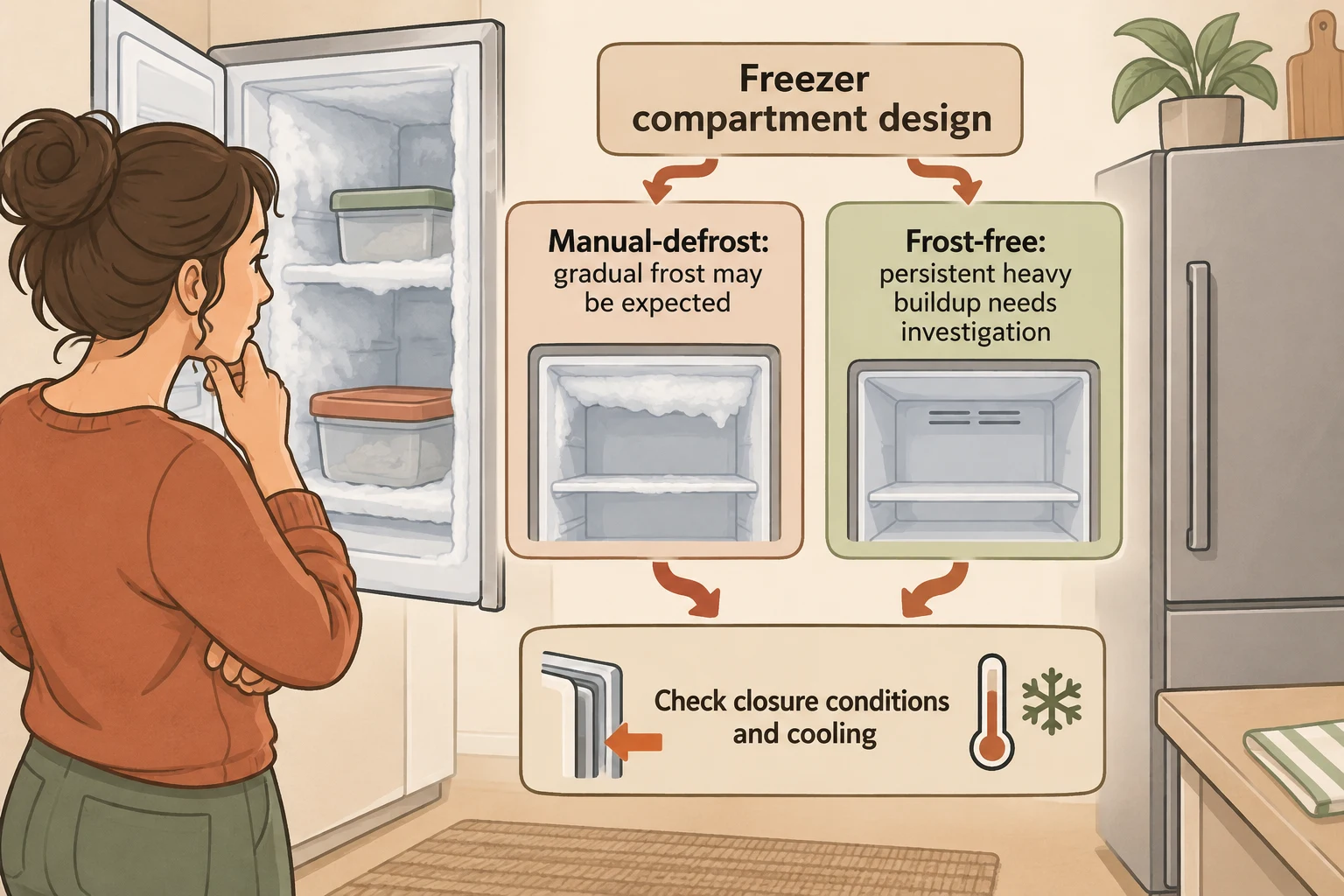
Find out whether your freezer is manual-defrost or frost-free. Normally, gradual frost build-up in a manual-defrost freezer is due to normal functioning and does not require servicing. Heavf, persistent frost build-up in a frost-free freezer should be inspected. Frost near the door may be due to sealing, but it is not sufficient reason to replace the seal.[1][2][3][5]
Does your freezer normally need defrosting?
Look up your model number and check the manual section on defrosting, not just the general information on the refrigerator. Some compact, frost-free refrigerators may have an automatic defrost in the fresh food compartment, while the freezer may need manual defrosting.[1]
Frost accumulates due to moisture in a manual defrost freezer. GE’s FCM9SRWW/FCM11SRWW manual states that average wall frost should not be greater than 1/4 inch. I would not use that number to determine when to defrost your freezer. The manual should also describe where the meltwater drains to, which is important to know to avoid a mess when it occurs.[2]
In a frost-free system, the frost should be removed automatically from the cooling element. Persistent wall frost is not normal. Humid conditions may cause frost to accumulate on the wall of the refrigerator. If the wall frost builds up and takes away space for your food, that is not normal.[1][3][4]
Picture me, in an imagined kitchen, wrestling a drawer past a ridge of frost while a bag of peas keeps slipping onto the floor. Eventually, I get frustrated enough to start pricing door seals. Then I stop and consider whether I have checked to see if this freezer needs routine defrosting. Model first, then I look up the serial number.
Where the frost starts is a clue, not a verdict
Do not assume that frost means defrost. Take a picture. Notice whether you are looking at fluffy frost near the opening, a coating across the back, or a smooth ice sheet on the floor. I would rather preserve that difference than erase it and be left trying to describe “a lot of ice.”
| What you see | What to check next | What it doesn’t prove |
|---|---|---|
| Frost concentrated near the door or drawer opening | Packages preventing closure, dirty seal contact surfaces, or visible gasket damage | That the gasket itself has failed |
| Light frost scattered over packages or interior surfaces | Recent frequent opening, humid conditions, or a door left ajar; watch whether it persists | That every trace of frost in a frost-free appliance means a malfunction |
| Persistent thick frost across the rear wall of a frost-free compartment | Closure and loading conditions, then service assessment if buildup persists | Which heater, sensor, or other concealed component is responsible |
| A solid sheet of ice on the floor | Possible meltwater or drainage trouble, especially in an automatic-defrost bottom-freezer refrigerator | That a bad door seal caused it, or that you can reach the drain without disassembly |
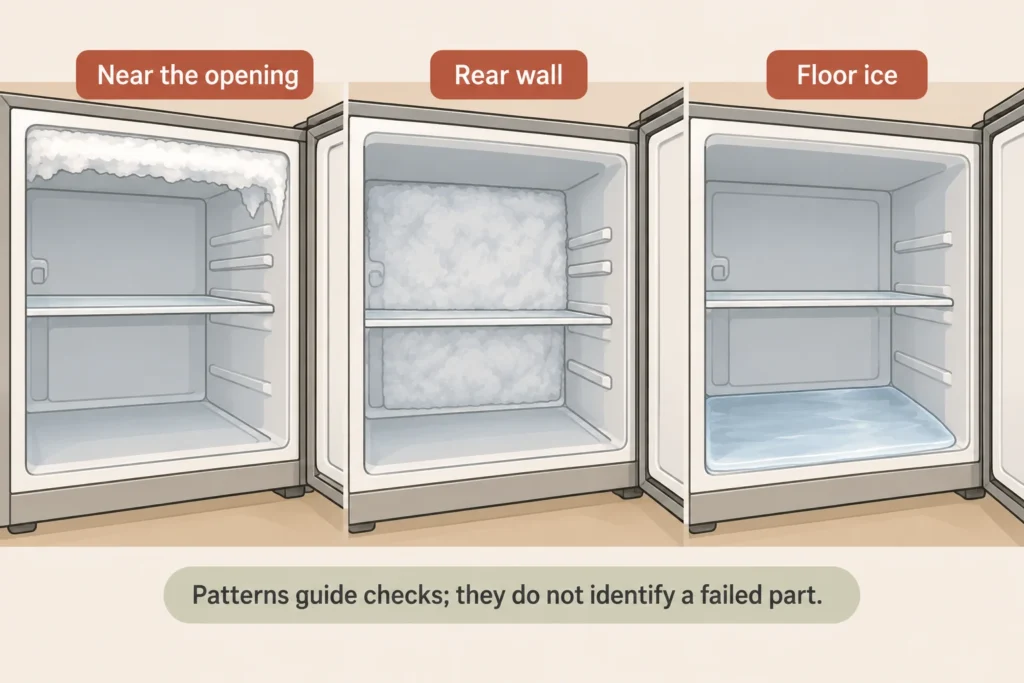
An obstructed defrost drain can let melted water freeze on the bottom of a model with a bottom freezer. This is different from the problem of moist air entering through the door. GE says that to access the drain, you may need to disassemble the model, and this is not something the owner should need to do. Because of this, GE says accessing the drain may not always be easy.[6]
When the door seal becomes a stronger suspect
Make sure that there is nothing holding your door open before you start blaming the rubber seal. Move any packages that may be obstructing the door inward, and make sure that all removable bins and trays are in their proper position. The food in the bins and trays should not be obstructing the air vents of the model. Once the door or drawers are closed normally, check for a gap.[3][4][5]
If you see sticky residue, this means that you can clean something. If you see a tear or a section that is twisted, or something that is not meeting the cabinet, this means you can report this for a service repair assessment. It is not always the case that if you see frost on the door, this means that the door seal is bad. Frost alone may mean that the seal is bad, but this may not always be the case. An intact looking gasket can be part of a door that is not closing properly.[5]
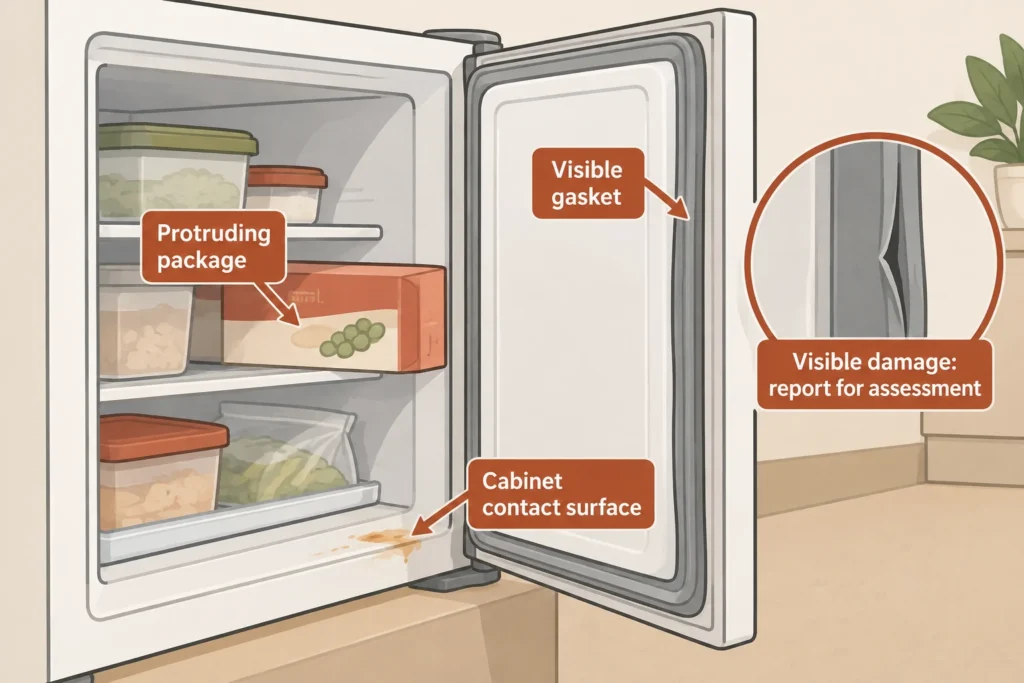
I wouldn’t be tempted to clean the gasket my own way here. LG lets you use a mild detergent, but GE’s Consulted Care page specifically says to use a solution of baking soda, to be rinsed and dried, to clean. Use the cleaner recommended by your model for the accessible contact surfaces. Do not pull, stretch, heat or reshape the gasket to make contact.[5][7]
If closing a trapped package restores closure, then you have fixed a real condition. If there is still a gap after you’ve cleared up all residue and obstructions, report the gap as it’s not worthwhile to buy a gasket based on the frost.[3][5]
Protect the groceries before planning a defrost
Store protected cold items before turning the unit off. I’d rather have another working freezer: storage target is 0°F, verified with an appliance thermometer. A temporary option to store cold items would be to use an insulated container with cold packs. It is not the same as a freezer, so monitor the temperature and use existing outage guidance for keep-or-discard decisions.[9][10]
Estimated holding times for food safety don’t apply when you’re manually defrosting and intentionally warming a food compartment of a frozen food storage device. I can’t tell you how long it will take for food to be safely cold enough to not risk the quality of the food in your groceries. The U.S. Department of Food and Safety (FoodSafety.gov) site provides some guidance on food safety time-temperature integration, but the frost on the wall has nothing to do with the temperature of the food.[2][10]
When you must defrost manually, unplug the device as indicated for the model, and allow the ice to melt passively. Drain the water as indicated for the model. Collect the water as indicated for the model. The GE Chest freezers indicate both the interior and the exterior of the unit have plugs that drain, but your model may not have this feature. After the ice melts, dry the unit, and plug it in to restart it. Allow it to reach the storage temperature you set before putting food in it.[2][9]
If it comes back, report what changed
After a justified closure correction or defrost, note where buildup first returns and the duration. A quick return is important, but there is no magic number of hours or days that identifies a failed part. Heavy returning frost in a frost-free compartment, recurring floor ice, or buildup that is much faster than your manual-defrost freezer’s previous pattern is reason to get an assessment, not just schedule a closure.[3][5][6][8]
Cooling also deserves separate attention. Keep appliance thermometers and note if the door is left open, because one quick reading doesn’t give a history of the temperature. If food is beginning to soften or the freezer is not able to maintain its storage temperature, then you need to move the food to protected cold storage and contact your landlord or service provider. Do not wait for a more distinctive frost pattern.[9][10]
- Also include the freezer compartment’s defrost design.
- First set of pictures showing "fluffy" frost (most likely water) versus "solid" ice frost.
- When you corrected closure or defrosted, and when build-up returned.
- Any obstructing packages, dirtied contact surfaces, visible gasket damage, or remaining gaps.
- Thermometer readings, the timing, softening of the food or water, and/or leaks.
I would stop repeatedly defrosting because of unexplained build-up. You need someone to assess the model’s closure, drainage, or operation, not just remove the evidence or replace a gasket (the easiest thing to name).[3][5][6][8]
Sources and references
- GE Appliances: Refrigerator and Freezer, Types of Defrost Systems
- GE Appliances: FCM9SRWW/FCM11SRWW Owner's Manual, 49-1000547 Rev. 2 (2021-08)
- GE Appliances: Refrigerator & Freezer, Ice on Freezer Wall
- Whirlpool: Frosting in the Freezer Section, Quad Door
- LG Electronics: LG Refrigerator, Frost Buildup
- GE Appliances: Bottom Freezer Refrigerator, Clogged Drain Tube, Ice on Freezer Floor
- GE Appliances: Refrigerator, Freezer and Standalone Ice Maker, Care and Cleaning of Interior and Gasket
- GE Appliances: Frequently Asked Questions About GE Refrigerators
- USDA Food Safety and Inspection Service: Freezing and Food Safety
- FoodSafety.gov: Food Safety in a Disaster or Emergency