


If you have an equal number of tasks, that can be deceptive if one person is responsible for scheduling, reminding, and completing them. Divide your whole list of responsibilities by how much time it's actually taking to complete the task and when you know you will get it done and your availability. Once your task is completed, start dividing your additional tasks into those with deadlines and work that you can do whenever. Make sure you have someone that can do your task if needed for the time being. Just because someone is able to do tasks at any time doesn't mean they are your default helper or backup.
1. List each complete responsibility
Take your list of tasks you are splitting and add all the things you need to do to know you need to do them. Laundry may consist of knowing you need to do laundry, checking if you have detergent, making sure there is room for the machine, doing the laundry, moving it to the dryer, drying it, putting it away, and leaving the machine for the next person. If you're doing laundry because someone else told you to and got it ready for you, you're sharing that task with them.
It's still work you put into something that may not produce anything physical. Studies have shown that mental housework can be separated from actual physical housework. Thinking about what you're going to need, finding what will work, making the decision and seeing if it's working all fall under this category, which is why I believe we should count more than just physical tasks. These percentages are just how I feel they should be broken down.[1]
List how often each one occurs and the general amount of active time it takes. Also list how many times you will need to come back to it and when it's due, and who currently has hidden responsibility for it. Machine time does not count as active time, but you do need to be available to move a load when the machine is done. The same goes for emptying a bin for 10 min once a week vs cleaning up the kitchen for 10 min every night. Those aren't the same task.
Specify who is responsible for restocking items. They can keep their own stock or there can be a shopping owner that they send a list to by X date. Either scenario can work as long as someone is responsible for knowing when they're running low and someone is responsible for buying them. You should have all of your responsibilities accounted for when each one can provide you with what you need and nothing requires prep or finish time from an unknown person.
2. Assign work to reliable time windows
Look at everyone's entire repetitive schedule, not just what's open today. Factor in drive time, caring for others, sleeping, access to shared machines and time that has been agreed you will get back from those tasks. If someone works shifts, then look at all of their shifts. Someone may be flexible with work but not have much spare time, and someone else may have more spare time at a set time.
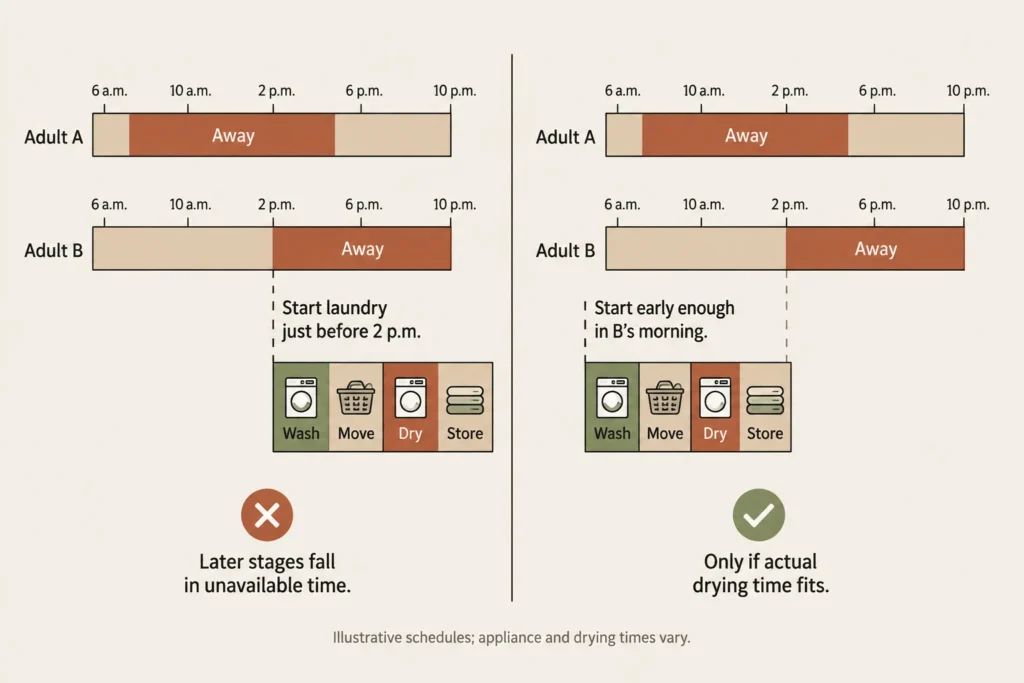
Studies have shown that when splitting housework, other factors come into play besides hours worked at your job. This was based on people that had a partner that also was a parent. But the question of whether they can do everything needed by the time your household needs it done is a good one.[2]
Start with items that have to be done by a certain time. When reassigning, see if something can be moved up. Trash can be placed out the day before if your city allows it. Laundry could be done before someone leaves for their late shift instead of starting right before they leave. Don't pass the remaining step on to whoever gets home next.
Person 1 leaves the house at 7am and returns at 5pm. Person 2 leaves at 2 and returns at 10. Person 2 has the rest of the day free to do things. Garbage pickup is Thursday morning and you can place it out Wednesday. All these jobs would work for person 2 if they have the correct appliances for doing laundry and can dry it in time to leave for work.
| Responsibility | Owner and window | Complete scope |
|---|---|---|
| Weekday kitchen reset | A, after the evening meal | Handle dishes, clear agreed preparation space, and leave the sink usable before the next morning. |
| Collection bins | B, Wednesday morning; return after collection | Track collection changes, gather waste, place bins, and return them during an agreed Thursday window. |
| Shared laundry needed Monday evening | B, Monday morning | Plan the load, maintain supplies, wash, dry, and store needed items before leaving at 2 p.m. |
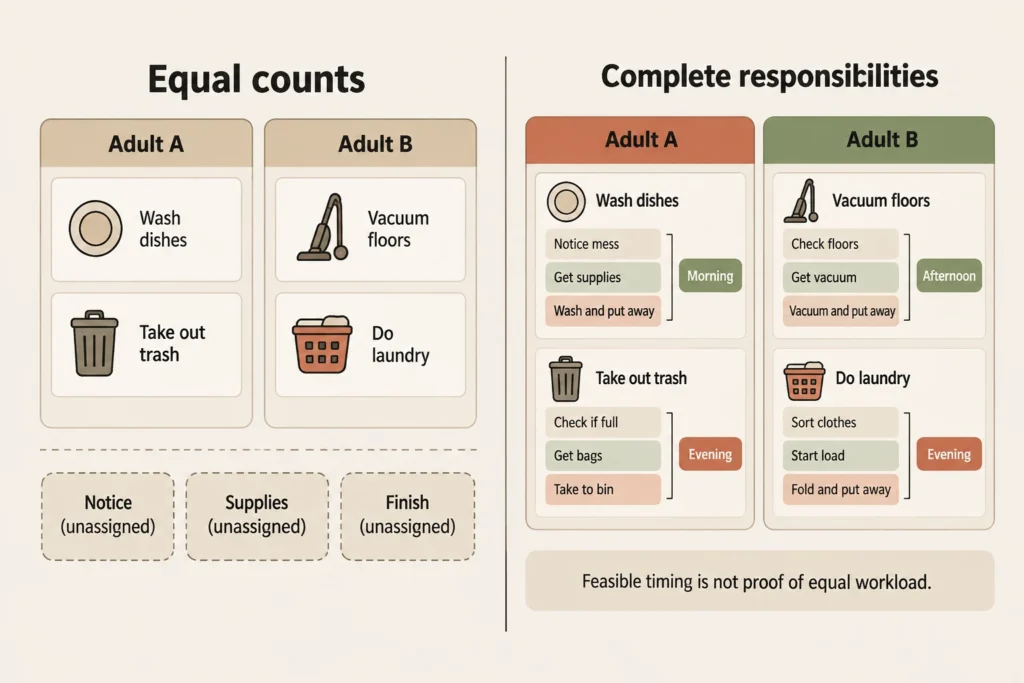
This gives you an idea of what jobs could be done by whom. You will still need to see if it's even between the two people. There may be more to person 5's jobs than person 2's. It could go either way with laundry and replenishing supplies as well. Factor those jobs in and what it takes to do them before assigning cleaning the bathrooms and floors.
How do you want it to be fair: equal free time, an even amount of work they can handle right now, or someone doing more until the other person is able to help again? They could be working more hours than the other person, but that doesn't always mean they can take on more chores. Make sure each person knows when they can get it done and has time when they aren't expected to pick up after someone else.
3. Specify completion and temporary backup
Have everyone know who is responsible for what. When it needs to be done by and what you consider done at the least. If someone can't do their job who will step up. Have a system in place on how to communicate that and who will accept it. What jobs will be transferred over and when the original person will take them back. Sending someone a text saying you can't do it isn't transferring the job.
Using Monday laundry as our example. B would identify a potential collision by Sunday night on the message board created for your home. A will cover if able. If B was able to get it done then its fair to expect A to at least put it on to dry and put away if they accepted covering it. B would take over with their next scheduled laundry day. You are not covering their supplies or future loads of laundry.
If you can’t make it all happen by end of day Monday have a plan B. Wash only what you need to have clean the following day. Wear something you have clean or hold off on doing laundry you don’t need done. If you fall ill have that plan ready to go as well. Don’t expect them to help with everything if they are sick. Having a back up works if you know what can be put off and how long you’ll need to cover.
Sometimes its not possible to own everything yourself. If laundry requires two people to complete have designated points. B can leave it out at a certain time for A to dry and put away. Both are completing tasks and can count towards their chores. Including managing when they need to be completed. Its not a chore B owns if A is doing half of the steps.
4. Review misses and rebalance ownership
Depending on what failed have an appropriate fix. Not having a feasible time would mean changing the time or who owns the chore. Then adjust other tasks to fit. If a task took longer than expected or required more energy reduce what your trying to accomplish or how much is being accomplished. If a task only gets done when you remind yourself create ownership to notice when it needs to be done and create your own reminder. If your not handing off properly create an ending task or combine ownership. If you ran out of supplies or don’t have access to a machine work on getting that taken care of.
Lets say B is unable to finish their laundry for Monday. And A has been drying their clothes after work. This brings the initial conversation back to the table. If B is able to wash it but can’t finish before leaving work. Split the task and take something else off A’s plate or change what day they do laundry. If B no longer has time during there day to complete it give the task to A and discuss what B can do to help. Always remember if you are helping someone out with their task it may not be a task that should be theirs.
You can’t assume that because someone isn’t able to complete a task they don’t want to. If there is time, ability and way to split up a chore and the person still doesn’t want to own that task you can bring it up. Creating more time for the task won’t help the problem. Keep assigning chores to others until you feel each person can handle what they are given.
Sources and references
- Harvard Kennedy School; study published in American Sociological Review: The Cognitive Dimension of Household Labor (2019)
- Work and Occupations / SAGE: Unpredictable Work Schedules and Gender Divisions of Domestic Labor (2025-11-25)