


The trash is full, the hand towel is missing, and a pan blocks the sink. Everyone has stepped around one of those problems, then one person clears all three, which means they did more than clean: they noticed, decided what had crossed the line, and chose the response. Use that sequence as a test: if the same person usually notices, decides, and prompts, assigning someone else the physical chore hasn’t truly shared the responsibility.
Researchers describe cognitive household labor as anticipating needs, identifying options, deciding, and monitoring, work that can remain invisible even when physical chores are divided. An observational study of mothers with young children associated carrying more of this work with greater stress and lower relationship quality, though that finding isn’t a template for every household.
Agree on five moments when the home needs to work
Replace “keep it clean” with an outcome anyone can recognize. The standard should protect the next ordinary use, not enforce one person’s preferred method or demand a perfect-looking room.
I used to clear an entire counter before breakfast and felt irritated when it filled again. Protecting one cutting-board-size prep area was more useful: the counter could hold things, but it couldn’t block breakfast.
| Function | Agreed usable result |
|---|---|
| Meal prep | One sink basin and a cutting-board-size prep area are available. |
| Hygiene | A hand towel or working dryer is available, and bathroom trash stays below the rim. |
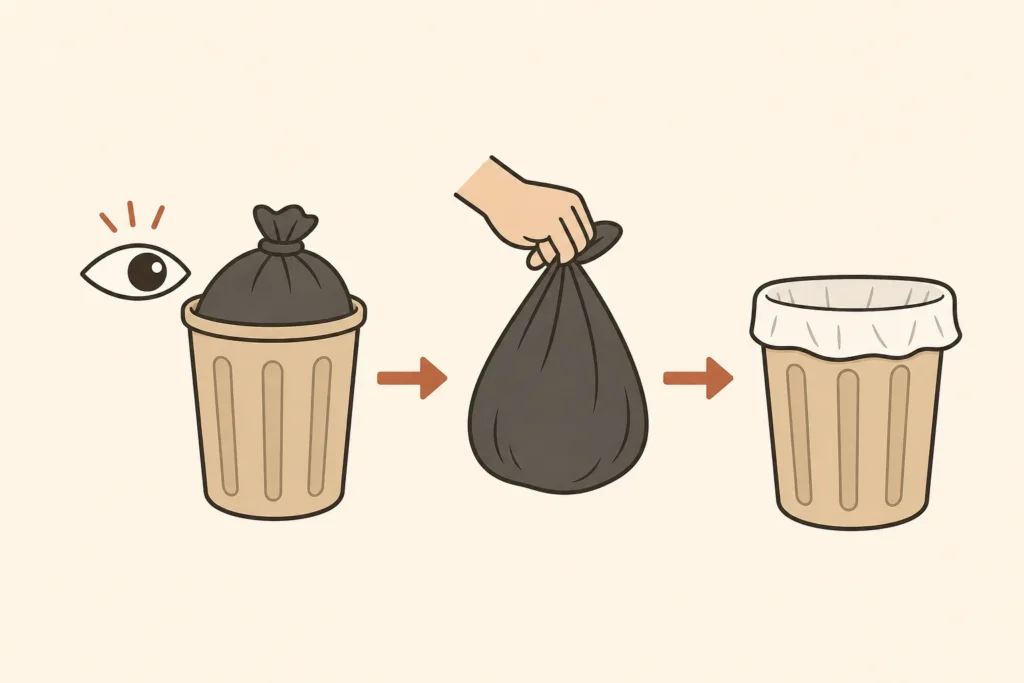
| Trash flow | A bag at the fill line leaves the shared area, and a new liner is installed. |
| Laundry | A wet load moves out when its cycle ends, and a finished load leaves the machine by the agreed handoff time. |
| Shared surface | One defined eating, working, or landing area remains available. |
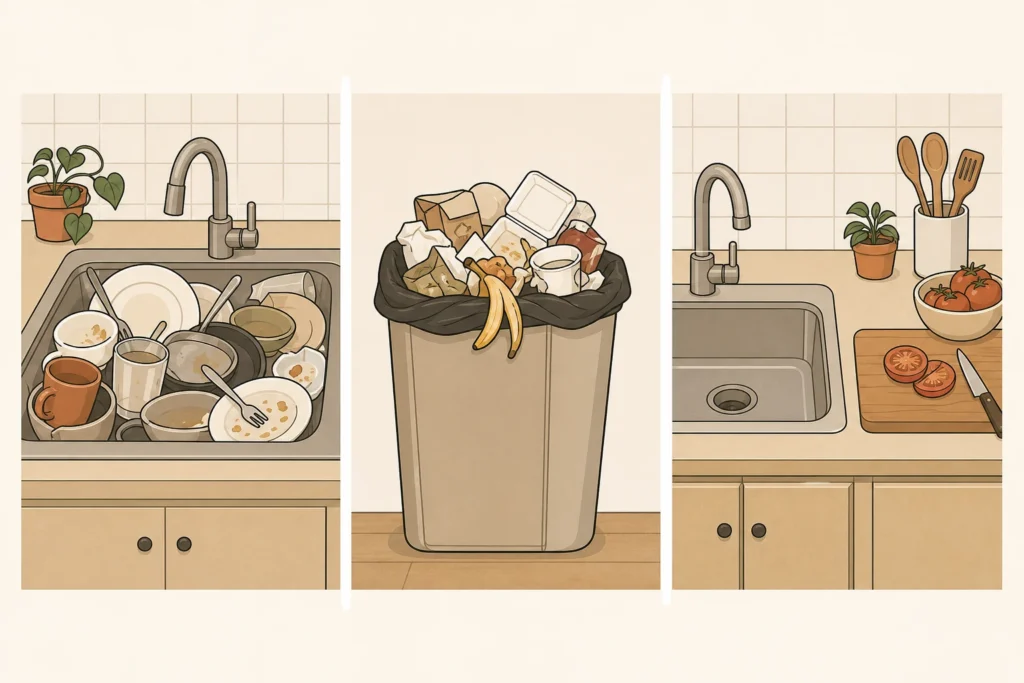
Choose the three to five functions that cause real friction in your home. More standards usually mean more administration, which is precisely what you’re trying to reduce.
An owner handles the handoff, not just the visible chore
Complete ownership is a closed loop, not waiting until someone assigns the physical part. It includes four small jobs:
- Recognize the agreed trigger.
- Complete the reset.
- Restore the supply or access needed next.
- Flag an exception before it becomes someone else’s surprise.
I find “tell me when the trash is full” particularly annoying because it leaves the noticing job exactly where it was, while “I check during the evening kitchen close, take it out when needed, and replace the liner” is ownership. The owner can choose how to get the agreed result, and a label or shared note can help, but maintaining that reminder must not become another person’s permanent chore.
Make fairness flexible without making one person the manager again
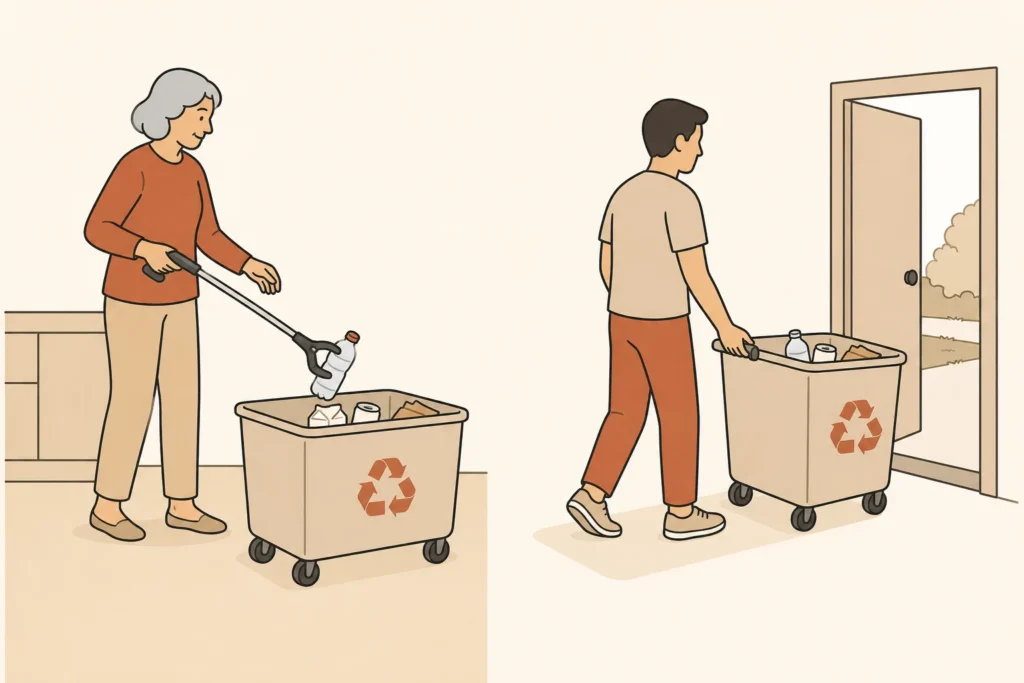
Equitable contributions don’t have to be identical. Illness, demanding work periods, caregiving, pregnancy, mobility limits, and sensory needs can change the bundles, but the change should be explicit rather than quietly absorbed by the usual manager.
Someone who cannot lift a full trash bag might own the bathroom supply and hand-towel reset while another person owns the trash route, and housemates on opposite shifts might make the kitchen usable before the afternoon shift arrives instead of expecting a simultaneous nightly cleanup. I like this kind of accommodation because it changes the task, tool, timing, or setup with the affected person’s input without quietly handing all the coordination back to someone else.
If someone repeatedly declines an agreed responsibility, a more detailed chart won’t fix the underlying problem. Standards can clarify willingness, but they cannot manufacture it.
Review the friction, not each other
Use a natural transition, such as before groceries arrive or at the start of a workweek, for a brief check-in built around three questions:
- Which standard prevented a daily snag?
- Which one still requires reminding?
- Is the problem the outcome, owner, timing, or setup?
When the same point keeps failing, revise the outcome, owner, timing, or setup before escalating the reminders, because a smaller result, different responsibility bundle, clearer handoff time, or easier setup is more useful than another round of “we all need to try harder.” The win is not an immaculate home or a perfect split, but a system that produces fewer surprises without quietly returning one person to the observer-and-reminder role.
Sources and references
- Harvard Kennedy School Stone Program / American Sociological Review: Daminger (2019), “The Cognitive Dimension of Household Labor” (2019)
- Archives of Women's Mental Health / Springer Nature: “Cognitive household labor: gender disparities and consequences for maternal mental health and wellbeing” (2025)
- University of Southern California / Annual Review of Psychology: Wood and Rünger (2016), “The Psychology of Habit” (2016)
- Centers for Disease Control and Prevention: CDC Disability Inclusion Strategies (2025-04-03)
- Cleveland Clinic: What To Keep in Mind When Asking for Help