

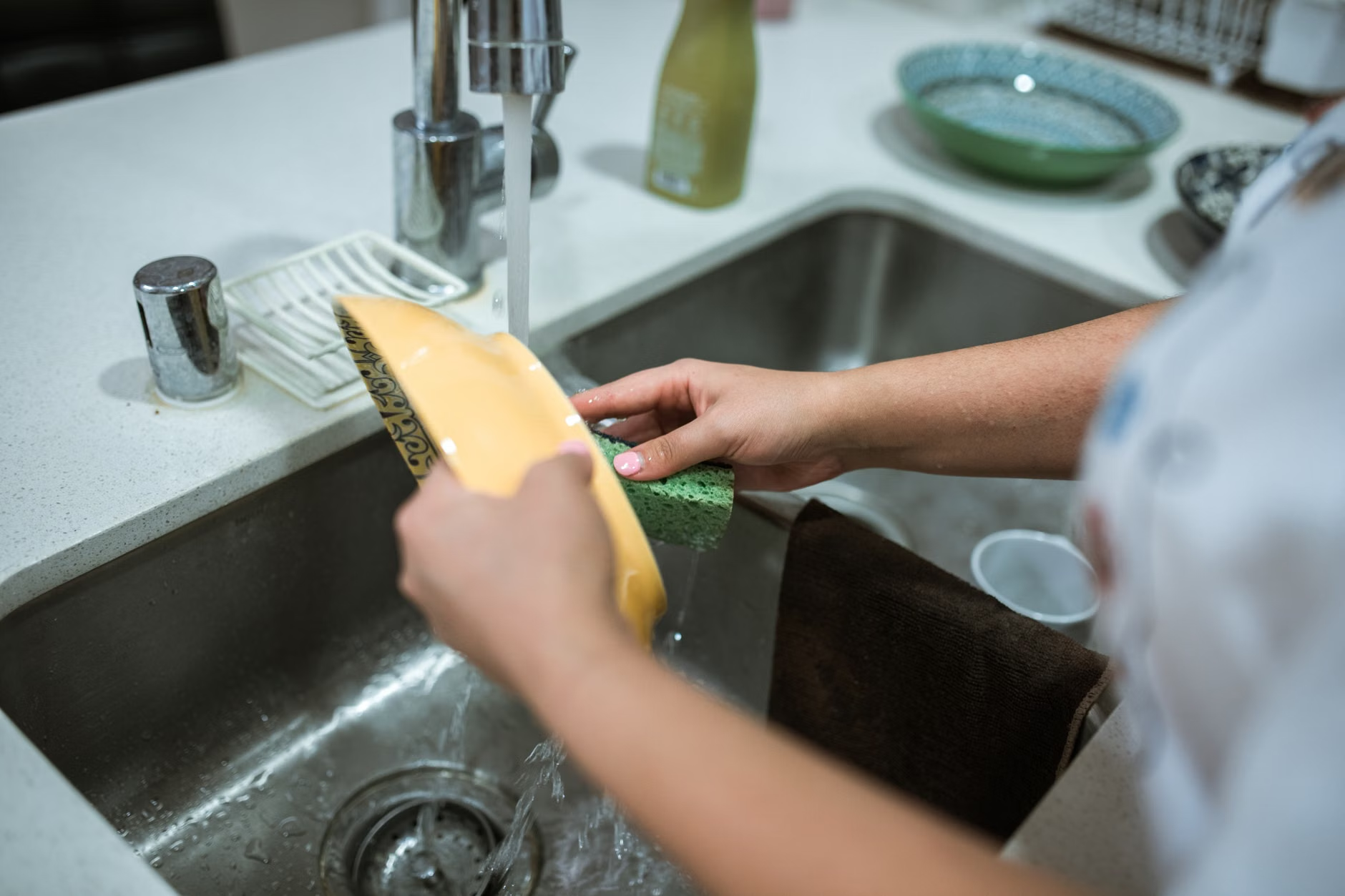
One pan laid across the basin can change the next meal. You can’t fill the coffee maker, rinse produce, or wash your hands without moving it, so another cup lands on the counter and the pile starts spreading sideways.
This is the annoying part: the kitchen may contain a manageable amount of unfinished work and still be functionally blocked. The answer isn’t necessarily to wash everything. It is to protect enough sink and counter capacity that cleanup can pause without making the next round harder.
An empty sink is not the same as a usable kitchen
Use a functional test instead of an empty-sink standard. You need access to running water and handwashing, room for one active pan or bowl, and a small adjacent landing area that isn’t occupied by a permanent pile. Kitchen-planning guidance treats that nearby counter as working space for good reason. A clear basin with a packed drying rack and nowhere to set a pot still creates a bottleneck.
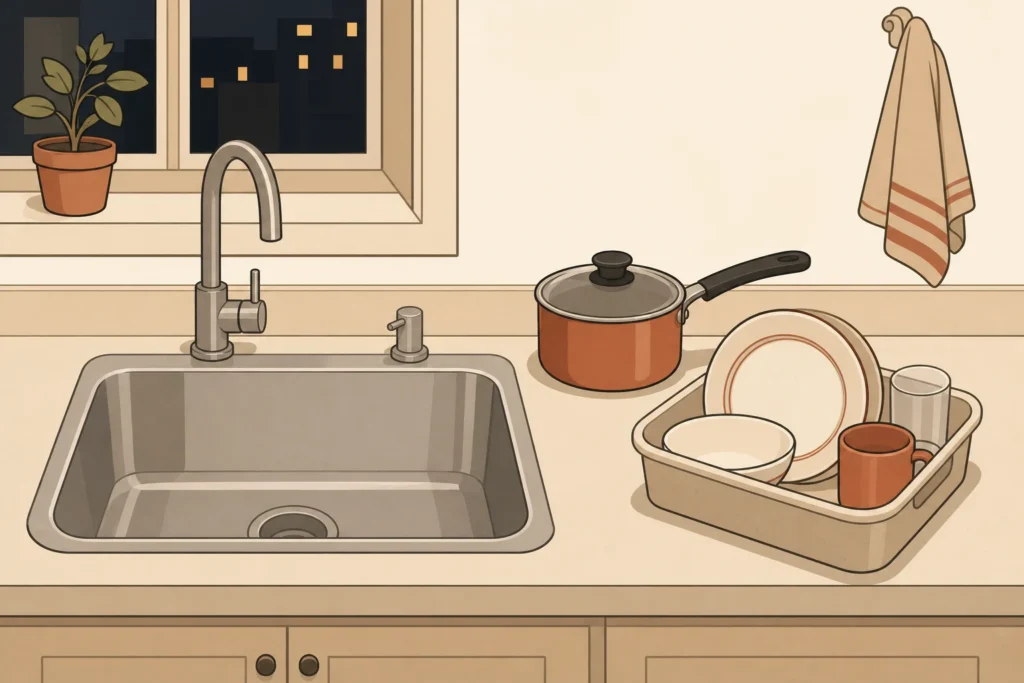
That test leaves room for unfinished dishes. It simply prevents them from taking the faucet, the entire basin, and the food-prep surface with them.
Find the first thing that steals the sink
Watch for the first moment when you have to move something to reach the faucet, put an item in the basin because its usual destination is unavailable, or surrender the adjacent landing area. Whatever caused that first forced move is the blocker, even if scraps, cookware, and clean dishes all accumulate a few minutes later. Fixing that point usually does more than adding another rack or another task.
- Food scraps arrive first: Move the trash or compost access closer to where plates are cleared, so scraping happens before dishes reach the basin.
- Dirty dishes arrive first: The sink is acting as the waiting queue. Give ordinary dishes a bounded holding route outside the working bowl.
- Clean dishes fill the area first: Drying and put-away capacity is the real limit. Clear fully dry items before washing another batch.
- A clean dishwasher stays full: Change when it gets unloaded. Until it can accept dishes, the sink has lost its main exit route.
Fix that first blocker before buying storage. A larger dish rack is not much of an improvement if it merely gives the pile better architecture.
Give unfinished dishes a route other than the basin
The useful handoff has three routes. Their order matters because it removes food, handles immediate needs, and contains everything else before the pile spreads.
- Scrape and load items that can go in the dishwasher. Remove large food particles rather than automatically pre-rinsing every plate, and don’t crowd items or block the spray arms.
- Wash the few items needed before the next cooking task. That might be the only cutting board, the breakfast skillet, or a reusable bottle needed in the morning. Priority comes from next use, not from which item looks most irritating.
- Contain the ordinary dishes that can wait. A washable dishpan, shallow tray, or one defined section beside the sink can hold a batch, provided it doesn’t become a food-prep surface or expand across the whole counter.
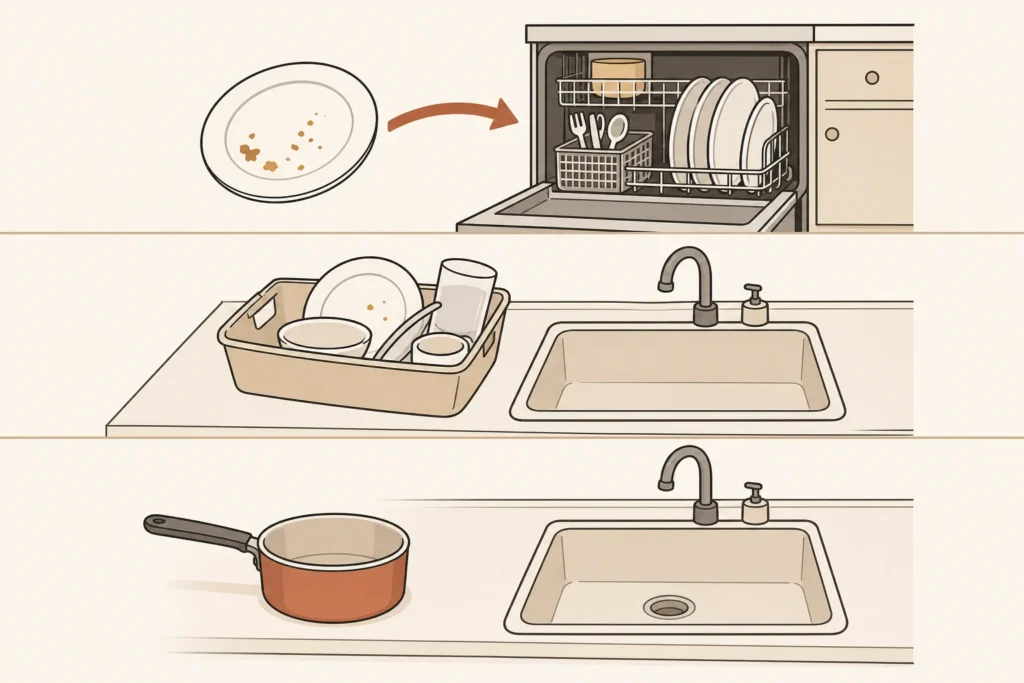
The wait zone needs a hard edge. Once the tray or dishpan is full, the next action is washing, loading, or putting clean items away, not beginning a second pile. That boundary is what turns deferred cleanup into a workable system rather than counter drift.
Match the reset to the kitchen you actually have
| Kitchen setup | Bounded buffer | Capacity rule |
|---|---|---|
| Dishwasher-led | Open dishwasher space, with one wait zone as backup | Scrape and load while space is available. If a clean load cannot be put away yet, contain dirty dishes in one zone until the dishwasher can be emptied rather than starting piles around the sink. |
| Small sink or hand-wash | One washing batch beside the sink | Keep the basin open for water and washing, clean the reusable essentials first, and stop adding to the batch when its container or boundary is full. |
| High volume or little drying space | A limited drying area and, if needed, one temporary landing spot | Put away fully dry items before washing more. The temporary landing spot can hold the next batch, but it cannot take over the food-prep area. |
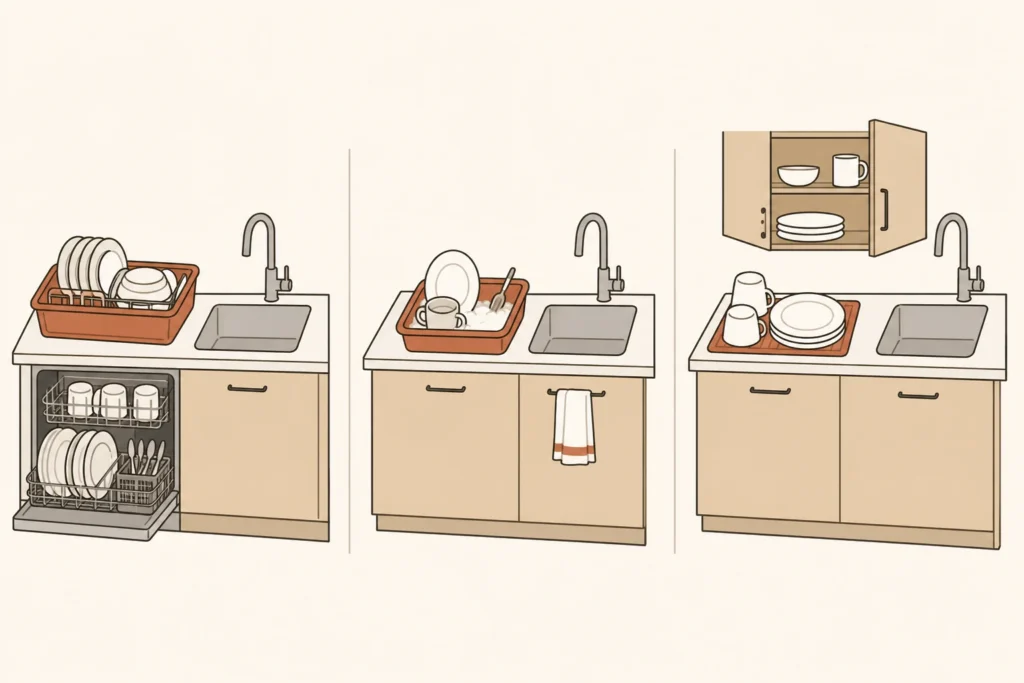
In a hand-wash kitchen, the basin itself is the tool, so storing the next batch inside it defeats the setup. In a high-volume kitchen, clean dishes can be just as disruptive as dirty ones. If the drying area fills first, faster washing only moves the blockage from one side of the sink to the other.
Use a cue and a stopping rule, not a nightly performance
Attach the handoff to one transition that already happens, such as plating the meal, putting leftovers in the refrigerator, or leaving the kitchen for the evening. Choose one, rather than relying on a vague promise to deal with the sink later. Research on health-related habits links specific plans and stable contexts with stronger habit formation. That research wasn’t about dishwashing, but the practical inference is modest: a consistent cue removes one repeated decision.
On an overloaded evening, the reset is complete when four conditions are true: food scraps are out of the sink, raw-food-contact cleanup is handled when relevant, water and handwashing are accessible, and the remaining dishes fit inside their assigned boundaries.
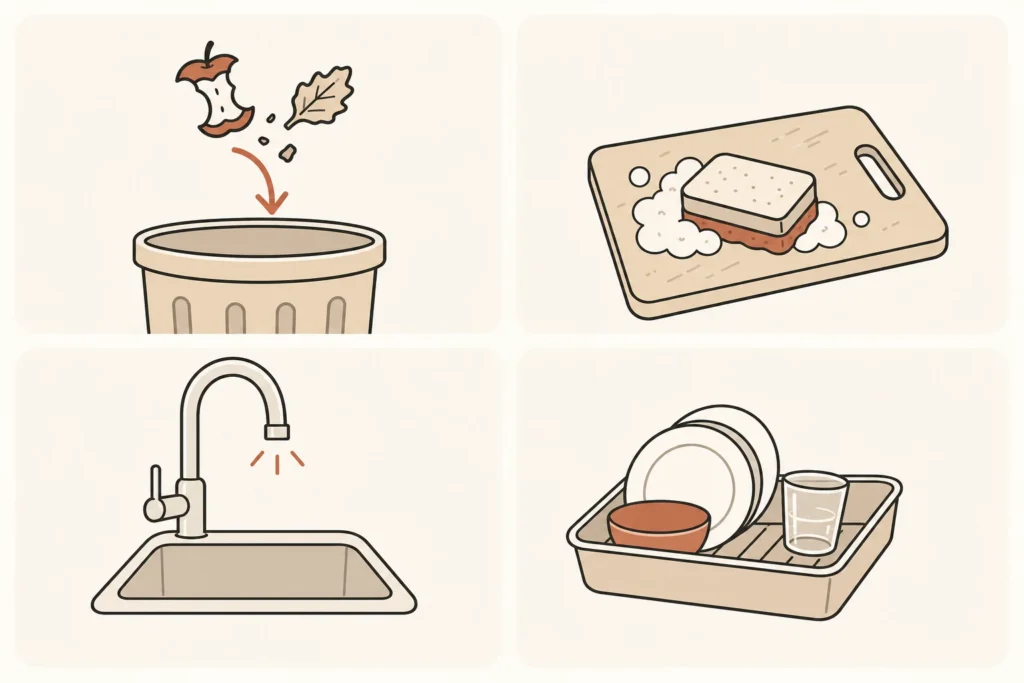
If you have more capacity, run or finish a dishwasher load, wash the cookware needed next, and clear the drying area. Those are useful extensions, not the admission price for going to bed.
If the sink still becomes unusable every day despite a bounded wait zone, let the first blocker choose the setup change. Clean dishes taking over point to drying space or dishwasher unloading timing. Dirty dishes escaping their boundary point to the wait zone or the number of dishes in circulation, while recurring scraps point to trash or compost access where plates are cleared. A pan can wait. It just shouldn’t get to decide whether tomorrow’s cooking can begin.
Sources and references
- U.S. Department of Agriculture, Food Safety and Inspection Service: USDA FSIS: Washing Food: Does it Promote Food Safety?
- Whirlpool: Whirlpool: Cleaning the Filter, Dishwasher (2026-09-12)
- National Kitchen & Bath Association: NKBA Kitchen Planning Guideline 11: Cleanup/Prep Sink Landing Area
- Peer-reviewed article indexed by PubMed Central: Time to Form a Habit: A Systematic Review and Meta-Analysis of Health Behaviour Habit Formation and Its Determinants