

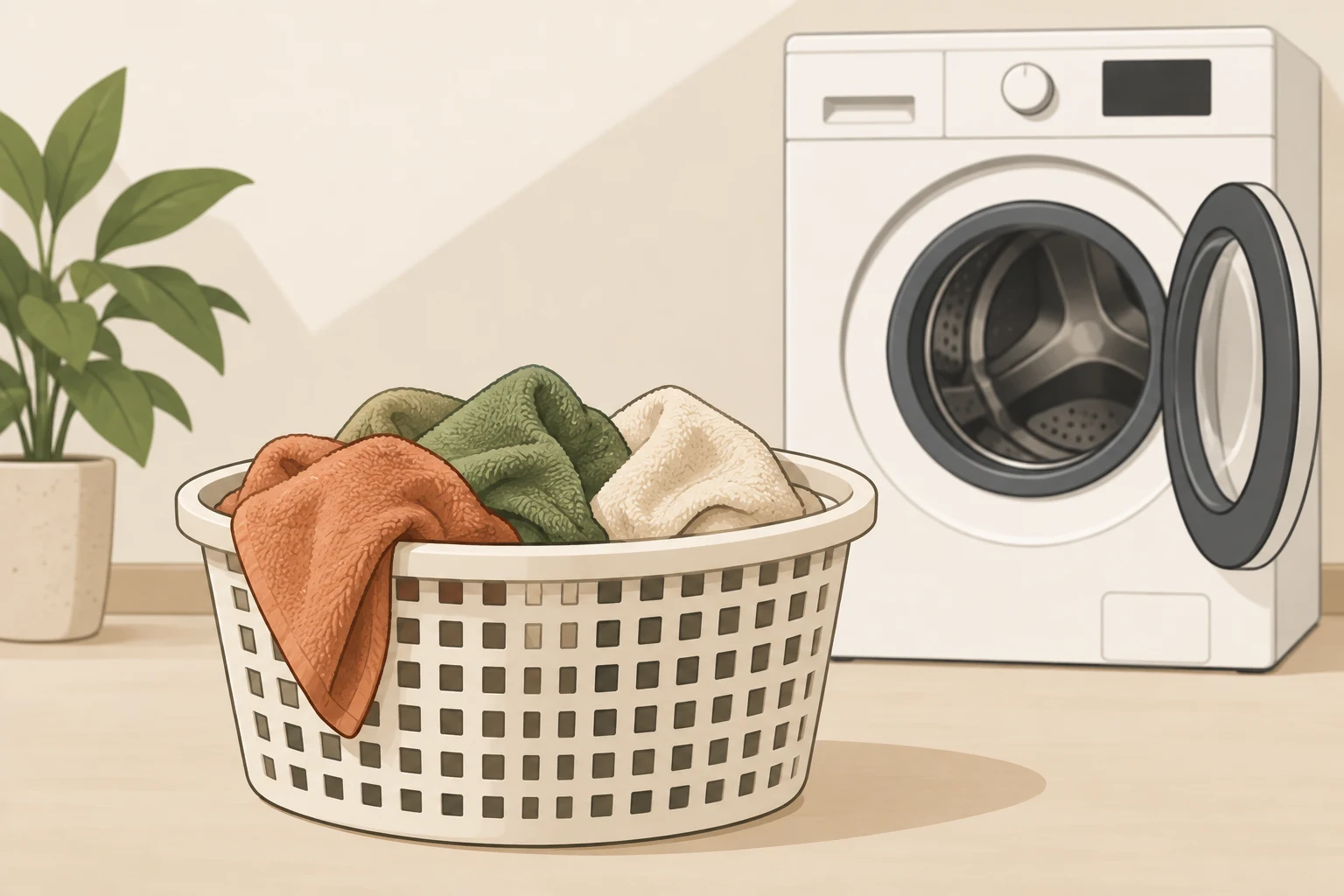
##### Separate cloths during cleaning by what they touch, then batch ordinary used cloths when their soil levels and care instructions are compatible. Keep them out of clean storage until washing and drying are complete. A dedicated toilet cloth does not automatically need a dedicated laundry load. Task separation prevents direct transfer, while load separation addresses exposure requirements, heavy soil, lint and incompatible care.
1. Sort cloths by actual contact
##### Identify what each cloth touched before rinsing, reusing, or putting it in the laundry. Not all soils require the same treatment. Toilet contact cloths should not be used for food contact, or near food, during their use. Labels or colors may help you remember what a cloth touched, but do not mean the cloth is clean.
##### Replace a cloth after using it to clean a spill. Raw meat juices are a reason for prompt laundering, not for letting the cloths pile up until later. The University of California recommends hot washing and high-heat drying for kitchen cloths. If a cloth's care instructions indicate it can withstand that, then use it for the kitchen. Do not use a microfiber cloth and substitute a lower-heat treatment based on your judgment.[11]
Illness alone does not require a separate load according to the CDC. In general, their guidelines state it is acceptable to wash the clothing of a sick individual with that of other household members. However, textiles contaminated with norovirus are an exception. For cloths contaminated with vomit or feces, the CDC states the items should be handled with gloves and not shaken. The cloths should then be washed with the hottest water and longest cycle available. The cloths should then be machine dried on the highest heat setting available. Norovirus is highly stable and contamination may remain on a surface for weeks. Cloths that have vomit or feces on them should not be considered suitable for reuse and exposure-specific instructions for the handling or disposal of the cloths should be obtained. Do not attempt to neutralize the norovirus, or any other substance for that matter, with a soak or by disposing of the substance down the drain.[1][6]
Pesticides, gasoline, and other solvents should be diverted from normal rinsing and laundering. Product labeling for textiles contaminated with the substance should be consulted. The NC State University Pesticide-spill Contingency Plan states contaminated gear should not be laundered with other household gear and may need to be disposed of. The EPA refers affected households to product labels and local hazardous waste disposal. It is recommended to consult product labeling regarding the cloth and not to try to neutralize the substance yourself.[7][8]
Oil should also be addressed separately. The Whirlpool manual states that if an item becomes saturated with flammable fluid or gasoline it should not go in the washer, nor should it be dried. This warning holds true even if the item appears to have had the fluid or gasoline removed. It is recommended that oil rags be stored in a fireproof container until substance-specific fire and disposal instructions state otherwise.[9][10]
2. Stage ordinary cloths for laundering
For soil that doesn't need immediate treatment, wash or dry the cloth now. If the instruction allows, rinse away the soil and squeeze it out first. E-Cloth says that rinsing and drying their products is okay. However, assuming that is the case for all specialty cloths is not permitted. Do not use this method for hazardous residues or cloths contaminated with norovirus.[2][6]
Avoid allowing damp cloths to accumulate in a bundled pile. In a study conducted in a domestic kitchen, Salmonella grew in cloths contaminated by food and became more difficult to remove with detergent after being stored for a period of time. It shows that food-contaminated cloths should be cleaned as soon as possible, but it does not support the same for dusting cloths or show that air-drying cloths disinfects them.[5]
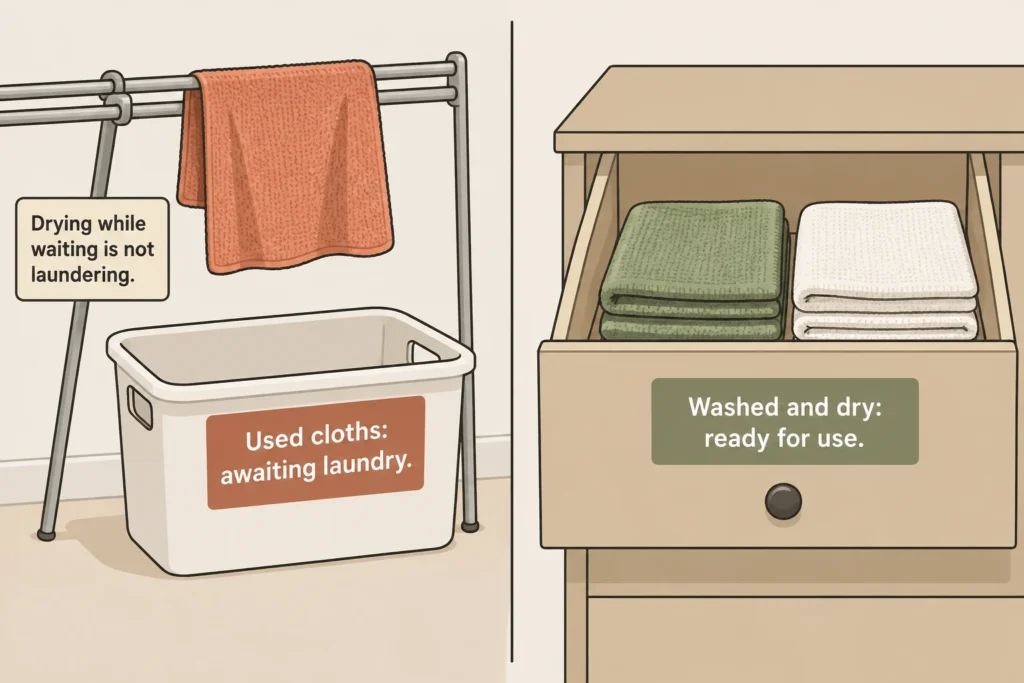
When regular used cloths are dry, collect them in a laundry container marked with the name of the household member. The arrangement works when cloths have a place to dry and no dried, unwashed item is mistaken for a ready-to-use one. Wash hands after coming in contact with soiled laundry.[1]
3. Build a compatible wash batch
A shared load needs overlapping requirements; the wash must be within the temperature and cycle limits of each item, and meet the time limits of bleach, detergent, and other additives. Then consider soil level and lint shedding. If allowed by the manufacturer, ordinary, lightly soiled cloths may share a laundry load with other lightly soiled cloths; heavily soiled cloths should not be loaded with lightly soiled cloths.[1][2][3][10]
| Cloth | Wash decision | Drying constraint |
|---|---|---|
| Cotton cloth or towel | Verify the label's temperature and bleach permissions. Keep shedding cotton away from lint-sensitive microfiber. | Use the labeled drying method. Cotton content does not override an oil-related appliance warning. |
| Microfiber cloth | Use its exact care instructions. Whirlpool recommends separation from lint-shedding fabrics; E-Cloth permits mixed laundry for its products. Avoid prohibited softeners. | Use permitted air drying or dryer settings. Whirlpool recommends low heat for microfiber; avoid dryer sheets where prohibited. |
| Specialty or treated cloth | Check the specific product rather than applying general microfiber instructions. Some E-Cloth dusting products have different care requirements. | Verify whether machine drying is allowed and at what heat before adding it to a dryer batch. |
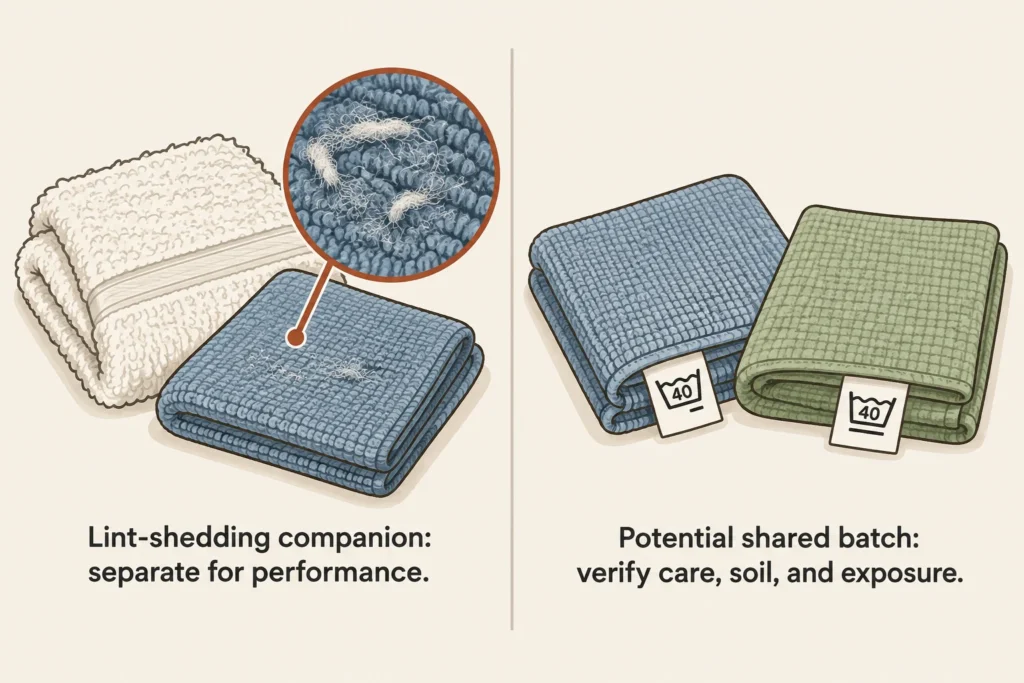
Mixed-laundry permissions and requests to wash microfiber separately may not be in opposition. The manufacturer may allow shared washing, but microfiber needs to be washed separately from towels to retain its lint-free feature. A cotton cloth from a bedroom may be a better microfiber wash companion than a low-lint bath cloth. Room names will not address the lint or the care-compatibility issue.[2][3]
Follow the direction on the detergent label for the appropriate dose based on the load size and soil level. Do not add softener to a load that prohibits it. There may be permission for a particular product to be used with chlorine bleach, as in the case of the HYGEN guide, but that does not provide a household bleach recipe or permission to use microfiber.[3][4]
Hand washing may be allowed for less soiled ordinary cloths. Do not use hand washing in place of an exposure-specific process. After hand washing, if the cloth still has soil or greasy deposits, do not store it with other clean items. Evaluate if it still needs to be washed with the other cloths, and if there are permissible methods to wash it.[3]
4. Dry cloths and verify readiness
Decide microfiber eligibility for the dryer separately from wash eligibility. Use the permitted drying method for the microfiber and abide by the contamination restrictions of the dryer. The microfiber may need to be dried on low or not at all. The CDC norovirus process calls for drying at the highest heat. The Whirlpool manual states that oil-exposed items should not be dried. Do not combine the directions to reach a compromise temperature.[3][6][10]
In permitted air drying, make sure folds don't dry trapped against one another. Check hem and seam lines as well as folds when drying. Continue permitted air drying if any part is still damp. Do not stack with the clean supply. Complete drying is a part of CDC's routine laundry guidance.[1]
If your microfiber cloth loses its ability to absorb liquid after coming in contact with fabric softener sheets or dryer sheets by mistake, try the recovery method as permitted by the manufacturer. E-Cloth notes that some microfiber cloths can be rewashed after being exposed to fabric softener sheets; do not extend this to all microfiber cloths and do not use an improvised soak. After recovery, check to see if it can still absorb water or dust and if it still does not smear or shed.[2]
Return a cloth to its clean task storage only after the process is completed, soil is completely removed, the cloth is completely dry and the function of the cloth is retained. Continued shedding, tearing and smearing are a clear indicator that it should not be used for that task any longer. A fresh smell and an unstained appearance do not guarantee it's safe. Make sure you do process and performance checks.
Sources and references
- Centers for Disease Control and Prevention: When and How to Clean and Disinfect Your Home
- E-Cloth USA: How To Wash Microfiber Cloths
- Whirlpool: How to Wash and Dry Microfiber Towels and Cloths
- Rubbermaid Commercial Products: Microfiber Laundry Guide (2024-06)
- Journal of Applied Microbiology: Achieving hygiene in the domestic kitchen: the effectiveness of commonly used cleaning procedures
- Centers for Disease Control and Prevention: How to Prevent Norovirus
- NC State Extension: Handling and Cleaning Up Damaged Pesticide Containers at Home
- US Environmental Protection Agency: Household Hazardous Waste
- City of Methuen: Disposal of Oily Rags
- Whirlpool: Whirlpool Owner's Manual W11590301 Rev. A
- University of California Agriculture and Natural Resources: Cleaning & Sanitizing the Home Kitchen (2026-04)