

Opening the dryer and finding warm, damp towels after a full cycle invites two unhelpful conclusions: run it hotter, or start pricing a new dryer. Warmth proves neither that the machine is healthy nor that it is finished. Moisture has to leave freely tumbling fabric and travel through the exhaust system; a packed drum, restricted lint screen, or poor airflow can interrupt that process.[1][2][3]
This first-pass diagnosis applies to conventional vented dryers. Ventless, condenser, and heat-pump dryers do not discharge air through an outdoor hood, so their filters, condenser, reservoir, and drain requirements must be checked using the model instructions.
Run one fair test before changing everything
One towel-heavy load, a comforter, or a drum packed with jeans and lightweight shirts is a poor verdict on the appliance. Make the next cycle a controlled test instead. The point is to change as little as possible, which is less dramatic than turning every setting at once and much more informative.[2][3]
- Choose a moderate load of similar fabrics. The items should have enough room to lift and tumble rather than moving as one dense bundle.
- Start with laundry that received a normal washer spin. If it is unusually heavy or dripping when it enters the dryer, treat washer performance as a separate variable rather than blaming the dryer.
- Remove lint from the screen and reinstall the screen fully before running the test.
- Select an automatic or regular cycle appropriate for the fabrics. Confirm that air-only, no-heat, or another unsuitable setting was not selected accidentally.
- Let the cycle finish, then note whether the comparable load dried normally or remained damp.
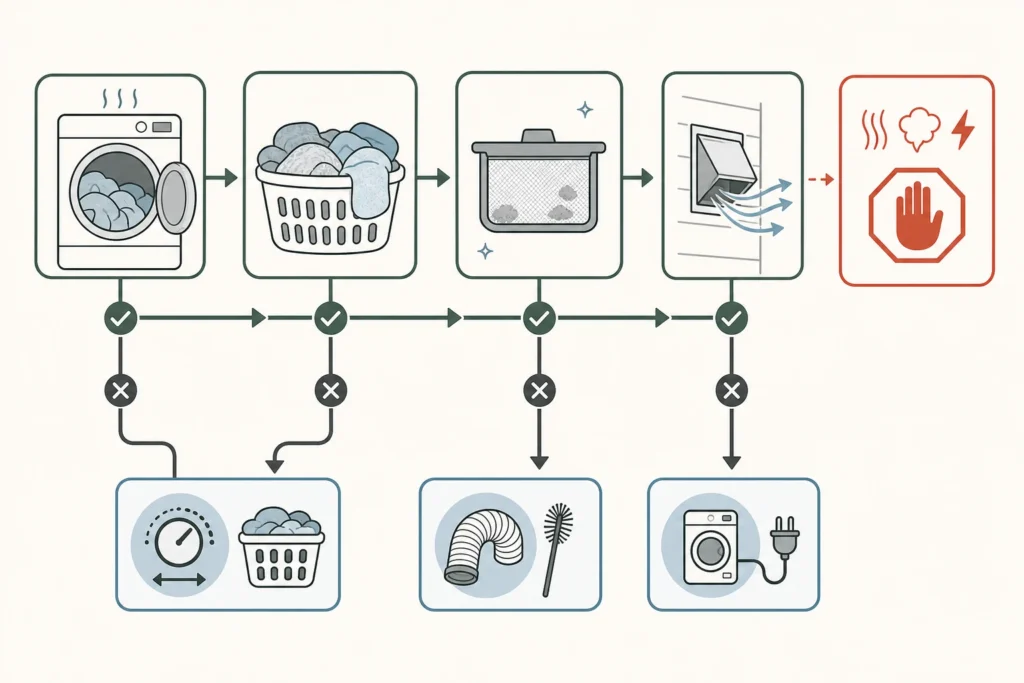
If this comparable load dries normally, the earlier result probably followed the laundry: too much fabric, mismatched weights, one bulky item, an unsuitable cycle, or clothes that entered unusually wet. Adjust those variables before pursuing replacement. If the test load is still warm and damp, follow the air path.
Make the lint screen a real airflow check
Peeling off visible lint is necessary, but a screen can look clear while detergent or fabric-softener residue remains on the mesh. If drying has slowed, consult the model instructions for washing the screen. A common manufacturer-approved method uses warm water, mild liquid detergent, and a nylon brush, followed by thorough rinsing and complete drying.[3][4]
Reinstall the screen firmly. Do not operate the dryer with a missing, loose, wet, or damaged screen. You may vacuum accessible lint around the housing if the manual allows it, but the lint-screen slot is not an invitation to push improvised tools deep into the machine.
Let the exterior exhaust answer the airflow question
With the lint screen installed and the dryer running, observe the outdoor exhaust hood from a safely accessible location. Exhaust air should be escaping, and a hinged flap should be able to open freely. If the outlet is on a roof, high wall, or another location that requires a ladder or difficult access, skip this check and arrange service.[1][2][3]
The pattern matters more than any one clue. A comparable load that stays warm and damp, combined with weak or absent outdoor exhaust, excess heat or humidity in the laundry area, or lint collecting around the machine, supports an airflow-restriction concern. It does not reveal whether the restriction is behind the dryer, inside a concealed duct, or at the outdoor hood.[1][2][3]
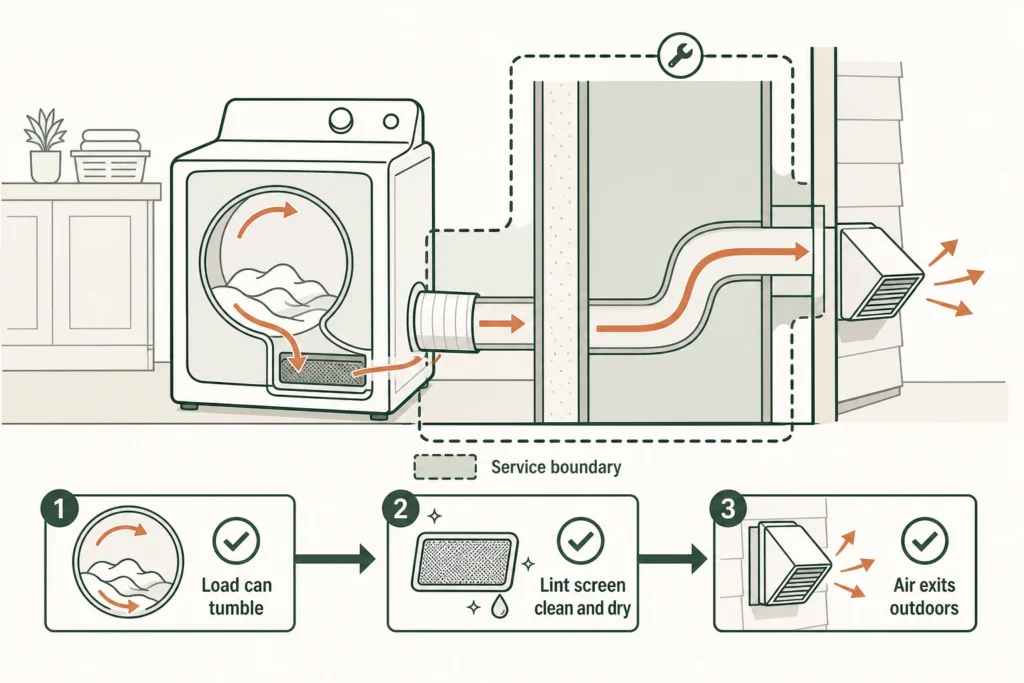
If the short transition duct behind the dryer is already visible, look for crushing, sharp kinks, disconnection, or plastic or foil accordion-style material. Do not shift a gas dryer, disconnect utility connections, enter a crawlspace, open a wall, or attempt to clear hidden ductwork. The useful home check ends where access and visibility end.[1][2]
Use the result to choose the next action
| What happened | Most useful interpretation | Next action |
|---|---|---|
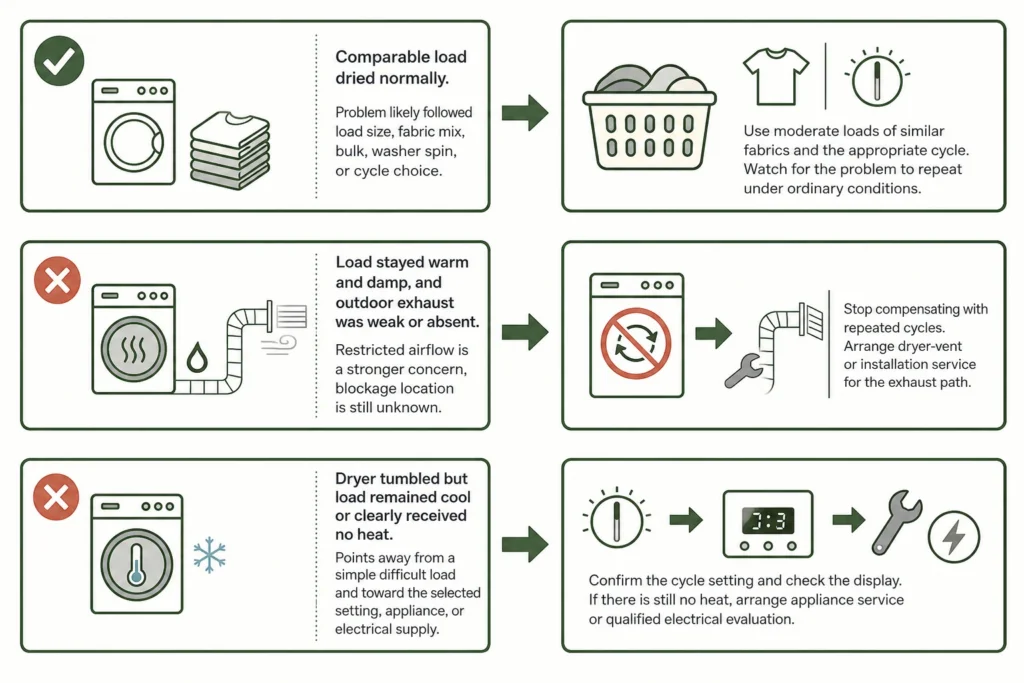
| The comparable load dried normally | The earlier problem probably followed load size, fabric mix, bulk, washer spin, or cycle choice. | Use moderate loads of similar fabrics and an appropriate cycle. Watch for the problem to repeat under ordinary conditions. |
| The load stayed warm and damp, and outdoor exhaust was weak or absent | Restricted airflow is a stronger concern, although the blockage location is still unknown. | Stop compensating with repeated cycles. Arrange dryer-vent or installation service for the exhaust path. |
| The dryer tumbled but the load remained cool or clearly received no heat | This points away from a simple difficult load and toward the selected setting, appliance, or electrical supply. | Confirm the cycle setting and check the display. If there is still no heat, arrange appliance service or qualified electrical evaluation. |
| An automatic cycle ended unusually early on a very small load | On models with moisture sensing, a small load may not interact with the sensing system consistently. | Follow the model guidance for small loads, which may mean adding similar items or using an approved timed cycle. |
| An error code or unusual noise appeared | The dryer has supplied a model-specific appliance clue rather than a general laundry clue. | Record the code or describe the sound, stop further testing, and contact appliance service. |
Stop when poor drying becomes a safety or service problem
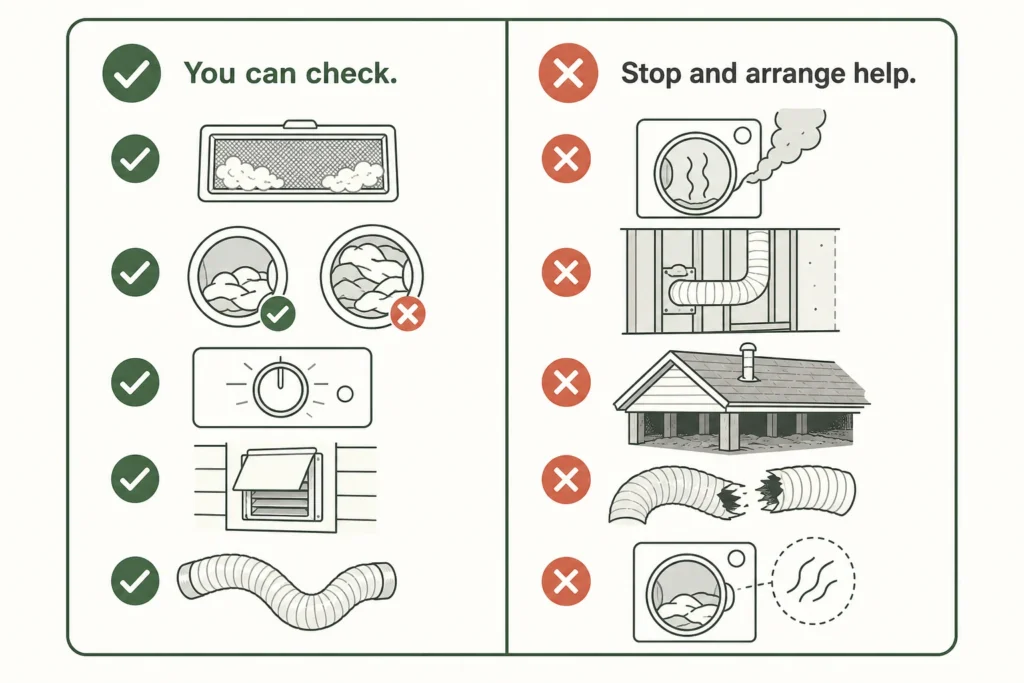
Weak or absent outdoor exhaust, damaged transition ducting, and uncertain concealed routes belong with a qualified dryer-vent professional or installer. No heat, error codes, unusual noises, or continued poor drying after airflow problems have been addressed belong with appliance service, or a qualified electrician when the electrical supply is the concern.[2][3]
Renters should photograph the symptom and any visible duct problem, record how long comparable loads take, and report the issue to the property manager. Concealed building venting is not a reasonable tenant alteration project.
Treat slower drying as the maintenance reminder
Remove lint before every load, keep the area behind and around the dryer clear, and treat a noticeable increase in drying time as a reason to inspect the visible exhaust path. A dryer that suddenly needs twice as long deserves attention, but not an immediate replacement verdict: test one sensible load, follow the airflow as far as you can safely see it, and hand off the problem when the evidence moves into the duct or the appliance.[1][3][4]
Sources and references
- U.S. Consumer Product Safety Commission: CPSC Safety Alert: Overheated Clothes Dryers Can Cause Fires
- Maytag: Dryer is not Drying or Experiencing Long Dry Times
- Whirlpool: Whirlpool Dryer Owner’s Manual, troubleshooting and lint-screen care
- Whirlpool: Cleaning the Lint Screen on a Dryer