

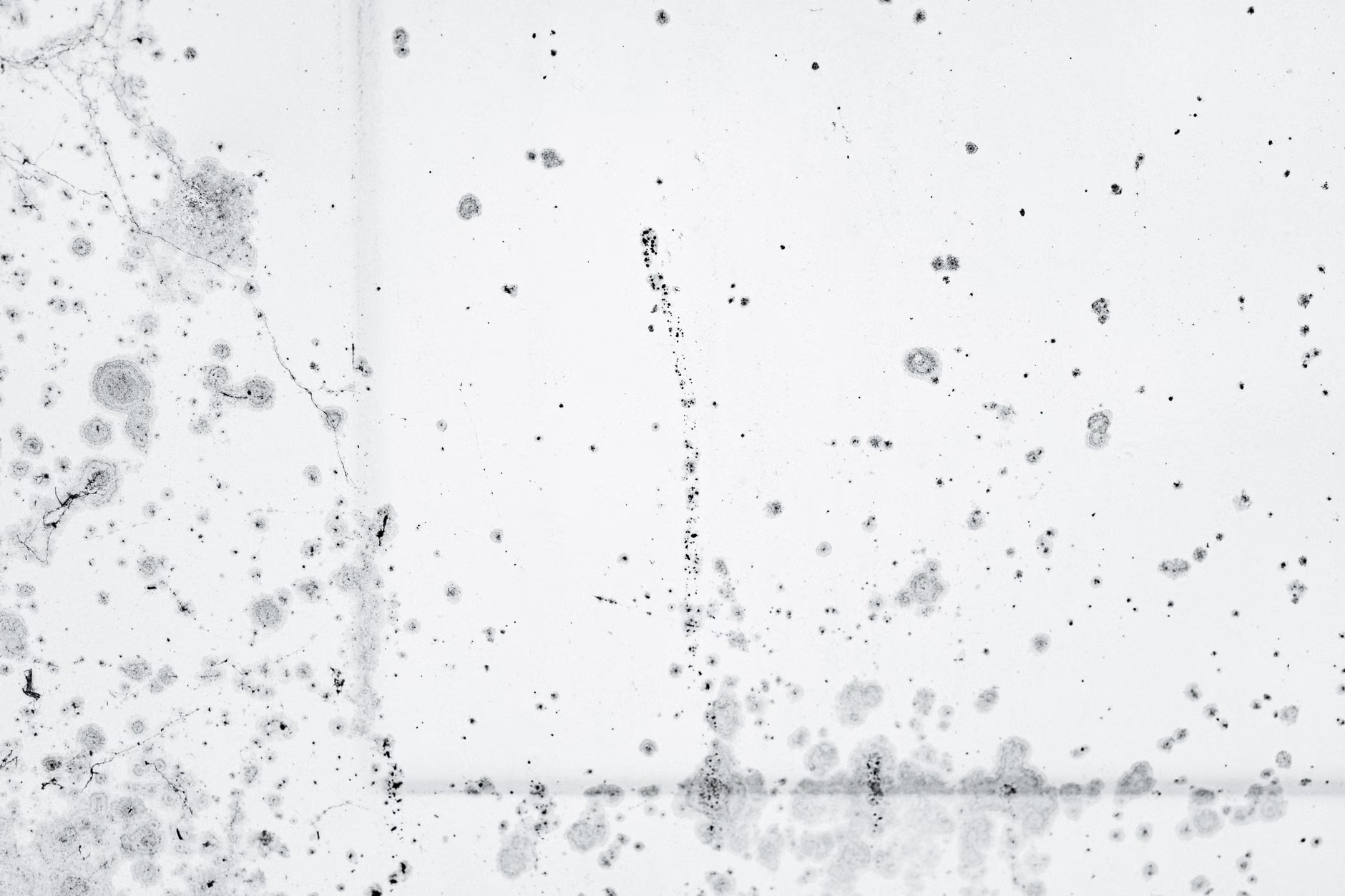
Small mold spots may mean there is still a moisture problem. They may also mean that building materials have been damaged and/or there is a history of water and/or mold in the house. In that case, house cleaning is not adequate. Size does not determine if the spot is cleanable. Renters should report any leak or moisture problem, regardless of whether the mold spot is on an accessible surface.[1][2]
Size is a screening factor, not clearance
EPA says that an area smaller than about 10 square feet can usually be cleaned by the residents. That’s about a 3-foot by 3-foot patch. That is not a threshold for toxicity. If there is a large water damage problem, that changes the guidance. A small spot does not determine the extent of the problem within a wet wall.[1][6]
If there is a history of sewage backup or other contaminated water, EPA says a professional should be called. A clean-looking surface does not resolve the issue.[1]
For people with asthma, allergies, COPD, or immune suppression, the CDC says not to participate in mold remediation. If participating, the CDC recommends an N95 respirator and protective goggles and gloves. Protective equipment does not change participation restrictions.[4]
Do not use color to determine if you should continue mold removal. Just because mold appears to be green or black does not mean the species has been identified. The CDC does not recommend home mold tests for the general public. If there is mold and a moisture problem, that justifies action.[3]
Material condition changes the decision
| Observed condition | What it changes | Next action |
|---|---|---|
| Small, accessible spot on intact glazed tile or another hard surface | Surface cleanup may be feasible if the water history and participant’s health allow it. | Use a material-compatible method, dry completely, and correct the moisture source. |
| Growth involving porous material, such as drywall paper or ceiling tile | Cleaning the face may not remove growth within the material; replacement may be necessary. | Request assessment of the material rather than repeatedly scrubbing it. |
| Peeling, swelling, crumbling, or persistent dampness around the spot | The job includes possible water damage, not merely surface cleaning. | Stop disturbing the area and request moisture-source and material assessment. |
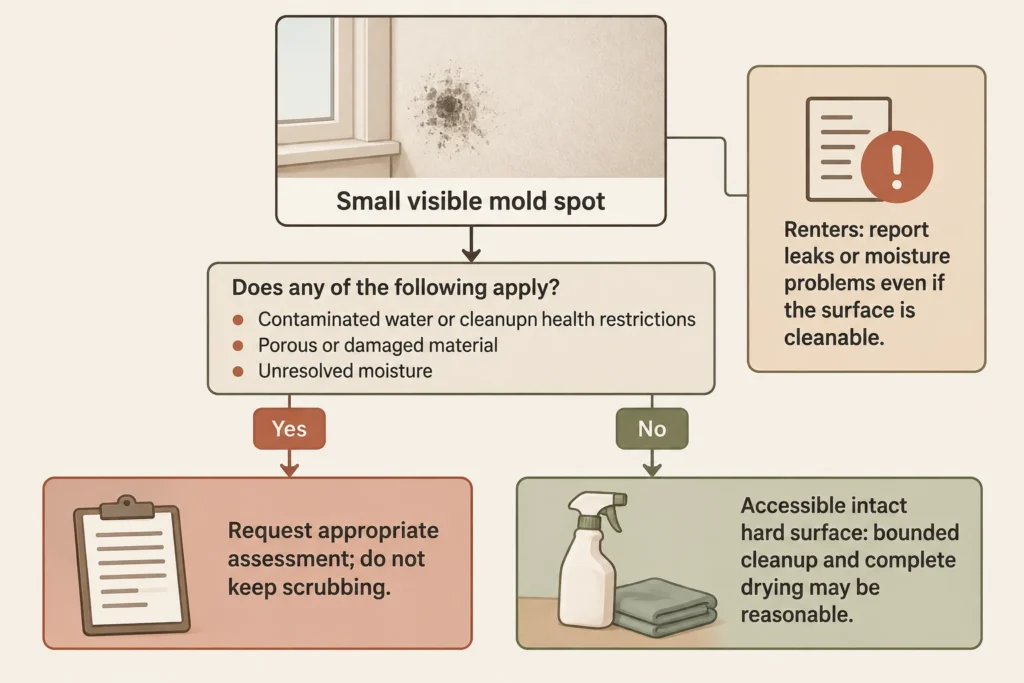
An intact painted surface doesn’t mean the wall behind it is dry. Peeling paint doesn’t mean there is mold behind it. If the wall behind the paint is dry, the paint will stay intact. Document the condition without digging into walls. The EPA states that if mold is behind a surface, and it is disturbed, then it can spread.[6]
Read recurrence alongside drying
If bathroom surfaces get wet frequently, then the EPA states that mold may develop and grow. If mold is developing repeatedly, the cause may be a lack of ventilation and/or maintenance. Recurring mold may not mean that there is a hidden water leak. An unresolved moisture issue may lead to mold spreading to other, harder-to-reach, areas.[2][6]
For example, let’s say a renter sees a 2-inch spot on the wall above the tub, and it comes back after cleaning. Also, let’s say that wall is visibly damp the next morning after the fan has been run all night. Continuous bathroom humidity can cause a 2-inch spot to come back. A renter can’t do anything about humidity in the bathroom, but keeping the surface clean does nothing to stop the moisture issue. A renter can’t do anything to address the moisture in the wall, and attempting to clean the surface more aggressively may cause paint to peel and swell even more.
Completion means that the water or moisture source has been removed, and the affected area has been fully dried. It should not come back. Repainting over mold does not address the moisture issue.[1][2]
Report observations and request assessment
Before doing any deep cleaning, take close-up and wide-angle photos of the stains and other relevant areas. Include photos of the surrounding area to give a sense of the overall size. In your report, give the approximate dimensions. Also include the time and date the stain appeared, when and if it’s been cleaned, leaks/overflows, if it remains damp or wet between uses, if there are material changes, if products have been used, if there are other stains, and anything else that you think may be relevant.
An example of a concise written request may be as follows: “A 2” mold-like spot returned above the tub. The wall is visibly damp in the morning. Nearby paint is also peeling and swelling. Pictures are dated. Please evaluate the source of the moisture and repair the wall if needed and ensure that the wall is dry and paint is not damaged before the wall is refinished.”
Homeowners should keep the request to assess the leak and/or moisture problem and the assessor’s response for reference. Mold, dampness and housing-maintenance complaint procedures provide procedures to address complaints, required contacts, and allow for further complaint escalation. For example, in New York City the complaint process states that the first step is for the tenant to notify the landlord. This is a local process and is not applicable everywhere.[5]
Sources and references
- US Environmental Protection Agency: Mold Cleanup in Your Home
- US Environmental Protection Agency: A Brief Guide to Mold, Moisture and Your Home
- Centers for Disease Control and Prevention: Mold (2024-09-26)
- Centers for Disease Control and Prevention: Mold Clean Up Guidelines and Recommendations (2024-02-16)
- City of New York: Mold Complaint
- US Environmental Protection Agency: Mold Course Chapter 3: Finding Mold and Moisture