

You clean the mildew line, wipe the walls, and get the bathroom smelling neutral again. A few showers later, it feels clammy and faintly stale, while the fan hums overhead as if it has fulfilled its part of the agreement. That recurrence is demoralizing, but it is not automatically a cleaning failure.
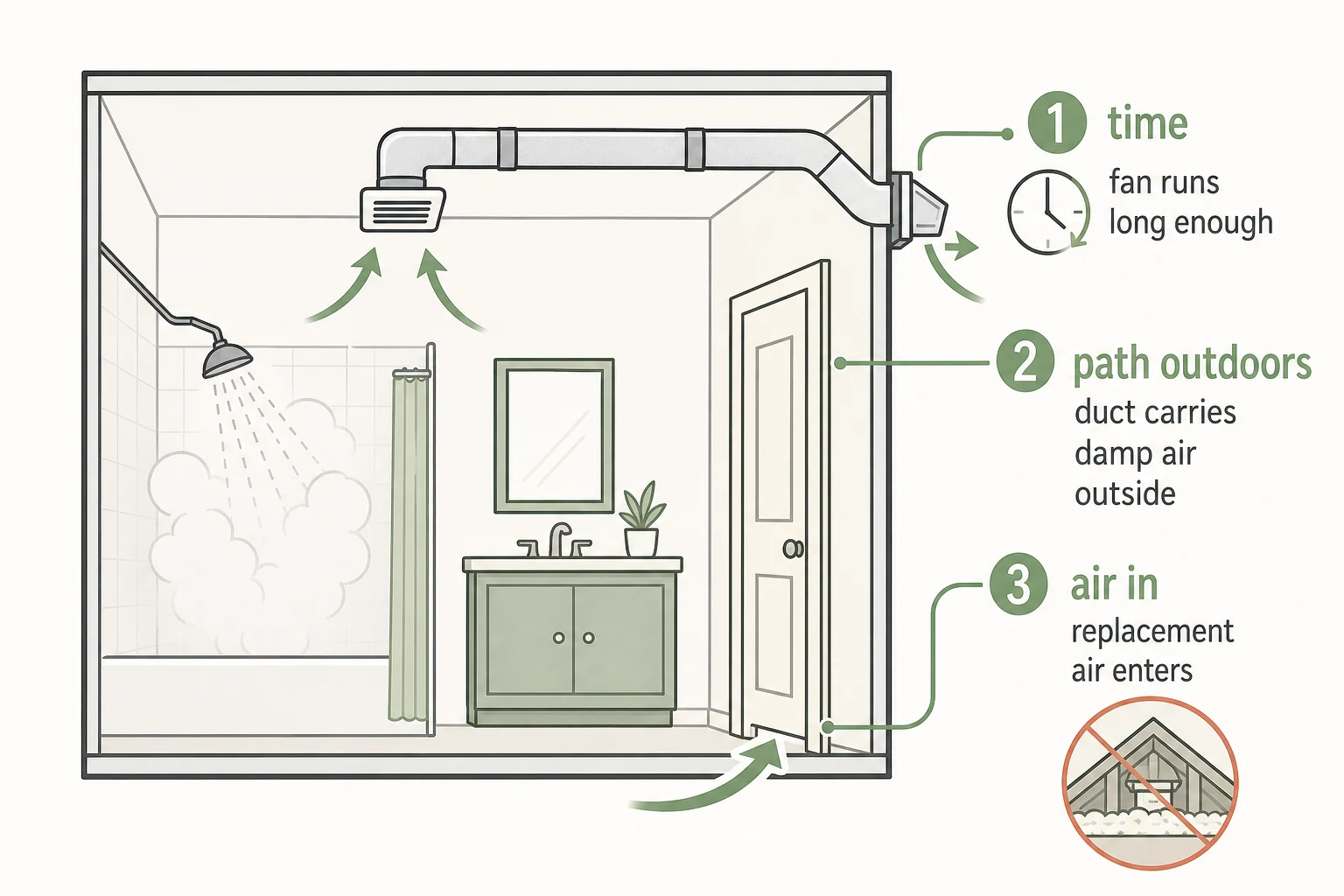
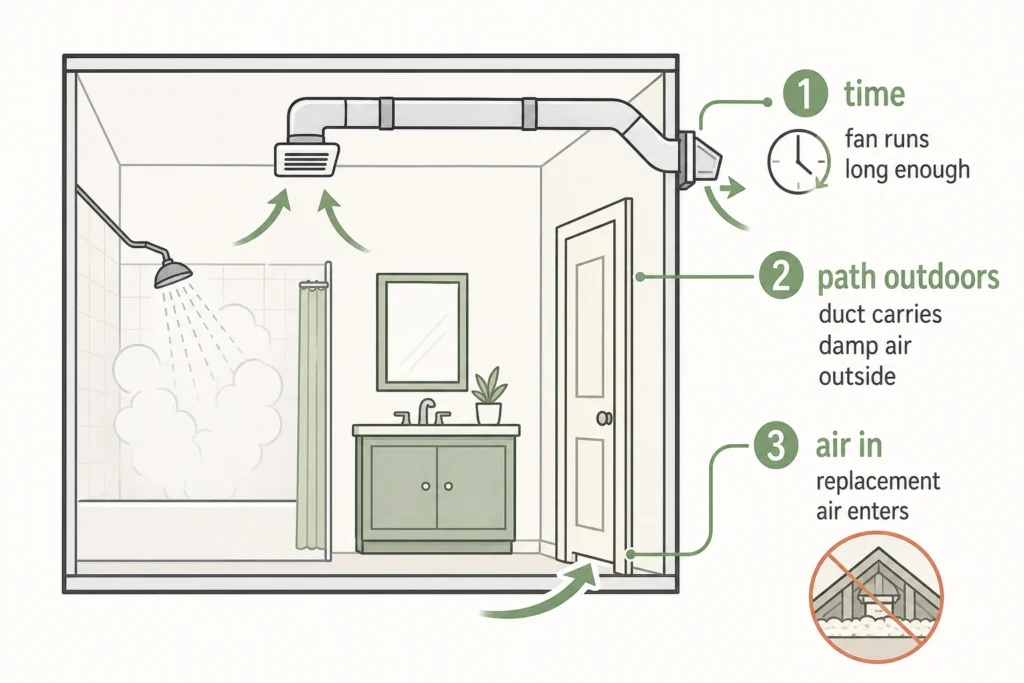
Cleaning removes what lingering moisture leaves behind. It cannot make the room recover from a shower. For that, damp air needs enough time to leave, a duct that carries it outdoors, and a path for replacement air to enter the bathroom.
A running fan is not the same as a drying bathroom
A fan motor can run while moisture removal remains poor. The fan may be left on too briefly, replacement air may be restricted, or the duct and exterior outlet may not be moving air as intended. Noise confirms that something is spinning. It does not tell you where the humid air ends up, which is the part that matters.
Condensation on walls, windows, or pipes is a useful sign that humidity is lingering, but one foggy mirror is not a calibrated fan test. A cold mirror can stay foggy even while the room improves. Look instead for a repeated pattern: Does the room become less clammy, and do wet surfaces begin drying after ordinary use?
Use one normal shower as a recovery check
- Turn the fan on when the shower starts, not after steam has already filled the room.
- After the shower, leave the fan running for about 20 minutes. A timer can help if forgetting is the weak point, but it is a convenience, not a required purchase.
- Spread the shower curtain or leave the shower door positioned so folds and corners do not hold water. Wipe or squeegee obvious puddles so the fan is not asked to remove every drop by evaporation.
- After several comparable showers, note whether fog recedes, the room feels less clammy, and surfaces begin drying. Lingering condensation, dampness, or stale odor despite the same routine is the meaningful pattern.
Twenty minutes is a practical starting point, not a pass-or-fail deadline. Shower length, water temperature, weather, room size, and whole-home humidity all affect recovery. Nor does a tissue fluttering at the grille prove adequate airflow. Household observations can guide your next step, but actual exhaust measurement requires proper equipment.
Let air enter without sending the shower into the hallway
When the fan removes air, other air must replace it. In many bathrooms, that replacement air enters through the ordinary gap below a closed or nearly closed door. Sealing that gap can work against the fan. At the other extreme, propping the door wide open as the main drying plan may simply spread humidity into the home. The hallway should not have to finish the fan's job.
Keep the bathroom's normal designed air path unobstructed, but do not trim doors, alter HVAC openings, or add vents as an experiment. Door clearance and room layout vary, and concealed ventilation problems are not improved by improvising on the building.
Clean the part you can reach, then reassess
Dust around an accessible grille and housing can restrict performance, so one careful cleaning is reasonable. A tidy grille, however, is not an alibi for a blocked, crushed, disconnected, or poorly routed duct hidden above it.
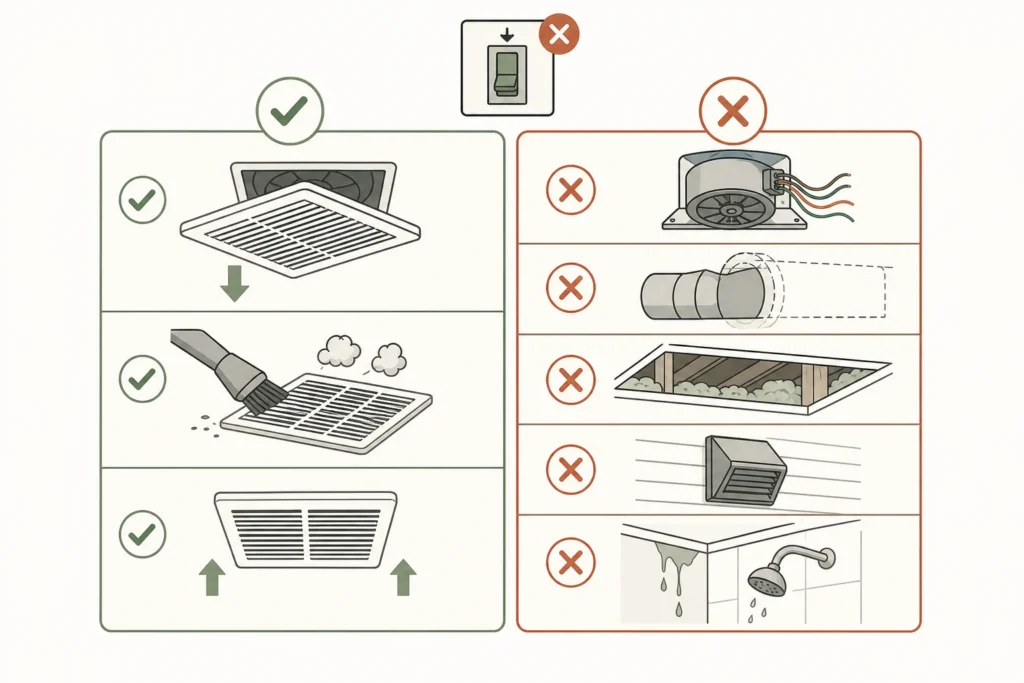
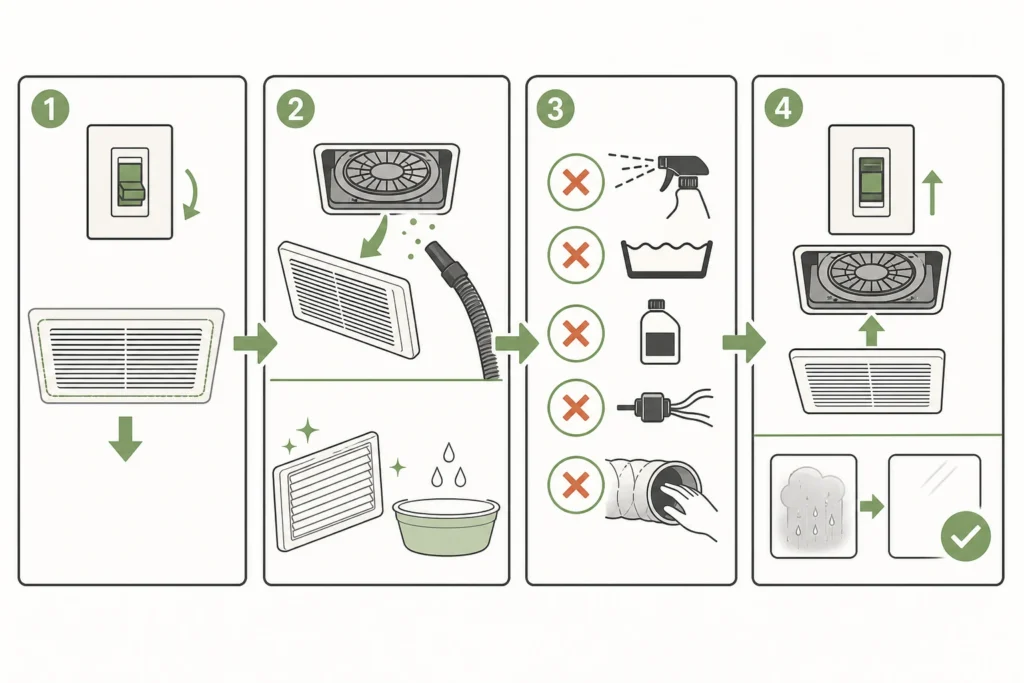
- Find the instructions for your specific fan model and confirm that the grille is meant to be removed by the user.
- Turn off power at the breaker before removing the grille or working at the opening.
- If the manual allows it, remove the grille, wash it, and let it dry fully. Vacuum accessible dust from the opening and fan body without disturbing wiring or concealed parts.
- Do not spray or soak the motor, apply harsh solvents, disconnect wiring, or reach into hidden ductwork.
- Reassemble the fan, restore power, and repeat the same shower routine. Judge the result by improved drying behavior, not by whether the fan sounds louder.
What the recovery result changes
The point of the check is not to award the fan a performance score. It is to decide whether a modest routine solved the problem or whether cleaning has reached its limit.
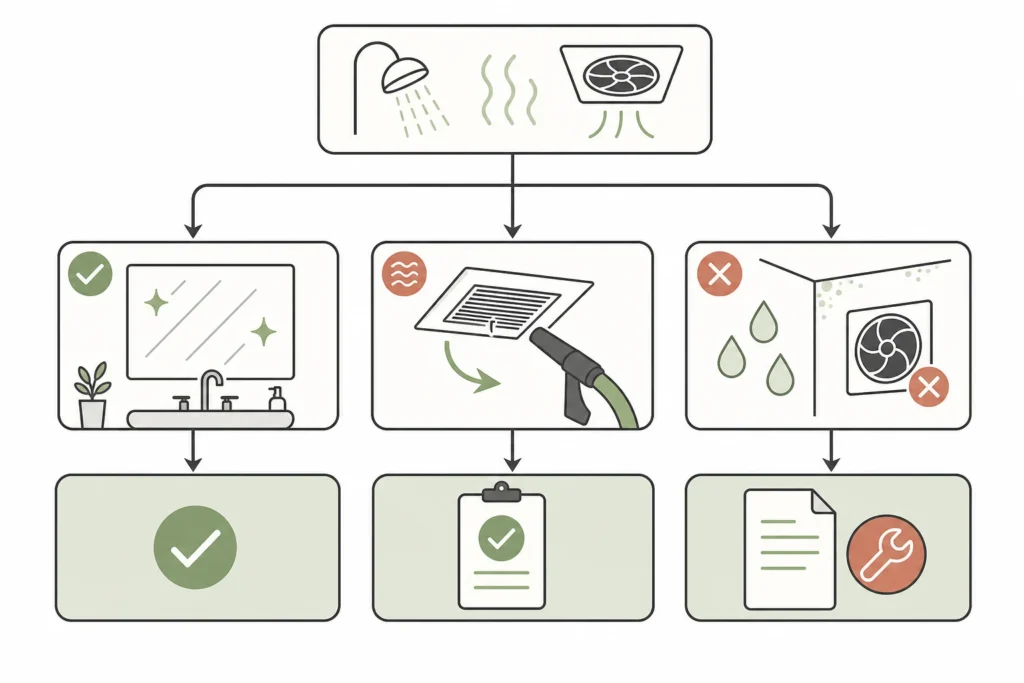
| What you notice after reasonable fan run time | What to do next |
|---|---|
| Fog recedes, clamminess eases, and surfaces begin drying reliably | Keep the routine: fan on from the start, post-shower run time, and pooled water removed. |
| Drying improves after longer run time or accessible grille cleaning | Maintain that change. Consider a timer if remembering to switch the fan off later is the main obstacle. |
| The fan runs, but dampness persists, especially with no known outdoor exhaust route | Request qualified service or submit a landlord report. Do not answer a concealed airflow problem with more cleaner. |
| Water drips from the grille, ceiling staining appears, or materials repeatedly become wet | Arrange prompt repair or report the condition. These signs can point to condensation, duct, exterior-seal, or water-intrusion problems. |
| The fan will not start, develops marked grinding or rattling, or raises an electrical concern | Stop DIY cleaning and have the fan assessed by appropriate maintenance or electrical service. |
When dampness becomes a landlord or repair issue
Renters should take dated photos of recurring condensation, mildew, stains, wet materials, or water at the fan grille. Note that the fan was used during and after showers, then report the condition to the owner or manager in writing. Repair duties and escalation procedures vary by state and locality, but documentation gives the maintenance request something firmer than “the bathroom feels damp.”
Owners should use qualified help for suspected blocked, crushed, disconnected, or improperly terminated ducts; exterior caps; fan replacement; wiring; ceiling stains; and recurring water intrusion. Bathroom exhaust should reach outdoors, not empty into an attic, crawlspace, wall cavity, or other concealed area. Do not enter unsafe roof, attic, or ceiling spaces to confirm a suspicion.
The durable routine is small: start the fan with the shower, give it reasonable time afterward, remove pooled water, and periodically clean the accessible grille. If that fair effort does not improve drying, let the problem change categories. A bathroom that cannot recover from ordinary use is not asking you to scrub harder. It is asking for the moisture path to be fixed.
Sources and references
- U.S. Environmental Protection Agency: A Brief Guide to Mold, Moisture and Your Home
- Home Ventilating Institute: Bathroom Ventilation
- U.S. Department of Energy Building America: Measure Guideline: Selecting Ventilation Systems for Existing Homes
- Panasonic: Panasonic Ventilating Fan Installation and Operating Instructions: Maintenance
- Wisconsin Department of Health Services: Tenant Landlord Issues Involving Mold
- Broan-NuTone: Bath & Exhaust Ventilation Fan FAQs