

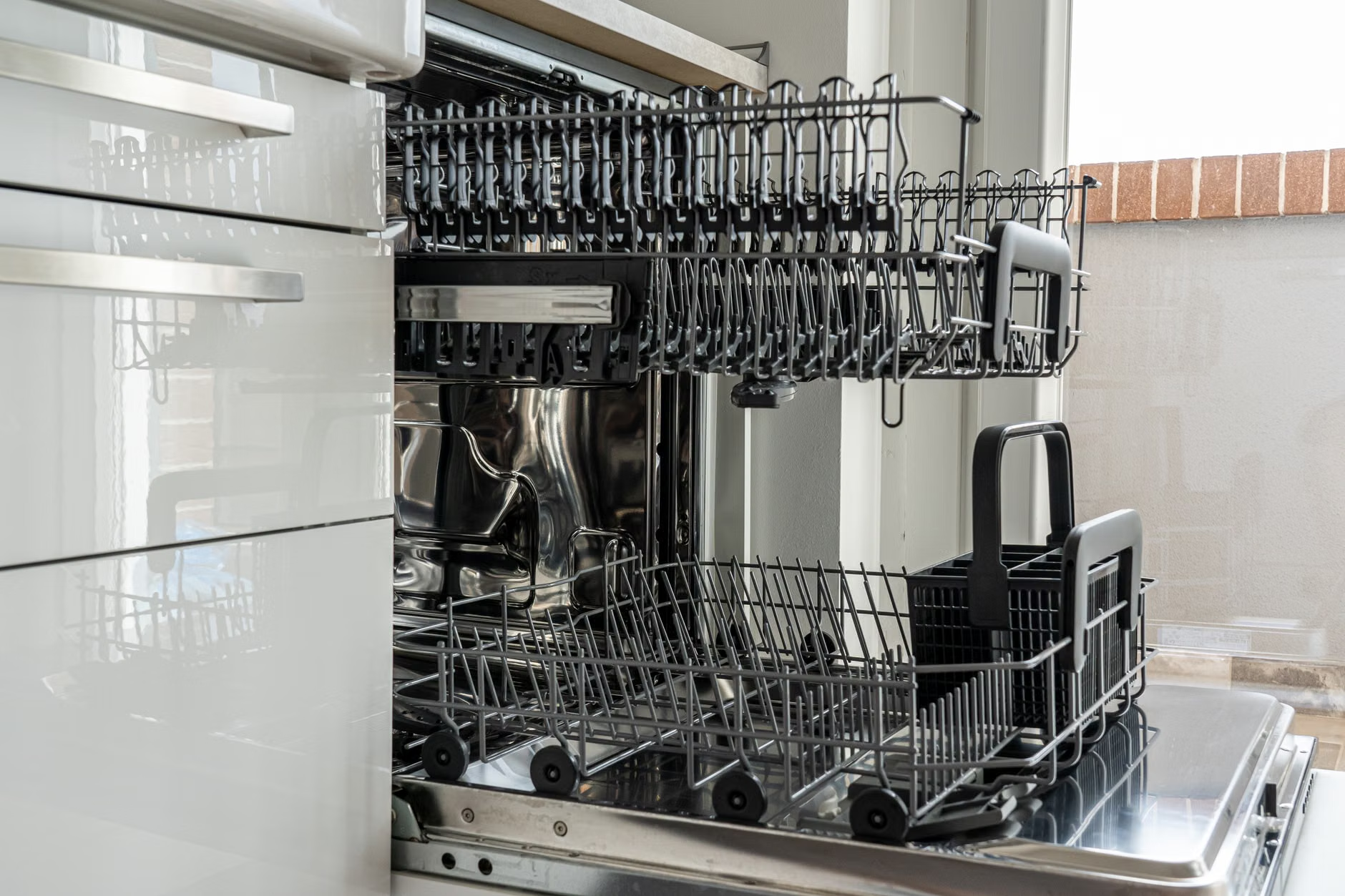
If certain items remain dirty and others come clean, verify spray coverage before trying another detergent. Stacked bowls, touching utensils, or dishes preventing a spray arm from rotating are recorded problems resulting in a partial clean. Compare areas where food is left and resolve one barrier, then run an equivalent load next. This will establish a pattern that will help select something to check; one dirty dish will not identify a malfunctioning part.[2]
Compare shapes, surfaces, and positions
Remember where each affected item is loaded on the rack, and where food is on it, before moving dishes around. If food is at the touching point of two bowls, orientation is likely worth investigating. If bowl insides are dirty while plates are clean, try investigating shape. If certain items consistently come out dirty in the same location, location is likely more important than what the items are. Consider these guidelines clues to your problem, not the end-all diagnosis: Shape, Soil, and Placement can all change in tandem.
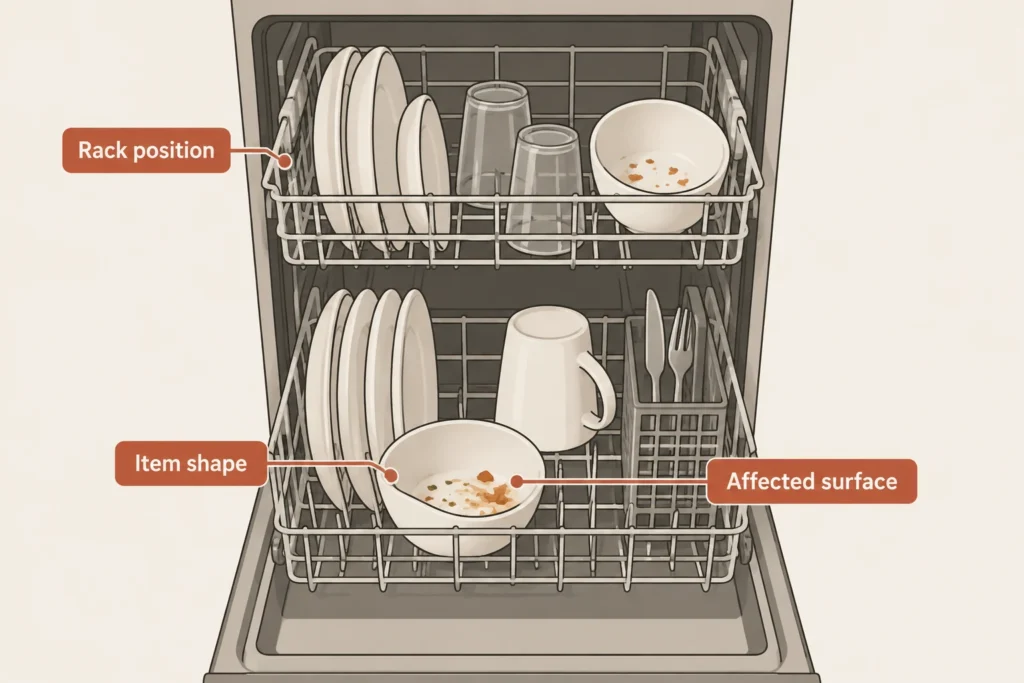
Distinguish haze from pieces of recognizable food or food that is stuck on. If your issue is cloudy glass rather than food removal, follow the cloudy glass guide linked below. Mineral buildup/film and etched glass will take a different form of troubleshooting.
Check exposure and arm clearance separately
Do not nest bowls. Do not allow utensil surfaces to touch. Position bowls and insides of pans facing toward the spray arm. Refer to your model's guide for proper rack positioning. Determine if a large pan or platter is blocking a smaller item from the spray arm. There is not an exact spacing rule: Does another dish cover the dirty surface?[1]
Stop and let the machine cool. If your manual allows, manually rotate the spray arms that you can reach. Look for an edge of a plate, pan handle, or utensil sticking down below the rack. Manually rotating the arm will show clearances only; it will not demonstrate powered operation or how it will clean all of your dishes. Bowls nested together will often stay covered even if the arm spins freely.[2][4]
Confirm rack-only settings before interpreting an entire dirty "rack" as an error. On Whirlpool models that have Top Rack Only, this option does not activate the lower spray arms. Other units with half-load options may behave differently. Also check for any rack water-connection requirement: one Bosch family of models requires the top rack to be pushed all the way back so its spray arm connector engages.[2][4]
Make the next load a useful comparison
Imagine two bowls of cereal come out still dirty while plates rinse spotless, and the bowls were stacked. Doubling the strength of your detergent isn't the first thing that would occur to you as a useful test because it doesn't vary the suspected shielding. On the next normal load, separate two similarly sized, similarly dirty bowls, placing one where your failed attempt was and one where they've been known to come out clean. Hold constant detergent type, cycle and total size of load, assuming the latter two are appropriate.
| Result | What to do next |
|---|---|
| Both bowls come clean | Keep the corrected placement. This supports a loading explanation but does not prove the appliance is fault-free. |
| Only the bowl in the former problem position retains food | Check model-specific rack connections, permitted arm care, and filter care. Record whether other item types also fail there. |
| Bowls retain food in both positions while plates come clean | Reassess bowl orientation and soil difficulty relative to the selected cycle before treating location as the cause. |
And the inconvenient truth is there may be a soil-cycle mismatch. Loading separated items does not guarantee baked-on food debris on a light-soil cycle will be washed well enough. I checked with Bosch tech support, and their manual calls for Express for lightly soiled items, and Heavy for baked-on food or grease buildup. Double-check what soil level your cycle claims to handle, any needed pretreatment steps, and what dishes it is meant to hold. If you used the wrong cycle, fix that error first before faulting the wash system. Don't declare the outcome proves loading alone is at fault.[1]
Limit maintenance, then escalate persistent failure
If there are food leftovers, first determine if your model uses an owner-cleaned filter or maintenance-free filtration prior to disassembling anything. If there is a removable filter, carefully follow instructions on how to release, clean, and lock it back into place. Whirlpool specifically cautions that using an abrasive brush or pad can harm filters and that the dishwasher will not operate unless the filters are properly reinstalled. "Maintenance-free" does not mean you can tear apart the sump.[3]
Check spray holes for food residue. However, only disassemble or wipe down an arm per your specific manual's instructions. Fouled spray holes and filters are POSSIBILITIES. They are NOT a DIAGNOSIS because of streaking. If you do service the unit, note it as another change. Verify another similar load instead of switching detergent and cycle at the same time.[2]
Contact manufacturer's service if varying articles continue to fail in the same location despite corrected loading allowances and allowed maintenance, or food remains after using an appropriate cycle. Note model number, cycle and options used, photos of damaged location(s), whether failure is article or location related, and what changes have been tried. Request model-specific washing performance evaluation. Pattern alone will not determine a pump, heater, or other issue within.