

Freezer burn doesn't put you at risk of food poisoning. If food was properly handled before it was frozen and kept at 0°F or below, the discolored, dry spots are strictly an aesthetic issue and you don't have to throw out the food. You can cut off the discolored areas, if you choose, or get rid of the food if it doesn't look edible.[1][4]
Picture me, in an imagined kitchen, pulling out a year-old package of chicken pieces and snagging its wrapper on the freezer basket. There’s already a pale, leathery patch underneath. I’m annoyed: replacing dinner wasn’t in the grocery budget. If I know the chicken was handled safely and stayed at 0°F or below, I’d consider trimming the patch and rewrapping the package, not automatically throwing it away.[1][4]
What happened to that dry patch?
When moisture from the surface of frozen food evaporates, the surface tissue dries and becomes tough. Exposure to air can also promote free radicals and increase the unpleasant flavors of food. That's why a loose wrapper can make one area of a bag of food dry and discolored. Appearance can be deceiving. Freezer burn can cause discoloration and dryness, but appearance doesn’t always indicate freezer burn.[1][2]
Tearing the wrapper of packaged food during proper freezing doesn't always mean the food is unsafe to consume. It can be rewrapped to prevent further quality loss. However, a contaminated or temperature-abused food can’t be saved by a fresh wrapper.[1]
Time matters for quality, too. The USDA's FoodSafety.gov states that frozen chicken pieces can be safely stored for 9 months, and it doesn’t mean that they are unsafe to consume beyond that. The times listed for the freezer are recommendations for quality for food that is continuously stored at 0°F or below. I wouldn't want an old date to waste otherwise edible food.[4]
The freezer’s history matters more than its contents’ looks
A normal smell or color doesn’t prove food is safe, and tasting a little isn’t a safety test. Freezing doesn’t eliminate most bacteria, either. An appliance thermometer helps you check that your freezer holds 0°F or below now; it can’t tell you what happened while the appliance was off last week.[3][4]
If food thawed during an outage, the dry patch is no longer the question I’d focus on. At an immediate post-outage check, remaining ice crystals or a food temperature of 40°F or below can support refreezing or cooking, with food-specific exceptions. Discard affected perishables that were above 40°F for two hours or more. Frost you find after food has refrozen can’t tell you how warm it got earlier.[5]
Food-specific exceptions, or an outage discovered after everything was frozen again, warrant following the instructions in our guide [What Food to Keep or Toss After a Refrigerator Power Outage](https://cleanhomeroutines.com/food-keep-throw-away-refrigerator-power-outage/).
Keep it, trim it, or pass on the meal
After safe storage and handling practices are put in place, very mild freezer burn does not need to be removed. Tough, mild freezer burn can be removed. The USDA states that tough, mild freezer burn can be removed, either before or after cooking. Removing freezer burn does improve the texture of the food and is a cosmetic improvement and does not make the food safe to eat.[1]
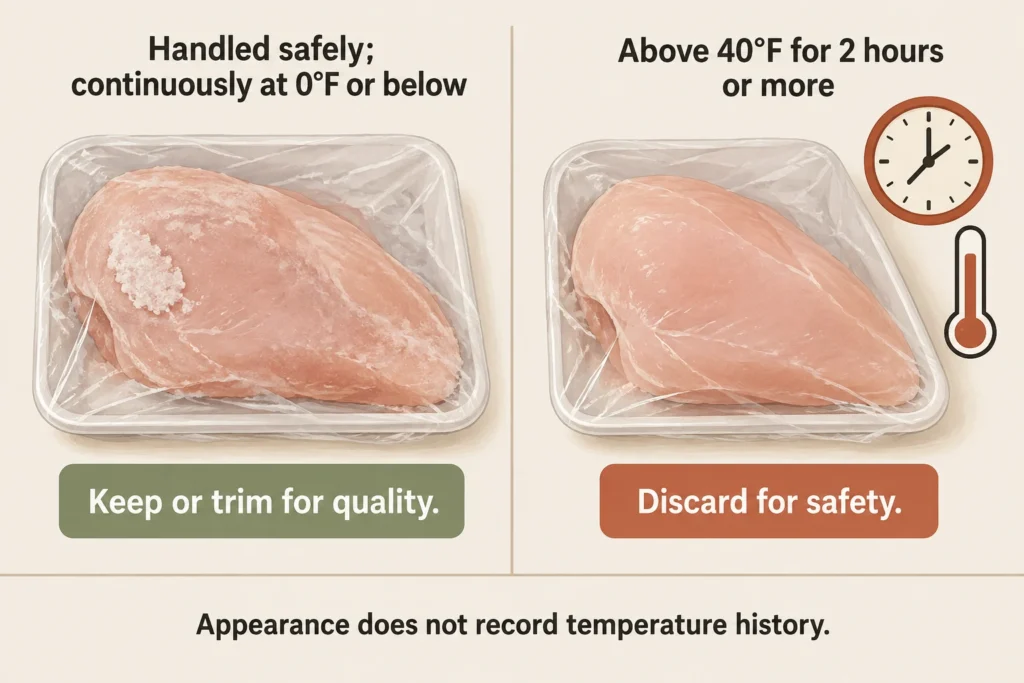
Discarding the food is reasonable, since there is no percentage of the food that can be safely removed. Cooking does not restore the lost texture and flavor of the food. I am for saving the food, but not for wasting extra ingredients in a meal that is already expected to be unenjoyable.[1][2]
Keep food in airtight freezer bags with the excess air squeezed out. You can use freezer wraps to seal food and wraps to prevent freezer burn. Use freezer-appropriate tape to seal freezer bags. Label the bags with the date and use the oldest packages first. Use the same practices on previously handled packages and protect the quality of the next meal.[1][2]
Sources and references
- USDA Food Safety and Inspection Service: Freezing and Food Safety
- University of Minnesota Extension: Preserving food at home: Freezing
- US Food and Drug Administration: Are You Storing Food Safely?
- FoodSafety.gov: Cold Food Storage Chart
- FoodSafety.gov: Food Safety in a Disaster or Emergency
- Clean Home Routines: What Food Should I Keep or Throw Away After a Refrigerator Power Outage?