

You can clean an intact kitchen sponge and keep it for ordinary dishwashing if food residue comes out readily. Replace it if it holds onto food, smells, or falls apart. If it directly collected raw meat, poultry, or seafood juices, I’d replace it before using it on dishes again. That last choice is a conservative recommendation, not a universal USDA disposal rule.[1][3][8]
What I don’t trust is the promise that one more sanitizing ritual settles everything. Cleaning removes soil, and a compatible treatment can reduce microbes. Neither tells you the sponge is suitable for wiping a clean cutting board. Its next job matters too.[1][3][8]
A rinse, a treatment, and drying do different jobs
A sponge’s pores are useful because they hold water and help you work over a dish. They also retain food and moisture inside the tool. Rinsing the outside until it looks tidy doesn’t tell you that the interior is free of residue or microorganisms.[4][8]
| Action | What it accomplishes | What it doesn’t tell you |
|---|---|---|
| Remove food with detergent and rinsing | Carries away retained food and other soil | Whether the sponge has a low microbial load |
| Use a compatible microbial-reduction treatment | Can reduce microorganisms under the treatment’s conditions | Whether every part was adequately treated or later use will spread contamination |
| Squeeze out water and store where it can dry | Reduces retained moisture | Whether pathogens have been eliminated |
| Replace the sponge | Removes the used tool from service | Whether a new sponge will stay uncontaminated after use |
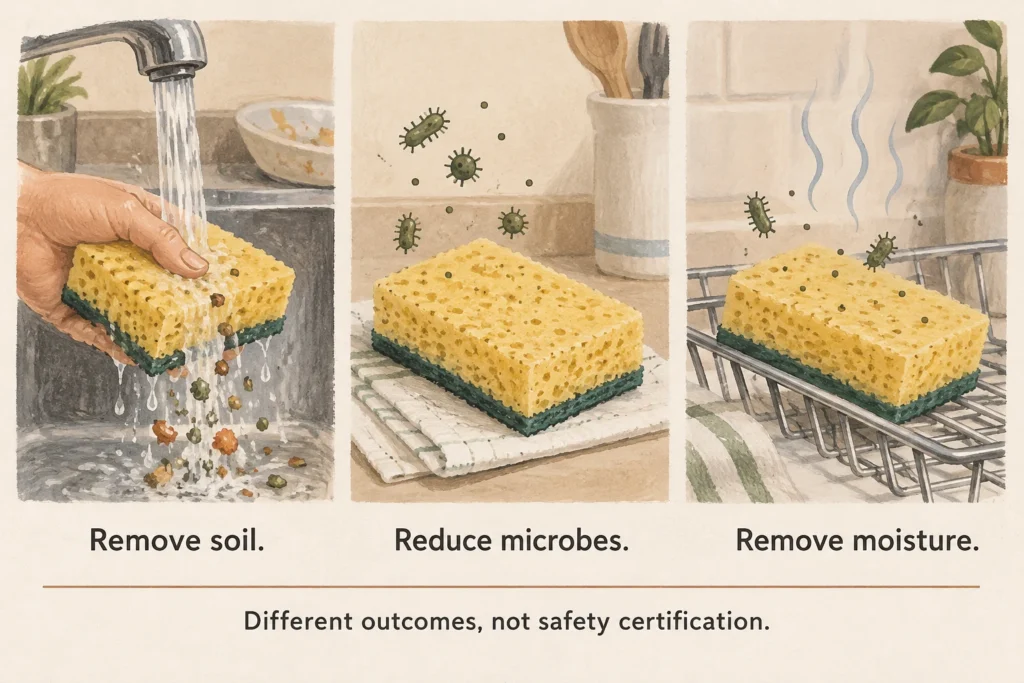
You can clean food residue from a sponge with soap and water. You can then leave it in a dry place so it can dry and maintain the integrity of the sponges’ pores. If food remains embedded after numerous cleanings, I would consider replacing the sponge.[8]
Drying should get the same attention. Pathogens can survive drying and transfer to contacted surfaces, according to an experimental sponge study. We don’t know the health risk pathogens in your kitchen, but that study suggests “dry now” doesn’t mean “decontaminated.”[4]
Why treatment results don’t settle the whole question
In a controlled study, microwave treatment and a complete dishwasher wash-and-dry cycle reduced microorganisms more than the chemical treatments tested. That’s a useful result, but it wasn’t a trial of household illness, every dishwasher program, or every sponge material. USDA’s caution fits alongside it: microwave or boiling treatments can reduce bacterial load without guaranteeing prevention of cross-contamination. Fewer microbes after treatment doesn’t mean the sponge won’t transfer contamination later.[1][3]
If your exact sponge permits dishwasher treatment, remove embedded food first and use a permitted complete wash-and-dry cycle, not a quick rinse program. I’d favor that over adding a separate microwave ritual. The distinction still matters: top-rack permission tells you about material compatibility, not independently proven microbial reduction.[3][6][8]
Never microwave an unknown sponge or a sponge containing metal. A dry sponge is extremely flammable. Treat product according to manufacturer’s recommendation and let it cool before handling. I can’t give you a safe and responsible microwave ritual for an unknown sponge.[6][7]
I would also not include improvised chemical soaks. The study tested different concentrations and exposure times. It was not a general bowl of bleach or vinegar. The uncertainty of diluting a chemical and using it to soak a sponge is greater without the chemical label and the sponge care label.[3][6]
Let contact history change your choice
Picture me, in an imagined kitchen, reaching for the dish sponge as a chicken package drips beside the sink. I already ran behind getting dinner and now what? Is it okay to put the sponge in the dishes after? I put it down, use paper towels to soak up the juice and throw away the sponge. One disposable cleanup is less work than trying to clean a sponge.
The Academy of Nutrition and Dietetics says to not use sponges to clean meat juice spills and to not use sponges for general counter top cleanup. The FDA also suggests paper towels to clean kitchen surfaces to avoid transfer. Discard the towels, clean the surface with detergent, then use a sanitizer for that surface and contact time, and then rinse.[2][8]
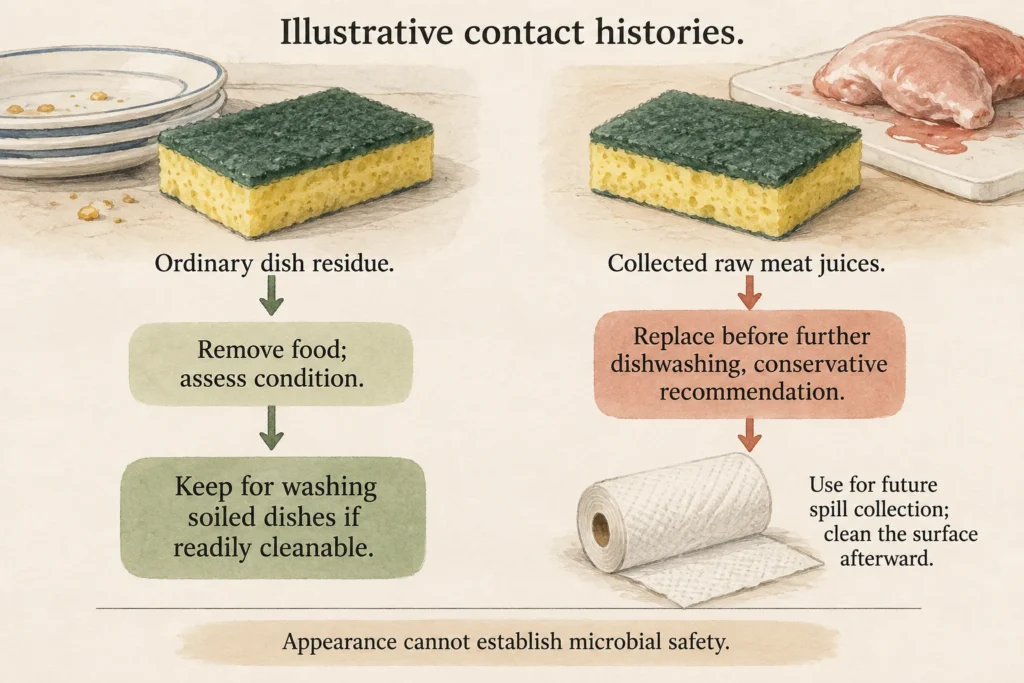
In the case raw juices from animal foods got on the sponge, I recommend throwing out the sponge before further dish washing. The uncertainty in treatment and possible transfer makes that a better option. Don’t use that sponge to clean counters and other prep areas. That gives the sponge another opportunity to spread contamination.[1][4][8]
When keeping it stops being worthwhile
A bad smell is a good reason to get rid of a sponge and not look for a stronger treatment. The same is true of other signs of wear, like food get stuck in the sponge and can’t be rinsed out, crumbling foam, tearing, and shedding. Seeing layers separate is a good reason to stop using a worn tool, but the reverse isn’t always true. Some research found that odor and discoloration of sponges don’t always mean there is a high microbial load, so an odorless sponge doesn’t mean it’s safe to use.[4][6][8]
USDA said that the best practice is to replace sponges frequently, but they didn’t say how many days or weeks that meant. Contact and case give you reasons to replace your sponges sooner, not keep a sponge because it looks good.[1]
If continual care of your sponges means you have to replace them often, you should try using a dish brush instead. A study showed that after drying overnight, brushes had less Salmonella than sponges. You should consider using a brush instead of a sponge, but it doesn’t mean using a brush will protect you from food poisoning. A sponge is best suited to washing dish, not providing a final wipe to a clean surface.[5][8]
Sources and references
- USDA Food Safety and Inspection Service: How do I clean my kitchen sponge? (2025-03-06)
- US Food and Drug Administration: Cleaning (Food Safety for Moms-to-Be)
- USDA Agricultural Research Service; Food Control: Effective household disinfection methods of kitchen sponges (2009)
- Journal of Food Protection: Kitchen Sponges as Reservoirs of Foodborne Pathogens: Microbial Growth Dynamics, Surface Cross-Contamination, and Hygiene Implications (2026-06)
- Journal of Applied Microbiology; Nofima and Universidade Católica Portuguesa: Bacterial levels and diversity in kitchen sponges and dishwashing brushes used by consumers (2022-06-07)
- Scrub Daddy: Scrub Daddy FAQs
- North Carolina Cooperative Extension: Risky or Not: Microwaving Your Sponge (2025-10-01)
- Academy of Nutrition and Dietetics: Kitchen Sponge Safety