

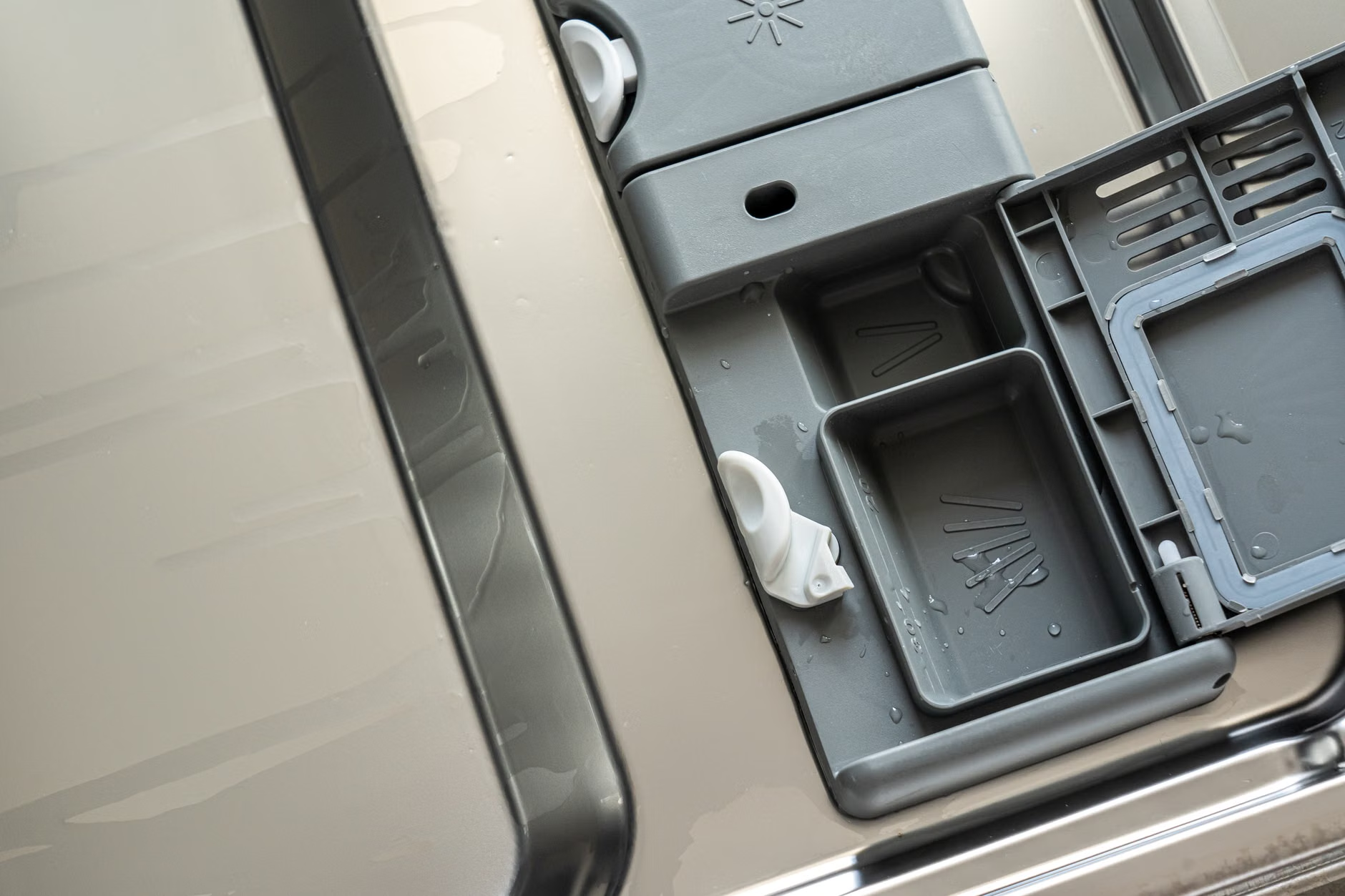
Detergent left in the washer drawer doesn’t mean the water inlet failed. First, check the completion of the cycle to see if that compartment was supposed to dispense during that cycle. Then look at the product, dose, and insert position and/or check owner-cleanable build-up. I’d do the corrections, give it one completed load, and not switch to another week of scrubbing and a load of water before contacting support about persistent dispensing issues.[1][2][3][4]
The compartment and timing come first
Find your model number and your manual’s dispenser diagram, and match the affected compartment to its dispensing stage. See if your manual gives examples like LG’s WM4000H*A manual, where Pre-wash setting dispenses pre-wash detergent, first wash setting dispenses main wash detergent, and the final rinse cycle dispenses softener. These examples are named models, and are examples of dispenser layout and drawers.[1]
Picture me, in a hypothetical situation, finding softener in the drawer, and reaching again for the cleaning brush. I’m annoyed, because I have a damp towel waiting to be washed again. However, I remember I’ve already canceled the cycle to do the final rinse, and leave the brush where it is. I’ve never seen that compartment fail at its scheduled job.
| What remains | How to read it |
|---|---|
| Product in a manual single-load compartment | If its option wasn’t selected or the cycle stopped before its dispensing stage, the leftover dose doesn’t establish a fault. |
| Product in an automatic multi-load reservoir | It holds several loads’ worth. Check whether dosing was enabled and available for that cycle, rather than expecting an empty reservoir. |
| A little water or minor residue | Don’t treat this as a whole retained dose. If dispensing and filling otherwise seem normal, residual water alone doesn’t justify a valve diagnosis. |
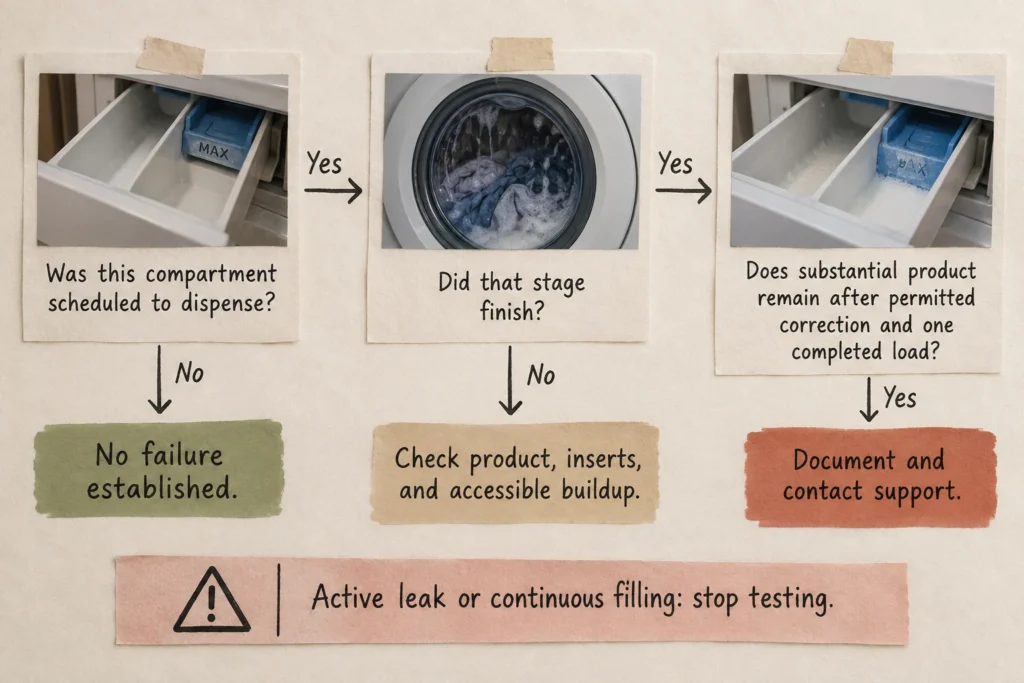
Check what went in before cleaning what’s left
Before suspecting the water supply, look at your product and the insert it comes with. Drawers use a gate to let liquid detergent out and hold powdered detergent in. Powdered detergent left in the cup can disperse when liquid detergent is added. Your model may use a different gate. Also, some products don’t belong in a drawer. Tide Pods, for example, should be placed in the drum with the clothing.[7][8]
The MAX line is a ceiling, not a recommendation. Use washer-compatible detergent, HE if required, and measure as directed on the product label and washer instruction, taking into account the product concentration. Overfilling can release product too early and thickeners can interfere with product dispersal. Don’t create a dilution ratio to solve this. Use the concentration setting of the dispenser to match your product if automatic dosing is used.[2][4][7]
Bearing in mind the safety instructions to unplug the washer and remove only the part the manual identifies as owner removable, build up on covers, drawers and dispensers is okay to clean. Use a soft bristle brush and warm water. Don’t clean the interior of the dispenser or other parts of the washer that are not identified as owner removable in the manual. Clean only what is recommended and pictured in the manual. Pay attention when putting the inserts back as a misaligned soft cover can obstruct the emptying of the dispenser just as build up can.[1][3][9]
Give the correction one useful chance
Close and reassemble the drawer, and then give it an ordinary load on a cycle that utilizes the affected compartment. Let the cycle finish, and then check, NOT with the drawer open while filling. A rinse-only flush will not tell you if main-wash detergent dispenses. With a manual single-load compartment, a major residual dose has been removed, and operation should return to normal. I would stop there, even if a small amount of water is left. An automatic reservoir is different and should still have the product, so use your model’s dispensing direction, not emptiness, to evaluate the result.[1][2][3][4]
If after completing a cycle a major single-load dose remains, or if you’re unable to resolve an automatic-dosing issue after adjusting settings and performing allowed maintenance, contact support. My one-load stopping point is to avoid multiple repeated failures when washing clothes, not to provide a diagnosis. Samsung’s general drawer guidance utilizes a longer troubleshooting sequence.
If the washer doesn’t fill up or fills up only to report a filling error, go to the next load. Check if any of the supply taps that are accessible are open and if any hoses are kinked. Contact support if that’s not the problem. For the Samsung 4C and nF families, if they do not fill up correctly, it means that the valve did not fill up, not that the valve failed.[2][3][4][5][6]
Tell support which compartment is effected, your model number, cycle and options, if it completed, the exact error code, if applicable, the product and dose. Include photos of before and after, if you changed anything or reseated anything. That is more helpful than assuming it’s a bad valve. I can not determine an internal valve, routing, control or drawer problem based on residue and you don't need to name the part that failed to ask for help.[2][3][4][6]
Sources and references
- LG Electronics; manufacturer-authored manual mirrored by Manualzz: LG WM4000H*A owner's manual, MFL71964303, Rev.04_052025
- Samsung: Dispenser drawer issues in Samsung washing machine
- LG Electronics: LG Washer, Water Left in Dispenser (2026-05-28)
- Samsung: Use the auto dispenser on your Samsung washing machine
- Samsung: Water fill issues with Samsung washing machines
- Samsung: Samsung washing machine information and error codes
- LG Electronics: LG Washer, Detergent and Additive Usage (2025-12-15)
- Procter & Gamble: Tide PODS Original product instructions
- LG Electronics: LG owner's manual MFL67584598