


Do not finish cleaning a room if your vacuum develops a burning smell. Don’t run the vacuum again to find the source of the odor. If you notice smoke or fire, or if there is active electrical sparking, do not touch the vacuum. Leave the area and get everyone outside. Then, call 911. Do not touch the vacuum to turn it off or unplug it.[1][2]
If there is no emergency situation, turn the vacuum off and disconnect it from the power source if you can do so without touching the vacuum. For a cordless vacuum, if the battery is hot or swollen or if there is a liquid leak or other distress, do not touch it. I would rather leave the floor with some dirt or crumbs than to have you touch a plugged-in appliance that could overheat.[1][2][6]
The smell’s name won’t settle the cause
I get the impression that your vacuum smells “burning rubber,” has “hot dust,” or has “melting plastic.” Or perhaps the smell is “acrid,” or there is an electrical odor. I don’t have a final diagnosis for your issue based on your description. Contact the manufacturer for instructions based on your symptoms. I would not allow you to continue using the vacuum based on your description.[1][3][6]
Picture me in the middle of cleaning up a mess with crumbs still under the table, and a strand of hair wrapped around the vacuum brush. The hair is still in my way, and it has irritated me to the point where I want to just give it a quick snip. But just because something is removable doesn’t mean it is the actual cause. I prefer to leave the vacuum disconnected than to give a quick snip and assume that means it is okay to finish the job.
Keep the timings you noted: at startup, when the powered brush engaged, after a blockage or automatic shutdown, or while it was charging. Observed timings with the brush can be used to validate model-specific checks in the foot area; a blockage can reduce airflow and cause a protective shutdown. Neither can answers the question “What caused the burning smell?” Do not repeat the event with a different attachment, outlet, or brush setting.[3][4][5]
What you can check while it stays off
Once the vacuum has been unplugged and cooled, check to see if there is any distress on the batteries. If not, look for the model number and check which cleaner head is installed. Before you remove anything, you need to know how that model prevents accidental startup. There may be a page which explains how to clear the hose. Checking that page may tell you if a vacuum which gives off a burning odor can be used again.[3][4][5]
Depending on the model, you may be able to empty the bin, replace the bag, inspect accessible air passages, and remove brush debris. Only washable filters should be washed and let dry completely before being reinstalled. The motor housings, wiring, switches, chargers, and battery packs are a few examples of things outside owner-performed checks.[4][5][6]
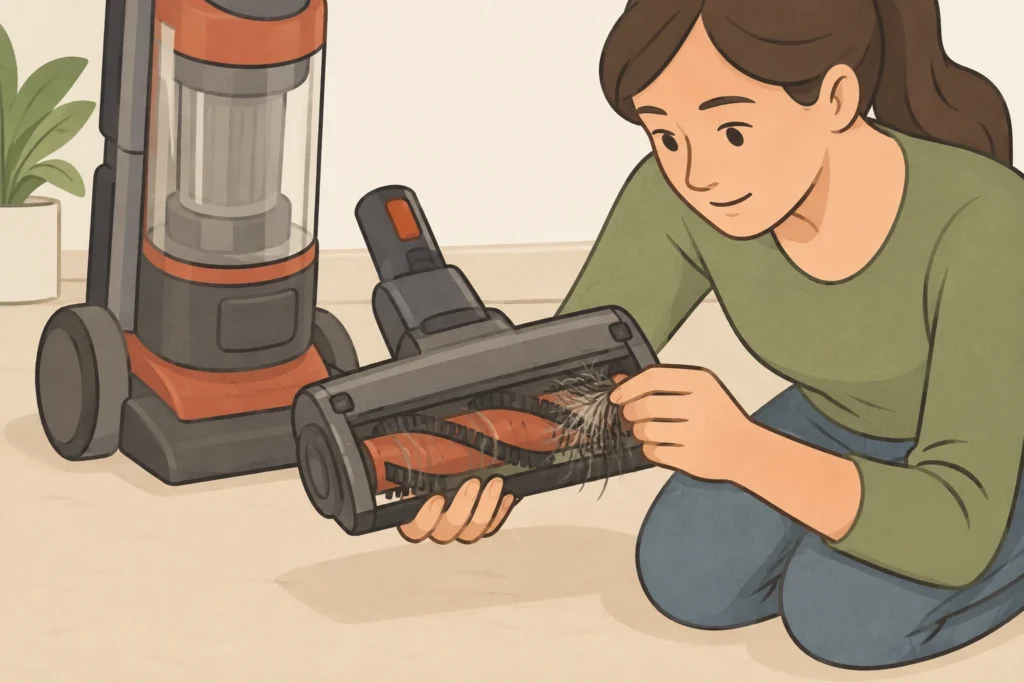
BISSELL provides a good example of the importance of details. The CleanView/PowerClean Rewind Pet models 2486, 2487, 2488, 2489, 2490, 2491, 2492, 2494, and 2495, route complaints of burning rubber to a procedure of unplugging, removing a six-screw access plate, inspecting for damage, and checking if the brush, which is secured by two phillips screws, spins freely. If it doesn’t, the brush is replaced. It is that detail I’d want before I’d be able to explain a couple of tangled hairs and assume the rest. That procedure, however, is only applicable to those models, and not to all vacuums with a brush.[3][4]
Cooling down isn’t permission to restart
A thermal cutout tells you protection operated, not that the underlying problem went away. The Dyson V7 manual supplied for this article explains cooling and blockage removal and reassembly. The instructions do not explain what to do about a vacuum that emits a burning smell. It should not be reset.[5]
Nor would I assume “it’s new” explains it all. A new motor break-in odor is distinguished from burning and electrical odors by RIDGID, and is routed to shutdown and service. That exception, however, does not explain what to do about an unknown vacuum.[6]
What would justify using it again?
I’d use it again after performing an owner correction and after completing all return to use conditions described in the guidance applicable to your model and the symptom, or after a manufacturer/service assessment confirms it can be returned to use. If the cause is unknown, do not use it. There are several conditions that indicate further use is not permissible. These include: visible scorching, melted parts, damaged wiring, battery warning signs, and a recurring burning smell. A damaged plug or outlet also requires the services of an electrician. Moving to another outlet does not resolve the damage.[1][2][4][6]
Check the CPSC and manufacturer recalls for your model and serial number, and provide the battery identifiers or date codes, if requested. The marketing name may not identify an affected unit. Provide the information only when safe to do so. Provide the information you previously observed to service. “What can I do to correct this before I can use/charge this again?” should be your question. This is likely to provide more useful information than “I cleared some hair.”[1][6][7]
Sources and references
- Oregon State Fire Marshal: Rechargeable Battery Safety
- Massachusetts Department of Fire Services: Electrical Fire Safety
- BISSELL: My CleanView/PowerClean Rewind Pet Vacuum Cleaner has an Unusual Smell/Bad Odor
- BISSELL: My CleanView/PowerClean Rewind Pet Vacuum Cleaner Brush is not Turning
- Dyson: Dyson V7 Operating Manual, SV11 configuration
- RIDGID: Wet/Dry Vac Troubleshooting
- US Consumer Product Safety Commission: Vacuum Cleaners recall category and Rowenta recall details