

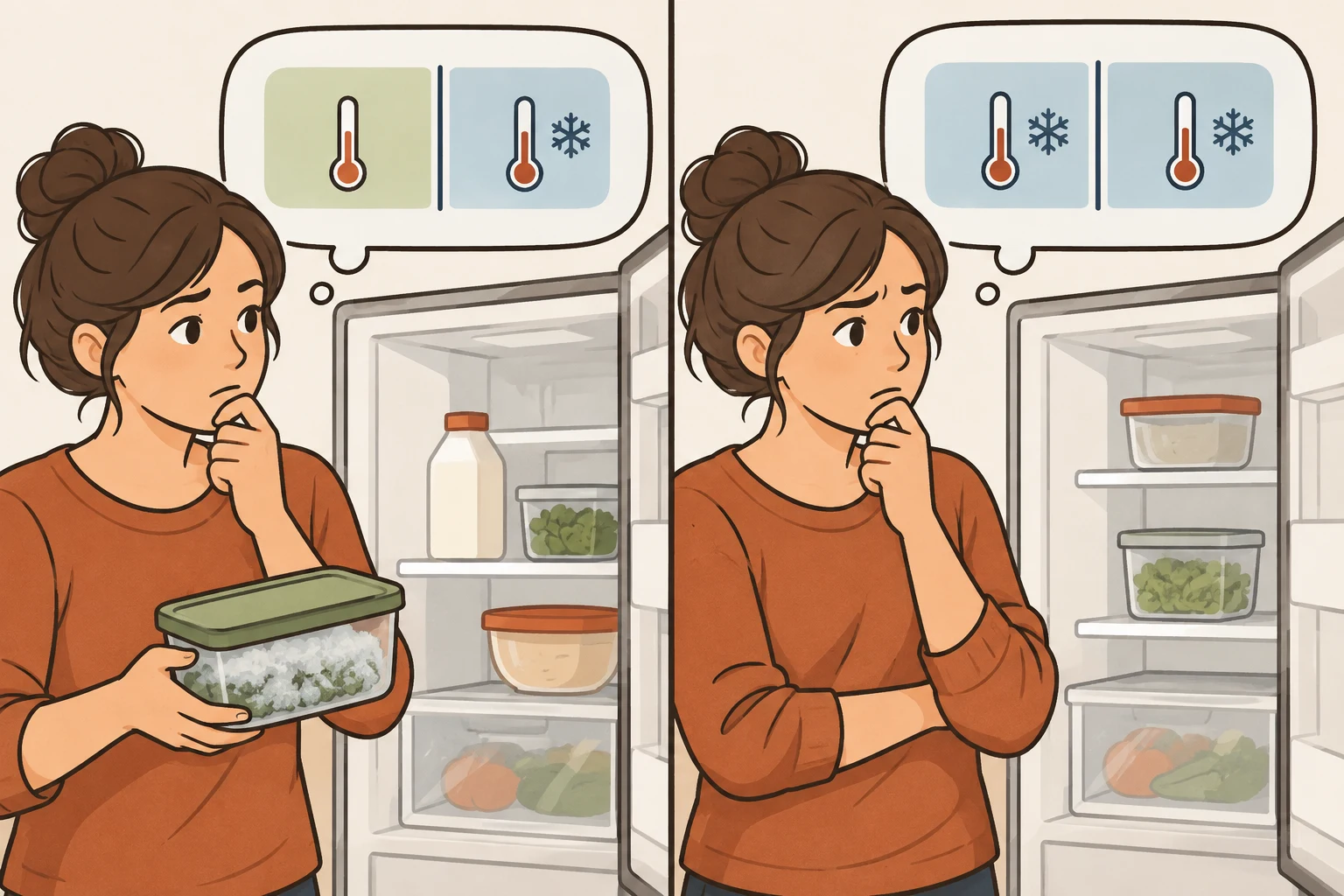
It’s not the temperature experienced by each and every item in your refrigerator. Foods at the back, exposed to the incoming cold air, may freeze while the middle remains properly chilled; repeat occurrences of low temperatures in ordinary storage areas suggest broader overcooling. I’d compare those areas before adjusting the entire refrigerator to a warmer setting. Refrigerated perishable foods should be stored at 40°F or below.[1][2][5]
Imagine I’m packing lunch and find another bag of spinach stiff at the back of the shelf. Now lunch needs rethinking, and I’m annoyed enough to turn the temperature up. Instead, I leave the control alone and note where the bag sat. I’d rather find out whether that spot is too cold than change the conditions for every grocery on the shelf.
The number on the control isn’t the whole story
Many models, unless indicated otherwise, will either show the current temperature, or a target, and will switch between the two. A numbered dial may not be marked in degrees. Take note of what your particular model’s display is indicating. Also note which direction makes the controls warmer; don’t make the assumption that higher settings are warmer.[8]
Compare places, not just settings
Take note of which foods froze and where they were, and compare that to the center of the main compartment using independent thermometers and the same method. Described in the Samsung manual is a center compartment water measurement that takes up to eight hours to stabilize. Only immers digital equipment designed to be waterproof.[1][5]
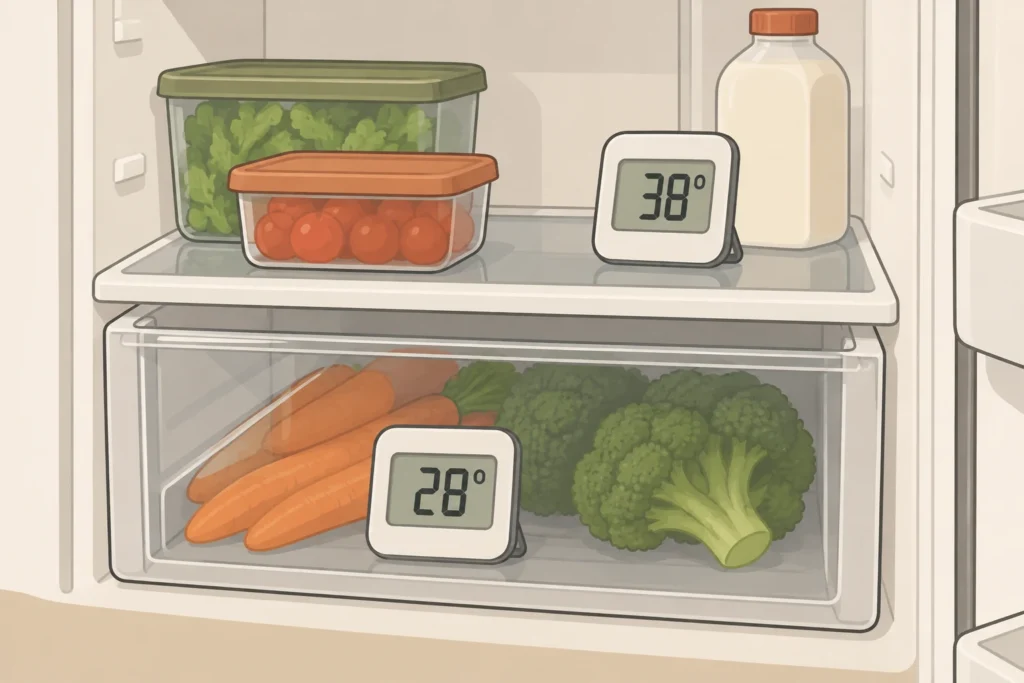
Comparing two readings at the same time gives a better idea of what is going on. The first thermometer stays in a location where both readings would experience similar loading and door usage. It is not a perfect reconstruction, but it is a reasonable comparison. Water-buffered readings smooth out quick fluctuations in air temperature and can miss earlier or intermittent freezing.[2][5]
If one location is very cold, it usually means there is a problem with placement or airflow. Repeated readings near or at freezing in an ordinary storage location makes placement less of a concern, but it doesn't completely eliminate it. I also wouldn't blame a failed part from either of these cases. Foods can freeze at different temperatures, so a frozen cucumber doesn't tell us much and shouldn't be used as a reference.[2][5]
Give the cold air somewhere to go
When there is a cold spot locally, I would move at risk food away from the cold air first. Use the diagram for your model and locate return openings and air supply vents and sensors. Move packages that are blocking these and give clearance to these openings. If a vent is blocked, this changes the airflow and is the exact opposite of what you’re trying to do.[1][2][3]
There’s not a definitive ‘coldest shelf’ or clearance distance. GE’s ‘six inch clearance’ applies to a design of a particular older, ceiling-mounted sensor. So unless your refrigerator is of that particular design, six inches is not your clearance.[2][3]
If confined to a single drawer, check its temperature mode separately. In covered Samsung BESPOKE Flex Crispers, Meat/Fish mode puts it at 30°F; Fridge mode is a different setting. A humidity slider is not the same as a temperature control. Moving the produce to a different, more controlled, setting may solve the issue.[7][8]
When to recheck, and when to stop adjusting
After rearranging the food, take resettled measurements at the affected location and in the center using the same conditions. Leave the main setting alone if the issue appears to be localized. If the readings instead support broader overcooling, try one modest warmer adjustment in your model’s specified direction, while checking that perishable-storage areas stay at 40°F or below.[1][2][5]
Give the refrigerator its specified stable time to see the effect of the change. GE states approximately 24 hours; the stated Samsung time is 28 hours. Use the time applicable to your model. That time is different from letting a thermometer settle, and is not allowing perishable food to remain at temperatures above 40°F.[1][5][6]
You want no new freezing and measured storage temperatures above freezing but no higher than 40°F. Continued freezing after the placement of the applicable drawers and controls and the stabilization period for any control change requires model-specific service as opposed to continually adjusting the setting. Provide the model number, location of affected areas, date and times of readings and settings, and changes made to service. I’d want those observations to be the basis for the next repair decision, rather than a best guess at a part name based on spoiled groceries.[1][3][4][5][6]
Sources and references
- US Food and Drug Administration: Refrigerator Thermometers, Cold Facts about Food Safety
- Whirlpool: Preventing Food from Freezing in the Refrigerator
- GE Appliances: Bottom Freezer Refrigerator, Too Cold, Freezing Food
- GE Appliances: Side-by-Side Refrigerator, Too Cold, Freezing Food
- Samsung Electronics America: What temperature should I set my Samsung refrigerator to?
- GE Appliances: Refrigerator, Temperature Stabilization Period
- Samsung Electronics America: Change the settings for the BESPOKE Flex Crisper drawers
- GE Appliances: GE Side-by-Side Refrigerators Owner's Manual, publication 49-60412 (2005-11)