

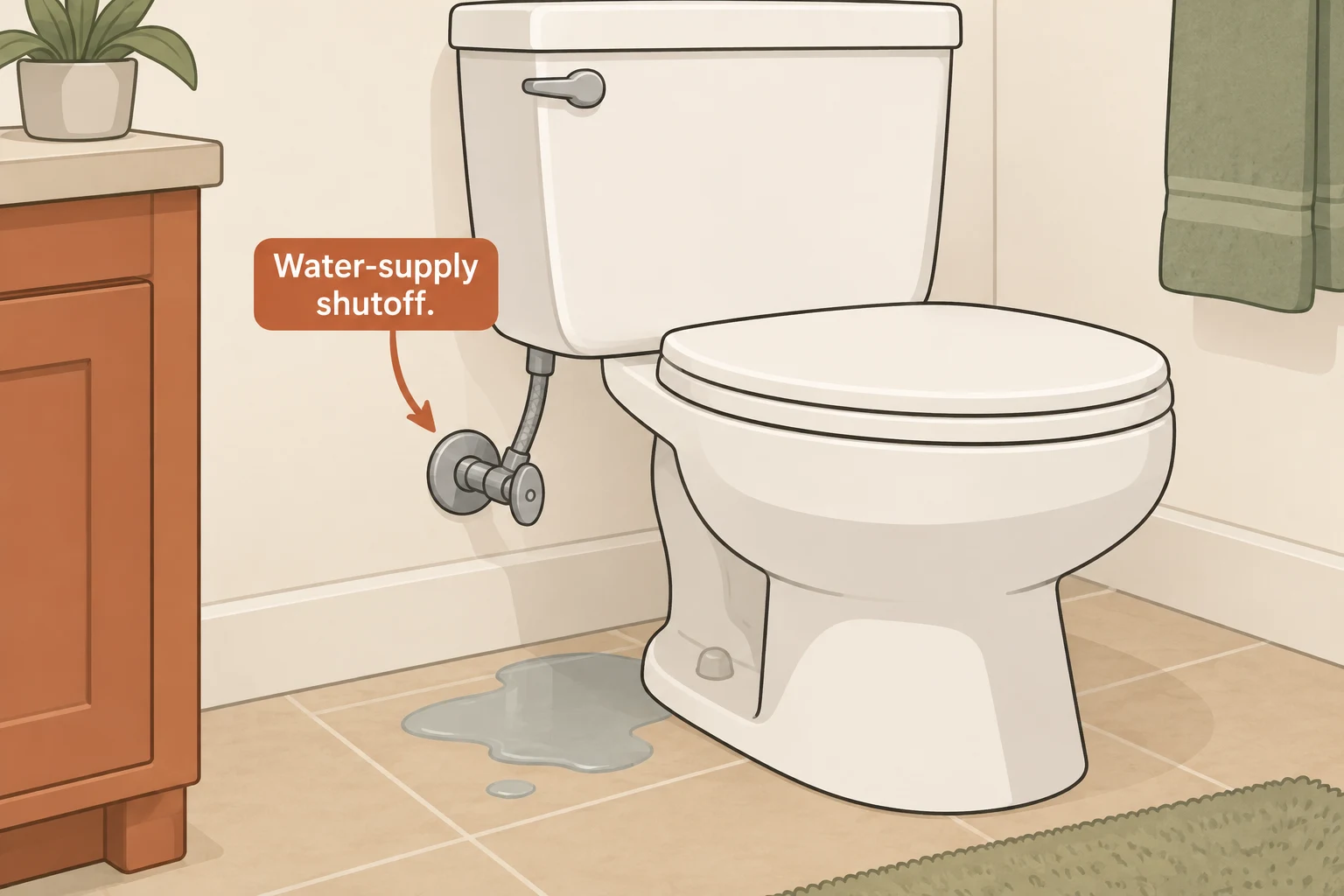
Don’t flush. If you can reach the toilet’s water supply valve without electrical exposure, close it. Until you determine the source of contamination and how far the water spread, keep people and pets away. Even if water is clear, it may have crossed the toilet rim and be contaminated.[1][4]
Stop the incoming water, then contain the spill
- The water supply valve is typically behind or to the side of the toilet. To turn off the water, close the valve. This may take several turns or it may close in a quarter turn. If it resists being closed, don’t use tools and don’t adjust or loosen fittings. Another option may be a home or unit shutoff, but don’t try an unfamiliar valve that serves a building with multiple units.
- Observe whether the toilet supply is shut off and whether the water level in the bowl stops rising. If the bowl continues to rise, or water returns, stop using all water fixtures and contact emergency maintenance or a plumber. A test flush will not help.
- For small safely reachable puddles, wear waterproof gloves and boots with eye protection for splashes. Use absorbent pads to trap the water. Put wet items in a leak proof bag or box before carrying them to other locations to avoid trailing water through the house. Wash your hands after removing the gloves.
The route matters more than the color
Did you see water escaping from the supply pipe or connector directly on to the floor without mixing with bowl water or passing through the bowl? This is a confirmed supply leak, and your priority is to clean and dry the area and not automatically consider it sewage. If water crossed the rim of the bowl, or you didn’t see where the water came from, you should consider it potentially contaminated. A recent flush doesn’t mean it is definitely clean. There are studies showing that contamination in the bowl can persist even after multiple flushes, and while it can’t predict the risk of your particular puddle, it can’t hurt to assume there is a risk.[4][7]
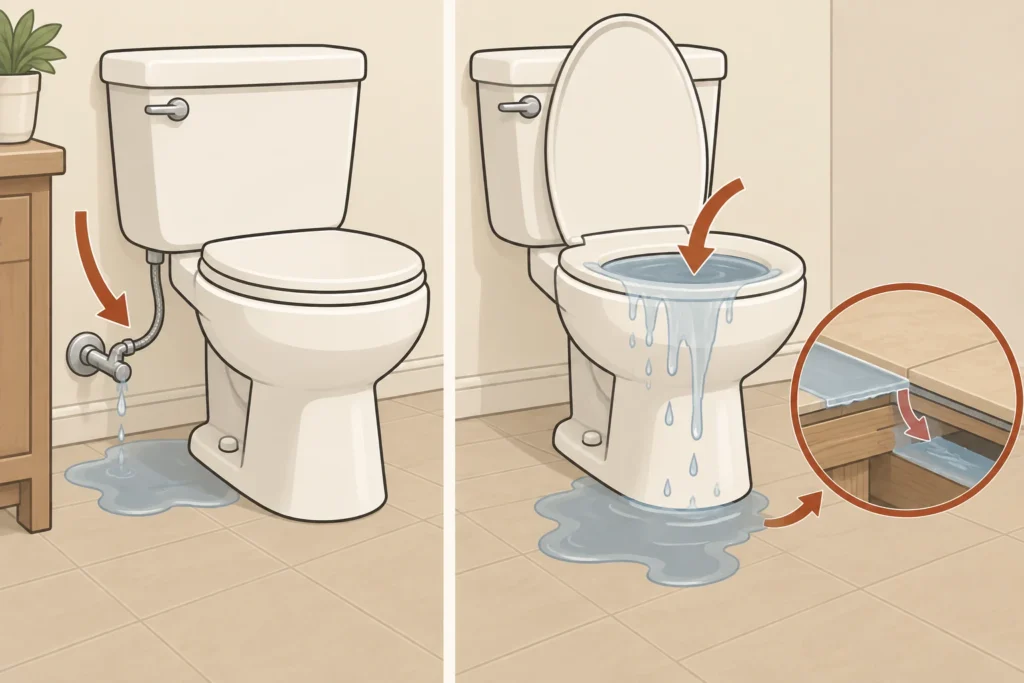
Picture me in an imagined bathroom reaching for a towel after the flow has stopped. Of course, I notice the water slipping under the vanity. I’m annoyed. I thought this was just a puddle to mop up. Now the towel is not the priority. The towel can wait; the inaccessible water changes the game.
Check the edges before choosing cleanup
Look for places where water may be dripping or pooling such as the threshold, seams in the flooring, base of walls, and edges of vanities. Be more concerned about a small puddle that disappears into an inaccessible layer than a larger puddle that is confined to an exposed hard surface. Even “waterproof” flooring may not answer that question. Mohawk’s rigid-vinyl warranty, for example, protects the flooring product from the subfloor and the adhesives.[6][8]
If the flow has stopped, there is no electrical risk, and you can reach everything, and it’s safe to dry it, a small spill may be managed at home. For spills on hard, non-porous, and compatible surfaces, remove the contamination and wash with dish soap. Next, follow the contact time of an EPA-approved disinfectant and dry the surface. Always ventilate the area, and never mix cleaning products, especially not bleach with a puddle of toilet cleaner.[2][3][9]
You don’t have to get rid of all your water-logged items. A bath mat can be set aside for later laundering. Other items may not be as easily replaceable and may require a maintenance/restoration assessment. Outside contaminants that seep into structural materials such as padding and wall cavities may not be fully cleansed by simply wiping them down. An assessment may be necessary. For more information on what to do with water-logged items after a sewage or drain backup, see our guide on salvage and disposal.[3][5][8]
If you rent and your toilet overflowed, report it immediately. While you wait for the landlord to arrive, you should also capture and send the landlord a picture of the toilet, describe to them when it began, and if the water level stopped or continued to rise. Maintenance may want to come investigate even if you already did the cleaning. Do not use the toilet again until the landlord comes to assess the situation and determines it is safe to do so. A dry floor is not a safe reason to flush.[1]
Sources and references
- Korky: How to Stop a Toilet Bowl from Overflowing
- CDC: Safety Guidelines: Reentering Your Flooded Home (2026-08-24)
- EPA: Flood Cleanup to Protect Indoor Air and Your Health
- Washington State Department of Health: Flood Cleanup
- Public Health, Seattle & King County: Sewage spills and septic system failure, Cleaning indoor sewage spills
- Mohawk Home: Mohawk Home Rigid Vinyl Limited Warranty
- Journal of Environmental Health; archived by CDC: Persistence of Bowl Water Contamination During Sequential Flushes of Contaminated Toilets (2017-10-01)
- EPA: Text Version of the Flooded Home
- CDC: When and How to Clean and Disinfect Your Home (2025-01-31)