

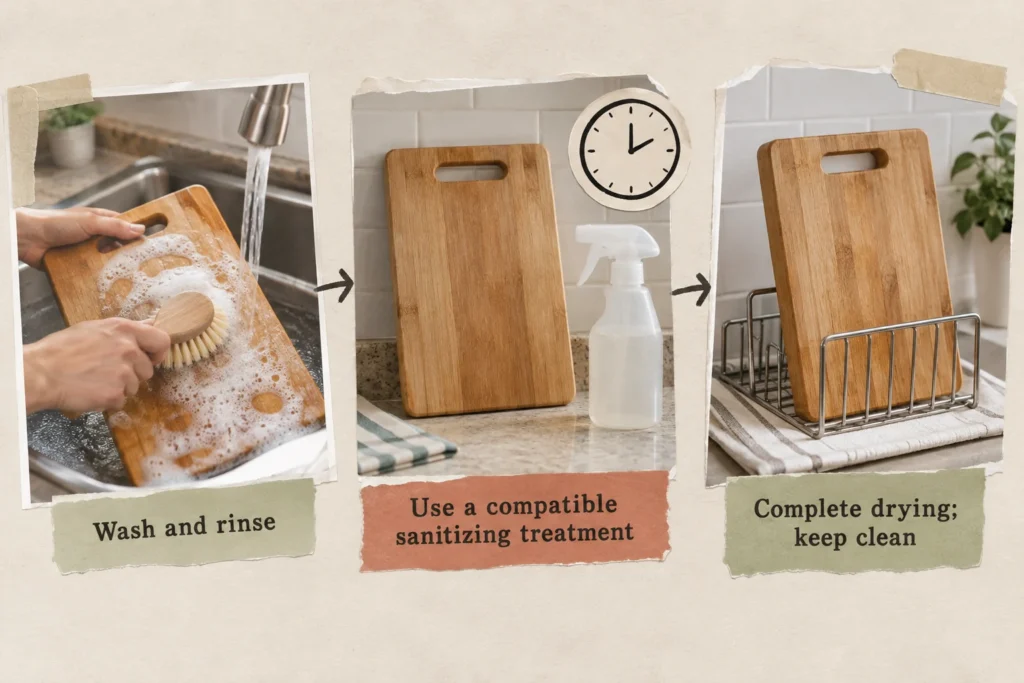
Wash cutting boards with hot soapy water and rinse. Check label to ensure the sanitizer is authorized for food contact and follow the boards care label. Finish the contact time and rinse or air dry and it's ready for use. Discard a cutting board that's excessively worn or has grooves that can't be cleaned.
A clean appearance doesn't mean it's safe to use again.[1][2]
Raw juices can hide in crevasses and tunnels and will run down the drain. Washing removes food and grease, but sanitizing treatments are required to kill microbes. Bleach is a good sanitizer, but you still need to wash first.[2]
Start with the food and grease, not the bleach
- Scrub the juice tunnels and edges and other contact areas with a board-safe brush or other suitable tool. Hot soapy water should be used first.
- The surface can then be rinsed. Look for food and grease. If food is stuck and won't rinse away, it's trapped in damaged or rough areas that you can't get to, the board shouldn't be used.
- For the sanitizing treatment to be effective, the entire area should be treated for the contact time specified on the label.
Picture me in an imagined dinner rush: chicken sizzling in the pan, lettuce waiting beside the sink, and the rinsed board looking ready. I’m annoyed at having to pull out another board, but that’s what I do. The lettuce can move; the sanitizer’s contact time can’t be shortened to fit dinner.
Keep one sanitizer’s instructions together
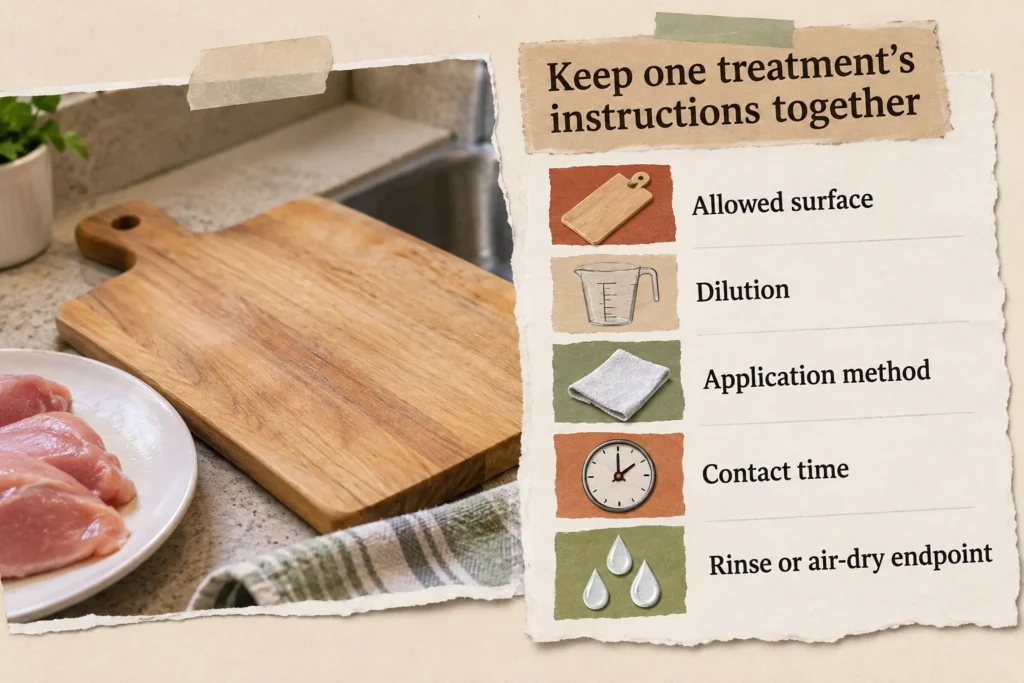
The conflicting nature of the bleach advice comes from the fact that different methods do use differing doses and finishes. So, I’d keep each method separate, not take a dilution from one and a rinse from the other.[1][5]
USDA’s general cutting-board method is 1 tablespoon of unscented liquid chlorine bleach per gallon of water: flood the surface, let it stand for several minutes, then rinse with clear water and air-dry or pat dry with clean paper towels. This does not allow you to use any bleach formulation on any board. Your product needs applicable food-contact directions and the board needs to be able to tolerate the treatment.[1][2]
For comparison, the consulted EPA-accepted label for Clorox Disinfecting Bleach, registration 5813-120, gives a specific plastic-board treatment: wash and rinse, soak in 2 teaspoons of bleach per gallon of water for at least 2 minutes, then air-dry. Use that method only if your product’s applicable container label carries those directions and your plastic board permits immersion. Don’t transfer it to wood.[5][6]
Read the food-contact sanitizing directions, not just the general surface-disinfecting directions. They need to cover your surface, dilution, application method, contact time, and rinse or air-dry finish. Never mix bleach with other cleaners, and rinse away the washing solution before applying it.[2][5]
The material name doesn’t settle the care method
The USDA generally allows dishwashing for nonporous and solid wood cutting boards but warns that laminated wood boards may split and crack. I’d rather keep a board intact and not put it through a cycle that the manufacturer says not to.[1][3]
| Board example | Permitted care | What that means after raw meat |
|---|---|---|
| John Boos wood boards | No soaking or dishwasher; diluted chlorine treatment is permitted. | Use compatible surface treatment, not the plastic-board immersion method. |
| OXO 3-Piece Everyday Cutting Board Set | Dishwasher-safe. | Dishwashing is an available cleaning route for this set; dishwasher permission alone doesn’t specify a sanitizing cycle. |
| Epicurean Food Service paper-and-resin composite boards | Manufacturer permits dishwasher washing and sanitizing. | A documented dishwasher route is available; don’t transfer that permission to an unidentified composite board. |
If the board’s care instructions and the sanitizer’s food contact label don’t align, don’t try using other boards’ instructions. Wash the board and keep it out of food contact until you can find a board with known care instructions. Lemon, salt, vinegar and conditioning oils will not fill that gap.[1][2][3]
Knife marks are not a replacement schedule
A board doesn’t necessarily need to have deep knife lines to be considered used and replaced. According to USDA, a board should be replaced if it has “excessive” wear or has grooves that are hard to clean. The supplied household guidance gives no definition for what constitutes an excessive groove.[1]
The definition for what should be replaced is different than what should be thrown away. For example, if food is trapped in a groove after washing, I would replace the board, as I wouldn’t want to risk food contact by using stronger bleach on the board.[1]
Heavy knife-scoring on plastic, especially with chicken-fat deposits, is very difficult to clean, according to a laboratory study. So, in the case of heavy scoring, a plastic board should not be used, but a wood board should be OK to use, especially if it can be cleaned.[8]
Finish without putting raw juices back on it
Give the treated board a clean place to dry, away from raw juice and used preparation towels. An air-dry instruction means to leave the board to dry, not to wipe it dry with a towel. As recommended by John Boos, dry the board by putting it up, and store it in a dry and well ventilated place. Don’t store a damp board by putting it flat.[5][9]
This also applies to your hands and the surrounding counter. Wash your hands with soap and water after handling raw meat and before handling the treated board. Clean and sanitize other surfaces touched by raw juices. The USDA recommends using a different board for raw meat, poultry and seafood, and a different board for produce and bread, in order to prevent cross contamination.[1][2]
When the treated board has finished its process and is intact and clean, you can use it again. Treat the board properly to maintain it, don’t expect it to be like new.[1][2]
Sources and references
- USDA Food Safety and Inspection Service: Cutting Boards (2024-08-27)
- USDA Food Safety and Inspection Service: Washing Food: Does it Promote Food Safety?
- John Boos & Co.: Frequently Asked Questions
- OXO: 3-Piece Everyday Cutting Board Set
- US Environmental Protection Agency: CRB, EPA Registration 5813-120, accepted label (2024-07-08)
- Clorox: Clorox Disinfecting Bleach
- Epicurean Food Service: Material
- Journal of Food Protection: Decontamination of Plastic and Wooden Cutting Boards for Kitchen Use (1994-01-01)
- John Boos & Co.: Complete Guide To Caring For Your Wood Cutting Board