

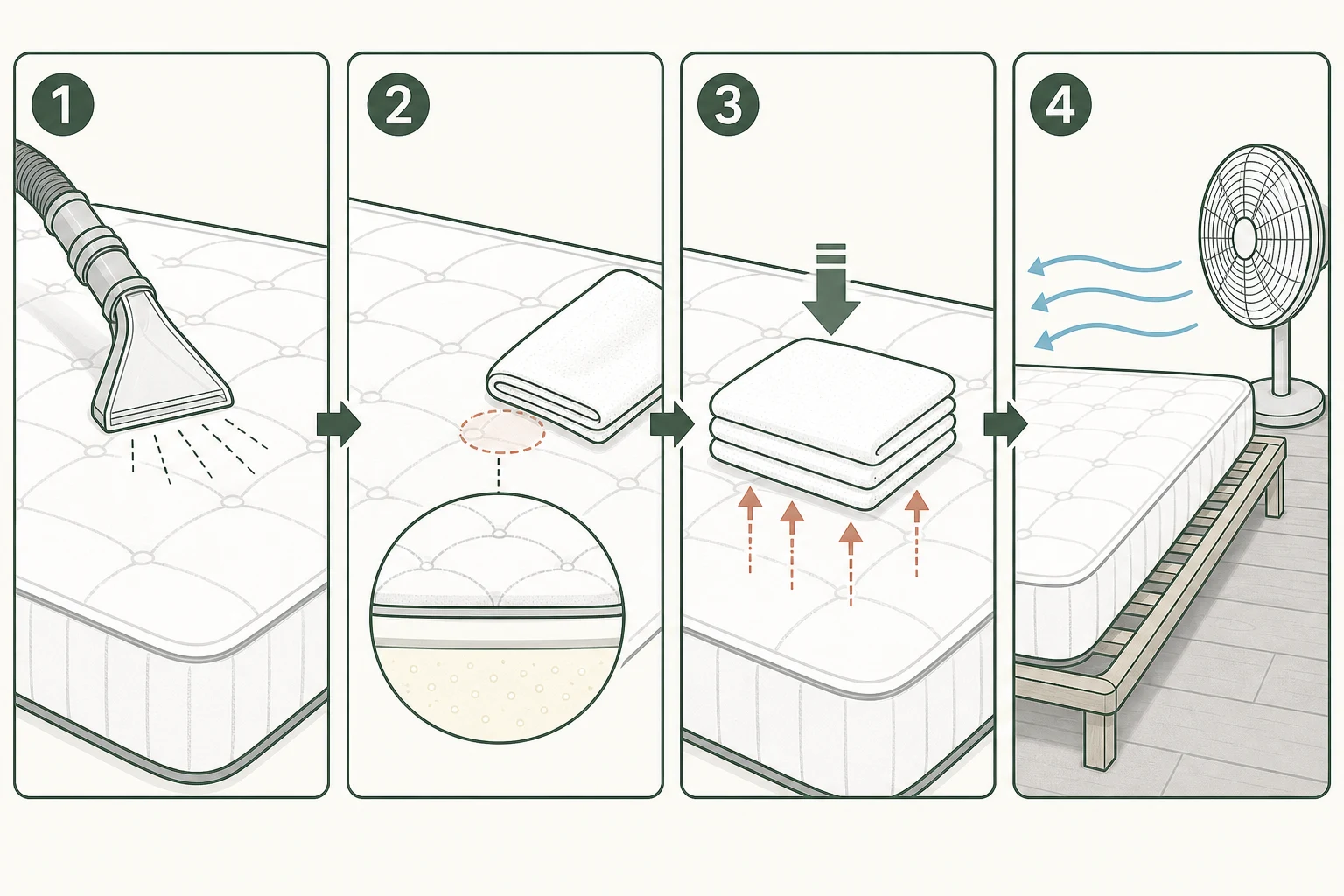
Before adding cleaner, decide whether the problem can stay within one folded-cloth-sized area. Mild odor on an otherwise dry mattress calls for vacuuming and airflow. One small surface mark may allow a barely damp treatment, but broad wetness, spreading dampness, or recurring mustiness calls for no more liquid.
This distinction matters because the visible cover is only the top layer. Moisture can move into quilting or foam even as a stain begins to fade, so complete drying is more important than removing every trace of discoloration.
Choose the cleaning route by area and moisture
| What you observe | Cleaning route | What to do |
|---|---|---|
| The mattress is dry, with mild generalized staleness and no defined wet area | Dry freshening | Vacuum thoroughly, leave the mattress uncovered, and move air across the surface. Do not mist the whole bed. |
| One small surface mark with a clear boundary no larger than a folded cloth | Localized spot treatment | If the mattress allows damp treatment, put a compatible cleaner on a barely damp cloth, blot the mark, and extract moisture immediately. |
| Broad wetness, a growing damp boundary, recurring mustiness, visible mold, or uncertain depth | No more liquid | Stop home treatment. The issue is no longer a controlled surface-cleaning job. |
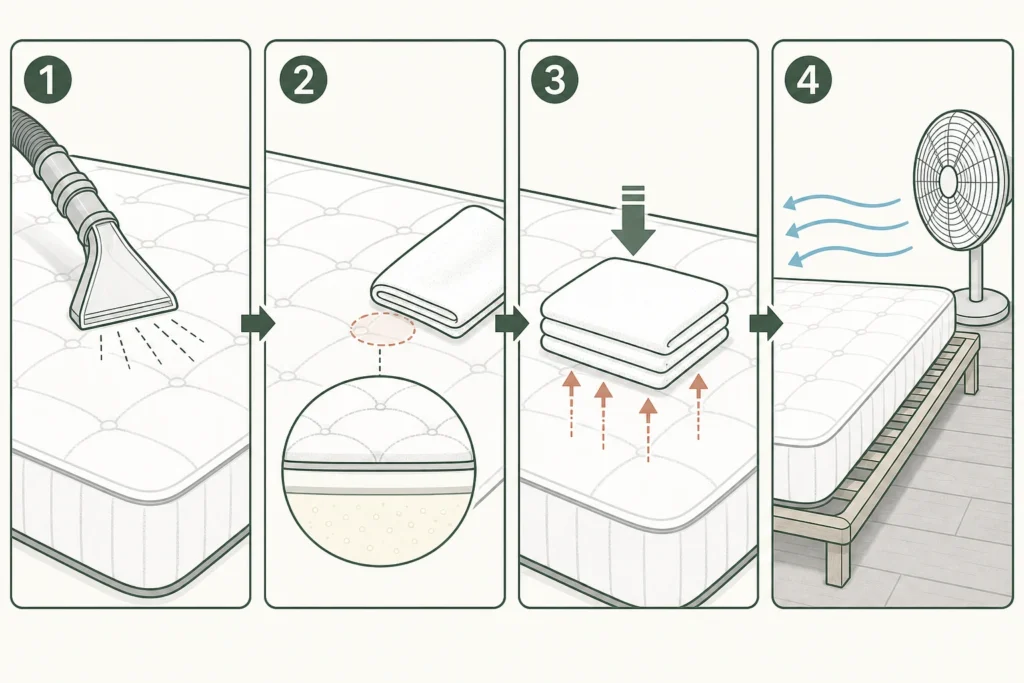
You do not need to identify the exact chemistry of every yellowish mark before choosing a route. At this stage, footprint and moisture matter more than color. If the damp area spreads beyond the treatment zone, stop rather than chasing the discoloration outward.
Check the cover and prepare the bed
Find the sewn-in care label and, if available, the instructions for the exact model. Determine whether the cover is nonremovable, removable and washable, or removable but not washable. A zipper does not necessarily mean a cover can go in a washing machine, and cover-washing directions do not apply automatically to the mattress beneath it.
Manufacturer directions differ in ways that change the method. Tempur-Pedic permits restrained spot-cleaning of certain nonremovable covers while warning against saturation and moisture in TEMPUR-Material. Serta advises against applying liquids to its mattresses and directs owners toward dry measures such as vacuuming and airing. Use the strictest instruction that applies to the mattress and cover you have; if the information is unavailable, stay dry.[1][2]
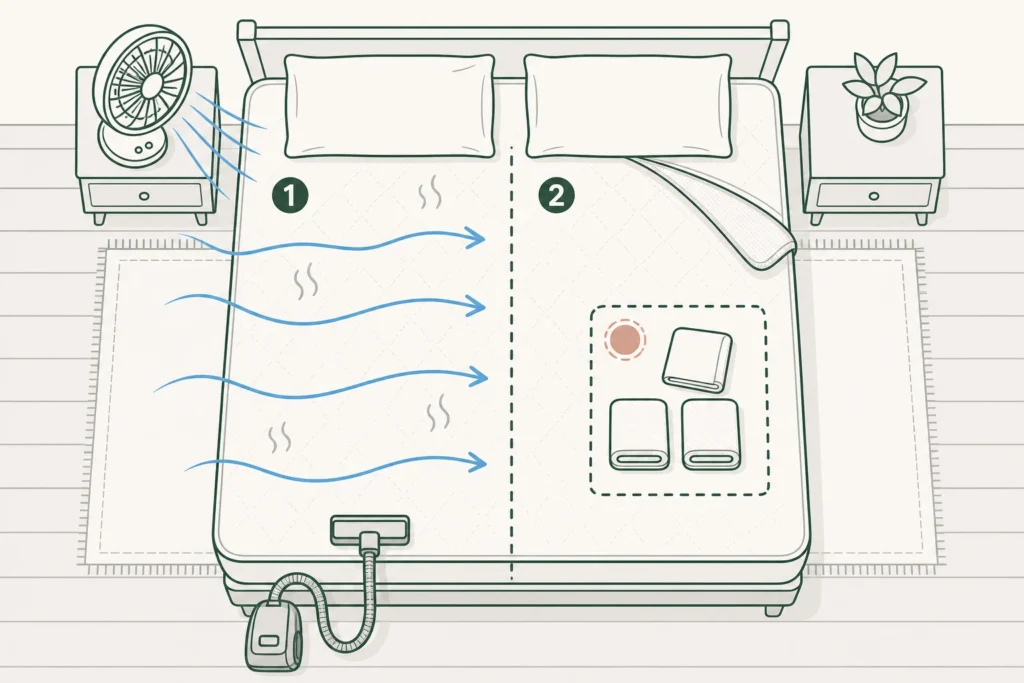
- Remove the sheets, protector, and any removable cover. Launder only the items whose labels allow it.
- Inspect the bare mattress for active dampness, mold-like growth, pest evidence, damaged fabric, or a mark that extends farther than expected. Stop if the problem is not confined to the surface.
- Vacuum the top, sides, seams, piping, and quilted depressions with a clean upholstery attachment. Remove crumbs, hair, and dry residue before considering moisture.
- Set out one clean, light-colored cloth for treatment and separate absorbent cloths for extraction. Using different cloths prevents removed residue from being pressed back into the cover.
- Position a fan to move air across the exposed mattress before beginning any damp treatment.
Freshen mild odor without spraying the mattress
For a dry mattress with mild, broadly distributed sweat odor, vacuuming and ventilation are the main treatment. Leave the mattress bare and move air across the top and sides. A scented spray or wet paste may cover the smell temporarily while adding moisture over a much larger area.
You can skip deodorizing powder entirely. If the mattress maker specifically permits it and the vacuum can safely collect fine powder, it may be used for mild surface staleness and then removed thoroughly. It is not a next step for a sharp musty smell, a known absorbed accident, an unknown odor source, or an odor that returns after airing; those clues call for investigation, not repeated powder or spray applications.
Spot-clean one small mark with a two-cloth method
Reserve damp treatment for a small mark with a defined boundary. Use a cleaner or mild solution permitted for the cover instead of assuming that vinegar, peroxide, dish soap, enzyme products, or another household formula is compatible. If there is a meaningful hidden fabric area, test the treatment there and let it dry before judging the result.
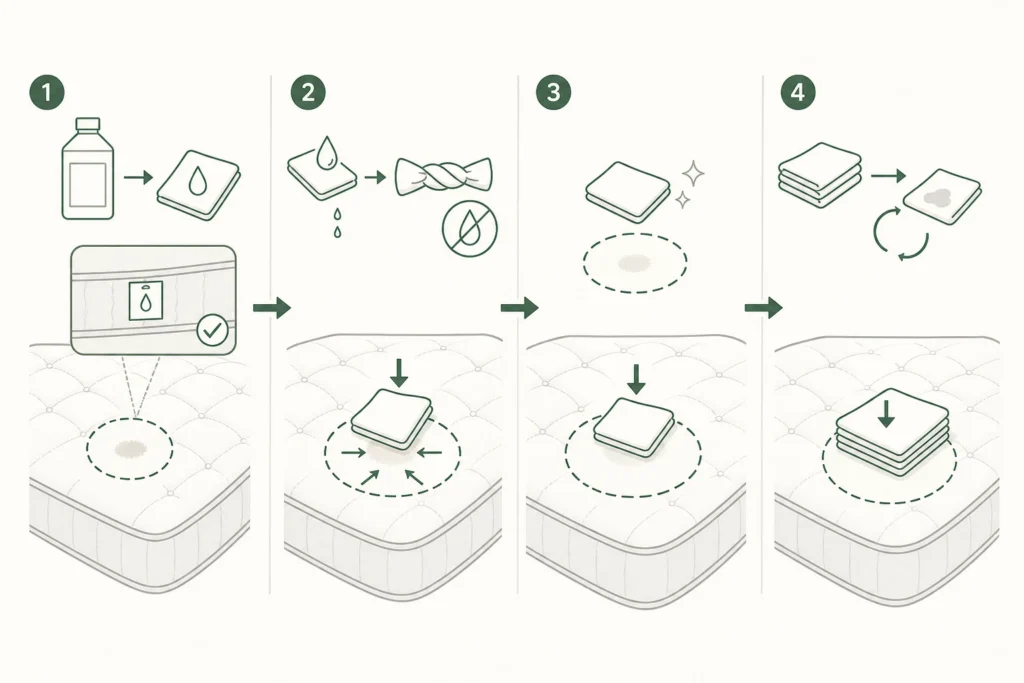
- Put the permitted cleaner on the treatment cloth, not directly on the mattress. Wring the cloth until it is barely damp and cannot drip.
- Press at the outer edge of the mark and lift. Work inward with controlled blotting instead of rubbing, scrubbing, or sweeping liquid beyond the original boundary.
- If cleaner residue remains, make one light pass with a second clean, barely damp cloth when the cover permits it. Keep this pass inside the same small zone.
- Immediately press dry absorbent cloths onto the area. Reposition or replace them as they pick up moisture, pressing straight down and then lifting cleanly.
- Stop if the damp patch grows, dye transfers to the cloth, or the cover changes texture. Begin drying rather than making another pass.
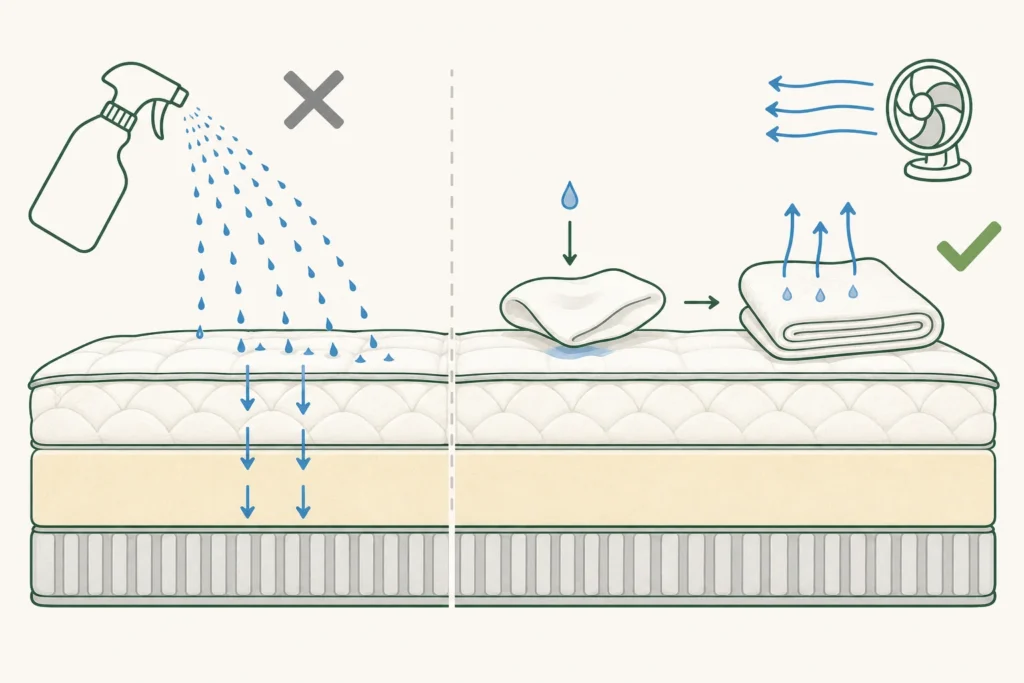
Old discoloration, body-oil yellowing, and set-in stains may remain visible or fade unevenly. A faint remaining mark is often the safer outcome when another pass would carry more cleaner through the cover. Too much liquid can also contribute to rings or migration from underlying materials.
Do not remake the bed until the mattress is dry
The EPA advises drying damp or water-damaged materials within 24 to 48 hours as a general mold-prevention measure. That is a reason to dry promptly, not proof that a mattress interior is dry after a set number of hours. Construction, room humidity, airflow, and the amount of liquid all affect drying, and a dry-feeling cover cannot confirm the condition of hidden quilting or foam.[3]
Stop when the problem is no longer at the surface
A cosmetic mark and an absorbed problem require different decisions. Do not keep adding cleaner simply because discoloration remains. Stop home treatment when moisture, contamination, or pest evidence extends beyond a small surface zone.
- A large spill, flooding, or wetness that has passed through the cover
- Deep or recurring urine, pet-waste, vomit, or other contamination odor
- Visible mold or a musty smell that remains after surface drying
- Bed-bug signs or other pest evidence
- Specialty foam, latex, temperature-sensitive material, or an integrated cover with restricted cleaning options
- A mattress that cannot remain uncovered long enough to dry completely
The appropriate next contact depends on the issue. Product support can clarify material and cover restrictions, pest evidence calls for pest-specific guidance, and extensive moisture or contamination may require an appropriate restoration or upholstery-cleaning professional. No single service or stronger cleaner is the answer to every condition on this list.
Once the mattress is fully dry, add a washable protector that fits properly and does not conflict with the mattress requirements. At each bedding change, inspect the protector and exposed surface, and handle new spills by stripping the bed and blotting promptly. The practical aim is to keep future washing in the removable layers rather than the mattress core.
Sources and references
- Tempur-Pedic: Tempur-Pedic: How do I clean a spill on my mattress?
- Serta: Serta: How do I clean my mattress?
- U.S. Environmental Protection Agency: A Brief Guide to Mold, Moisture and Your Home (2012-09)
- University of Georgia Cooperative Extension: Remove Stains From Fabric Softener, Bluing | Textiles