

Cleaning up the puddle isn't enough. However, a raw-meat leak doesn't necessarily mean you have to dump everything from your fridge. Contain the package and keep everything else cold. Track the juices to other containers, shelf edges and drawers below. Throw away any food that was directly exposed. Evaluate other food protected by containers separately from the wrapper/exterior. Wipe down affected surfaces, then disinfect using instructions safe for both the cleaner and fridge.[1][2][7]
1. Contain the package and protect food
Place the leaking package into a leakproof container before transporting it to another location. Store it away from ready-to-eat food. Do not rinse the meat or meat wrapper that is still wet with leaking juice: raw meat should not be rinsed as it can cause cross-contamination via splashing. Containing the leak will prevent it from spreading further; this does not correct for any time it was stored unsafely.[2][9]
Have two staging areas. One area should be clean for uncontaminated items. Have a washable tray or basin for suspect packages. After touching the meat package, wash your hands before touching any clean food or touching the cooler handles or refrigerator controls. Raw juices can be transferred via packaging and hands without any visible additional puddle.[2]
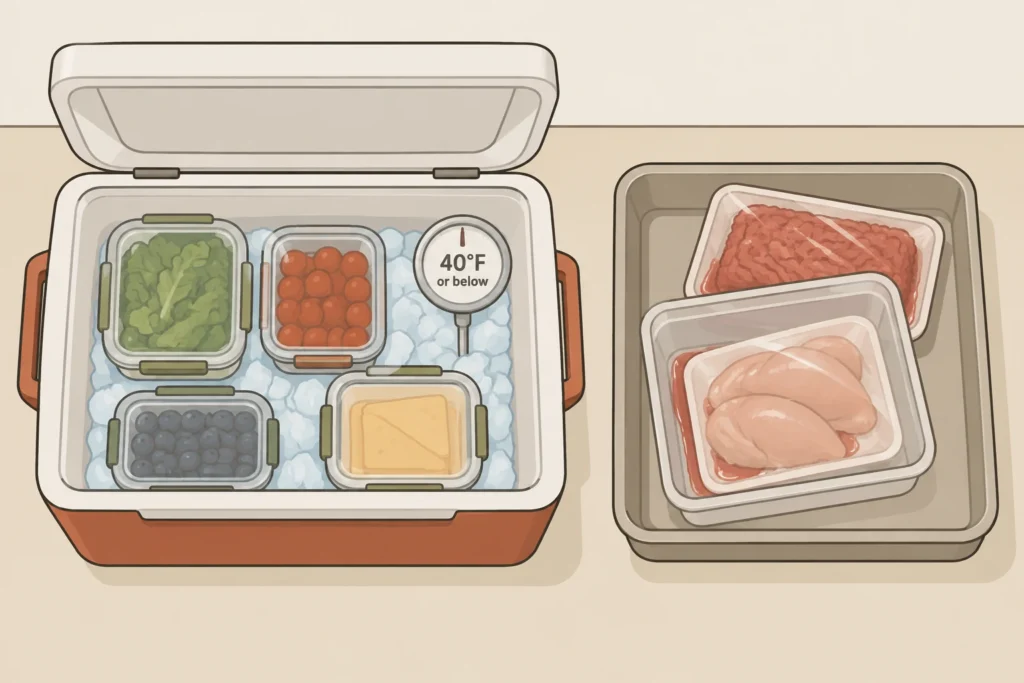
Transport only what is necessary to examine or access the spill. Packaged food that will not be disturbed should remain in the unaffected area of the refrigerator if refrigeration is still operating and you can close the door while working. If you must turn the unit off per cleaning instructions, or if decontamination requires extended opening, transfer food items to a refrigerator or an ice-packed cooler kept at 40° F or below. Packages should not be leaking during transport, and dry goods should never sit on a wet staging area with affected goods.[3][9]
2. Trace contact and sort affected items
Look under the package, under adjacent packages, and on the shelf front. Look for any trails dripping onto the shelf or drawer below, including shelving cutouts, undersides of drawers, and cracks. Examine container tops as well as bottoms: syrup inside a jar is not the same issue as syrup on or around the lid or opening. Don't forget items contacted by dirty hands, such as a drawer handle or counter.[2]
USDA recommends you throw away food that has come into contact with juices from raw meat. Maintaining food behind an intact, treatable barrier is a limited, conditional decision. It's not a blanket USDA saving guideline for packages. Just because there is a lid doesn't mean there is that barrier. If the juice penetrated a gap, compromised seal or spot you can't effectively treat prior to opening, don't assume the contents stayed protected.[1][2][7]
| What you find | What to do |
|---|---|
| Juices touched food itself, including uncovered leftovers or produce | Discard the exposed food. Do not try to make it safe by washing it with soap or sanitizer. |
| Juices touched only a smooth exterior of an intact, leakproof container | Contents may be retained if the barrier clearly remained intact and every contaminated exterior area can be cleaned and sanitized compatibly before opening. |
| Juices reached an opening, compromised seal, or closure whose protection is uncertain | Discard the affected food rather than assuming the lid protected it. |
| A removable outer carton is contaminated, but a separate sealed inner package is untouched | Discard the outer carton. Retain the inner package only if removing it does not transfer contamination. |
| Absorbent packaging is wet and there is no clearly intact inner barrier | Do not rely on wiping the package. Discard the affected item. |
| Food and packaging are outside both the liquid path and contaminated handling contacts | Keep them, subject to safe storage temperature and time. |
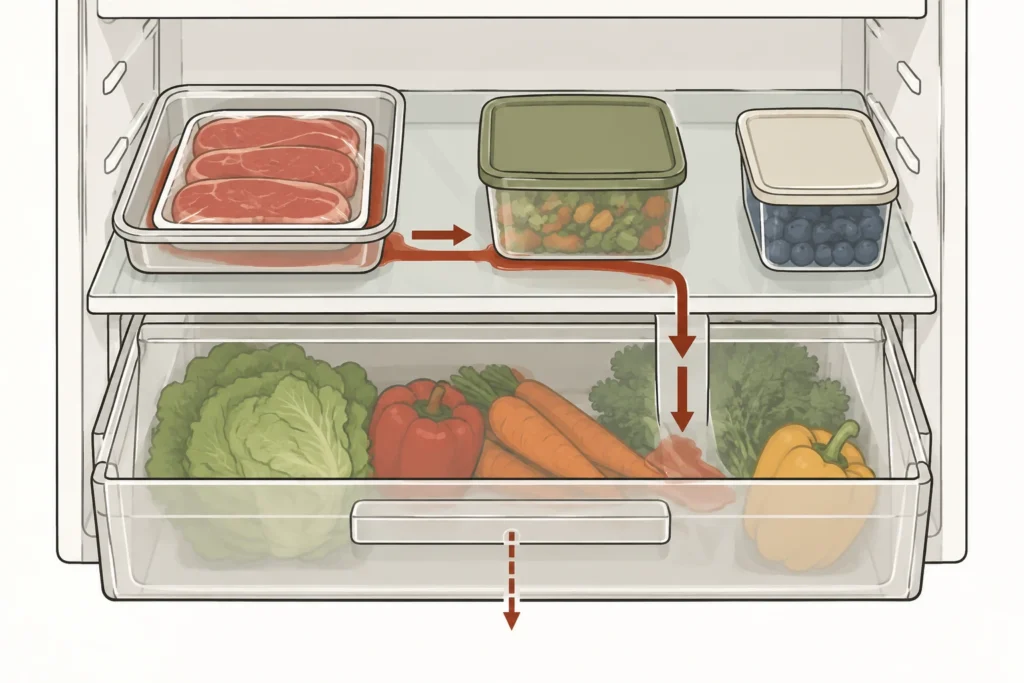
Complete this audit prior to releasing holds. Each impacted piece should have a disposition and the liquid trail should have an identified endpoint. If juice was lost behind a nonremovable liner, into a vent, or under components you cannot access by permitted shelf/drawer removal, do not tear it apart or deluge it with solution. Take that section out of service and ask the equipment manufacturer how to access and treat that specific area.[3][4]
3. Clean and sanitize compatible surfaces
Pat up moisture with paper towels and throw them away. Wash contaminated surfaces using a pre-approved mild detergent solution labeled safe for those surfaces, then rinse or wipe down surfaces to remove detergent residue according to label directions. Use a clean towel instead of dragging raw juices across multiple surfaces. Washing is the act of cleaning. Sanitizing is the separate process of applying a chemical to reduce the number of microorganisms. Applying sanitizer to the initial spillage does not negate the need to wash.[2][3][5][7]
Take out shelves and drawers only if the model allows. Allow cold glass to reach room temperature before washing with warm water; thermal shock may cause it to crack. Don't presume removable parts are dishwasher-safe. GE explicitly states you cannot dishwasher-clean plastic refrigerator components and glass shelves. On non-removable surfaces, direct moisture away from seams and vents (avoid pouring/spraying liquid into them).[3][4]
Selecting a sanitizer requires double-checking two sets of permissions. Directions on the antimicrobial product label must permit the intended use, which should include appropriate food-contact surface instructions. Directions for your refrigerator must allow the chemical for the specific surface type: glass, plastic bin or liner, gasket or coated shelf. Generic instructions for a food-safety bleach mixture don't determine appliance safety: Whirlpool flat-out bans bleach on plastic surfaces, liners and gaskets in its care instructions for appliances.[2][3][7]
Check the product label for directions on how to dilute the product, what surfaces it is allowed on, at what temperature it should be applied, how long the surface should remain visibly wet, and if a final rinsing with potable water or air-drying is necessary. The front label claim that a product can be used to disinfect is not sufficient information to determine if it can be used on food-contact surfaces. Temperature may alter the application: one label approved by the EPA for use as a sanitizer gives instructions to treat refrigerator surfaces and containers specified on the label at room temperature. Simply spraying it on a chilled shelf would not meet those instructions.[5][8]
If you can't verify both settings, don't make up a more dilute solution or replace bleach with vinegar or baking soda. Set the sanitized, affected part aside from use and ask your supervisor for a disinfecting process appropriate for the material AND model. Ensure there is no residue on the part when it returns, that the dwell time/temp was met and that it was rinsed/dried (if needed) according to instructions. Container exteriors should be cleaned and sanitized according to their respective material instructions, too.[2][3][5][8]
4. Restore cold storage and verify completion
Return cleaned parts when adequate rinsing and drying have been completed. If defrosting was in progress, resume it, checking with a refrigerator thermometer for 40° F or less; store perishables in the other cold unit until the refrigerator is ready to use. Only return withheld containers after outside contamination has been corrected. Store raw meats in a leakproof container, preventing juices from dripping onto other food.[6][9]
Count forward from the original time the food was removed from refrigeration when determining whether to save leftovers. Refrigerating them again won't negate the time unrefrigerated. The FDA recommends throwing away perishables that have been held at room temperature longer than 2 hours. And if the environment is above 90° F, reduce that time to 1 hour. These are guidelines for when to toss, not how long to clean up. You won't have to rush against the clock if you keep everything in active cold storage.[9]
Before you close the job, verify the spill path and secondaries: drawer pulls, staging trays, counter top, any sink front where contaminated parts may have been placed. Address those surfaces as well, throw away used towels and wash your hands. Job completion is based on food-exposure decisions, removal of soil, properly completed treatment and safe cold storage, not on lack of stain or odor. Food that appears normal can be unsafe.[2][6][9]
Sources and references
- USDA Food Safety and Inspection Service: Keeping Food Safe During an Emergency
- USDA Food Safety and Inspection Service: Washing Food: Does it Promote Food Safety? (2024-02-07)
- Whirlpool: Cleaning the Interior of the Refrigerator
- GE Appliances: Refrigerator, How to Clean the Interior
- US Environmental Protection Agency: What’s the Difference Between Products That Disinfect, Sanitize, and Clean Surfaces?
- US Food and Drug Administration: Are You Storing Food Safely?
- US Food and Drug Administration: Food Safety Tips for Consumers & Retailers During an Outbreak of Foodborne Illness
- US Environmental Protection Agency / Ecolab: Surface Cleaner Sanitizer RTU, EPA Registration 1677-259, accepted label (2026-05-13)
- US Food and Drug Administration: Refrigerator Thermometers, Cold Facts About Food Safety