


It may have been caused by either washing or drying; discovering clothing appears smaller after drying doesn't necessarily mean the dryer heat shrank it. Fiber type, fabric construction, and laundry history all play a role. Determine whether there was permanent size reduction or felting/distortion first, then look at washing and drying allowances individually. If necessary, verify regular dimensions with additional clothing that has been uniformly dried using the care instructions (don't re-test with another potentially harmful wash or dry cycle).[1][3][6]
Size loss, felting, or changed shape?
Dimensional stability shrinkage occurs when the garment, once fully dry, is shorter, narrower or both when measuring under similar conditions. Washing cotton fabric may help relax tension imposed during manufacturing processes and let the textile structure conform to different dimensions. The amount of residual shrinkage possible can vary based on how the fabric was knit or woven, and processed or finished. Two cotton shirts can behave completely differently even if the fiber content labels are the same.[1][5]
Wool felting is another matter entirely: untreated wool fibers will interlock via wet mechanical action, resulting in a smaller, denser piece of fabric. Reduced stitch definition and a thicker, denser feel lend credence to that idea, but appearance can be deceiving. Felting, once complete, cannot be undone. Treatments that resist shrinking allow some wool to be machine washable. Percent wool alone will not dictate whether it must be washed by hand or not.[3]
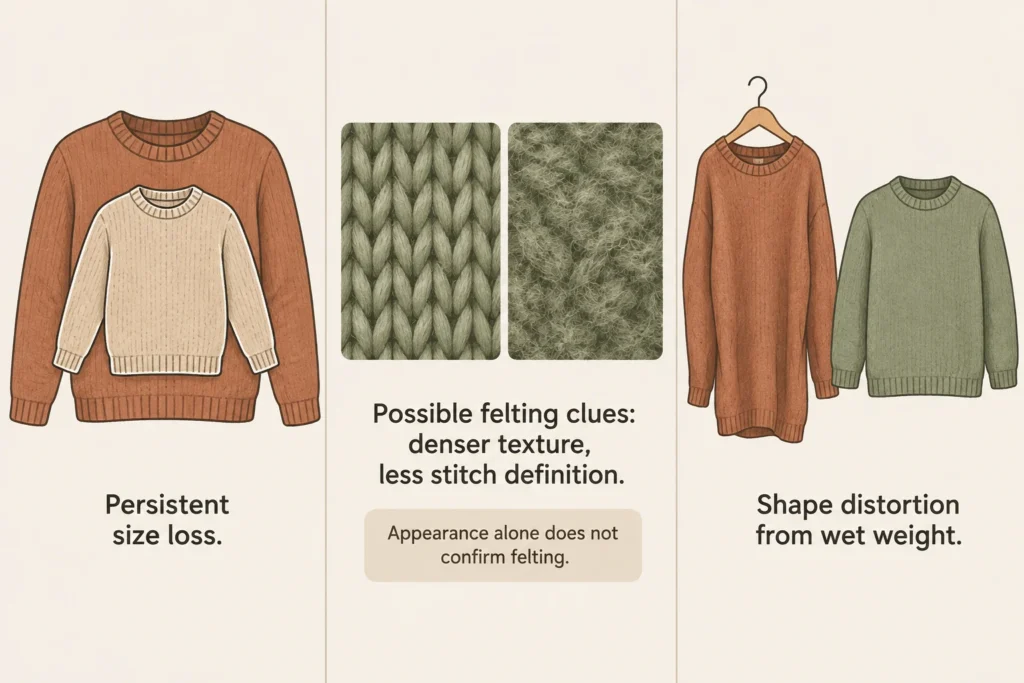
Uneven shrinkage is not the only change in proportions. A sweater lengthens and its shoulders droop because it stretched due to its own weight when hung wet. Flat drying while supported and gentle reshaping while damp can help some deformities; they can't undo felted fibers. Wait until after something is completely dry to judge fit and size. Don't consider its limp saturated shape to be its finished form.[4]
What timing and temperature can tell you
A shirt which exits the washer smaller than its peers gives you cause to look at the washing regimen — particularly mechanical action and care label appropriateness. But wet measurements are not directly comparable to dry measurements: water affects fiber and fabric architecture, and handling affects garment drape when wet. If a shirt looks ok in the washer but shorter when dry, however, it shrank during drying. In that case you cannot decouple heat from evaporation and tumbling.[1][2]
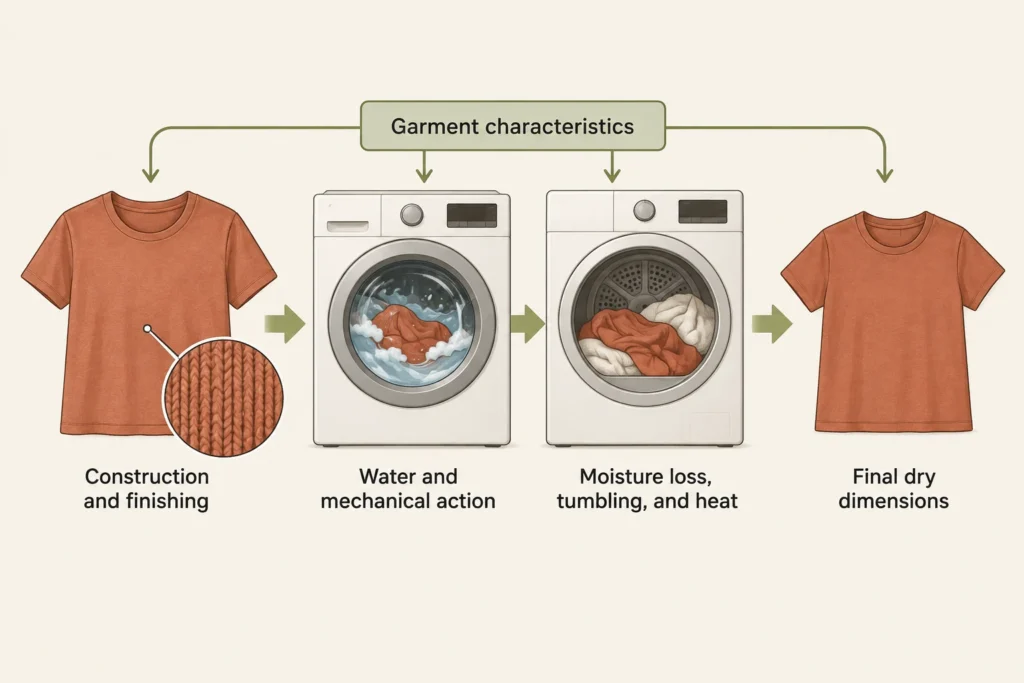
Low dryer heat will not prevent shrinkage. Research on a group of plain-woven and single-jersey cotton fabrics found zero impact from tested dryer temperature levels on shrinkage. That result doesn't prove heat is safe for every garment, blend, or finish. However, it does explain how a lower heat level can comply with a care instruction while still allowing structural shrinkage.[2]
Cold washing doesn't necessarily prevent shrinkage either: it only alters water temperature. There are many other causes of mechanical agitation or fiber relaxation. If some but not all of your clothing in a given load shrinks or stretches, examine their construction, care labels and laundering history prior to condemning a machine. Correlation does not establish that the common factor was appropriate for all garments.[1][3][6]
Protect vulnerable garments, then compare
Check washing and drying limits separately
Remove clothes that no longer fit, as well as garments with labels that call for limited care. Note the allowed wash type, temperature, mechanical-action guideline, and drying technique. Just because you recognize a fiber does not mean you can ignore care instructions for the entire garment: trims, colors, construction, and even remaining shrinkage may limit how a garment can be cared for. If a label is unreadable or missing, contact the garment manufacturer directly and ask if the garment can be machine washed and tumble dried. Find out what restrictions there are, if any. Keep the garment out of the wash until you know the limitations.[6]
Just because something wool can be machine washed does not mean it can be tumble dried. Refer to the independent drying instruction (including whether it must be laid flat). The benefit of doing this is that you have a full care pathway for each special item, rather than just lowering the wash temperature but keeping the same unrelated drying process.[4]
Choose one compatible correction
Correct the identified mismatch for the impacted pieces. Do not change compatible normal laundry. Utilize the necessary gentle cycle if the prior wash was more aggressive than the garment's mechanical-action rating; utilize flat drying if necessary. Tumble drying on low heat is not the same thing as flat drying. Hang dry clothing that cannot withstand being dripped on by wet garments above it. Make sure you have sufficient hanging space before washing an item of knit clothing that must be laid flat to dry.[3][4]
If you're allowed to tumble dry: separate your heat setting from your automatic dryness setting (or timed setting). In the Whirlpool tech sheet I read, they addressed temperature setting and dryness setting as independent adjustments; yours may label them differently, or may not allow them to be mixed. Determine which control dial affects temperature, and which affects the point at which the dryer stops. ACI recommends pulling slightly damp compatible knits to finish flat. Don't finish drying your clothes; that middle step is only for transporting, not storing.[5][7]
If you care about attribution, only vary one assailable variable at a time if possible. If both washing and drying damaged the tag, fix both rather than leaving one destructive factor in place so that the other can be cleaner. Accuracy in clothing preservation comes before isolating factors.
Compare consistent dry measurements
This optional home comparison was intended to record the result of a single typical, allowed care occasion. Without stretching, lay the garment flat when 100% dry. Measure lengthwise from where you select on the shoulder seam to the bottom hem. Measure widthwise between identical underarm points. Move the garment and remeasure to get an idea how much your placement affects the measurement. Note the wash and drying path. Re-measure dry, flat measurements at identical points after laundering.
A cotton knit shirt, for example, may shrink shorter after being washed cold and tumble dried on low heat. Checking the unchanged width but now smaller dry length confirms it shrank in one direction only and didn't simply become overall smaller. Checking the shirt while damp will not pass the wash test either, as appearance when wet is not a fair dry comparison. If allowing both washing and drying methods, having left the washshirt unchanged but then drying it successfully on a hanger could confirm that full-care pathway works. But having not shrunk then does not mean the dryer's heat was free of blame: the tumbling action changed as well, and previous washing may have already contributed to any slack lost.[1][2]
The last load should contain an equivalent shirt to use as a positive control since you will be washing it regardless. Similar fiber content alone is not sufficient: consider construction, finish, and wash history. Don't risk damaging a favorite shirt by using it as a control. If using warm won't hurt, knowing which is BETTER may be trivia.
When reshaping helps, and when to stop
Stretch your wool knit back into shape by carefully laying your wet sweater out flat on a towel (don't stretch it). This may alleviate some of the stretching caused by mis-handling; it's not a guarantee that your sweater will return to its original size. If your dry sweater remains stubbornly smaller than you'd like, or if your sweater has become stiff and felt-like, stop thinking of it as reshaping. More washing and stretching won't fix remaining shrinkage, and felting cannot be reversed.[3][4][5]
If shrinkage continues with proper care conditions stop testing and email the clothing manufacturer along with the fabric content label, care label, settings used and before & after dimensions. Ask if the amount of shrinkage you received is normal with that specific care instruction and if the garment is returnable for evaluation. Remember your end goal is zero shrinkage with compatible care, not continued attempts to fit into the garment.
Sources and references
- Cotton Incorporated: A Guide to Improved Shrinkage Performance of Cotton Fabrics (2004)
- University of Greater Manchester repository; The Journal of the Textile Institute: Effect of Tumble-drying on Selected Properties of Knitted and Woven Cotton Fabrics: Part II (2003)
- The Woolmark Company: Machine Washable Wool
- The Woolmark Company: How do I dry wool?
- American Cleaning Institute: Laundering Problems & Solutions
- American Cleaning Institute: Ask ACI: When Clothes Are Really Dry Clean Only
- Whirlpool: Dryer Quick Start Guide, W11708007 Rev. B