

Make sure the range hood filter is identified before washing. If the filter is metal and the directions allow it, then it can be brushed, with warm soapy water, and rinsed. If it is a disposable odor filter, it needs to be replaced. Regenerable odor filters need to be treated as the directions specify. If fumes are still coming from the range hood after it is cleaned, a stronger degreaser should not be used. Cleaning the filter will not help if the range hood is not capturing grease properly.[1][2][3][5][8]
What's behind that greasy metal face?
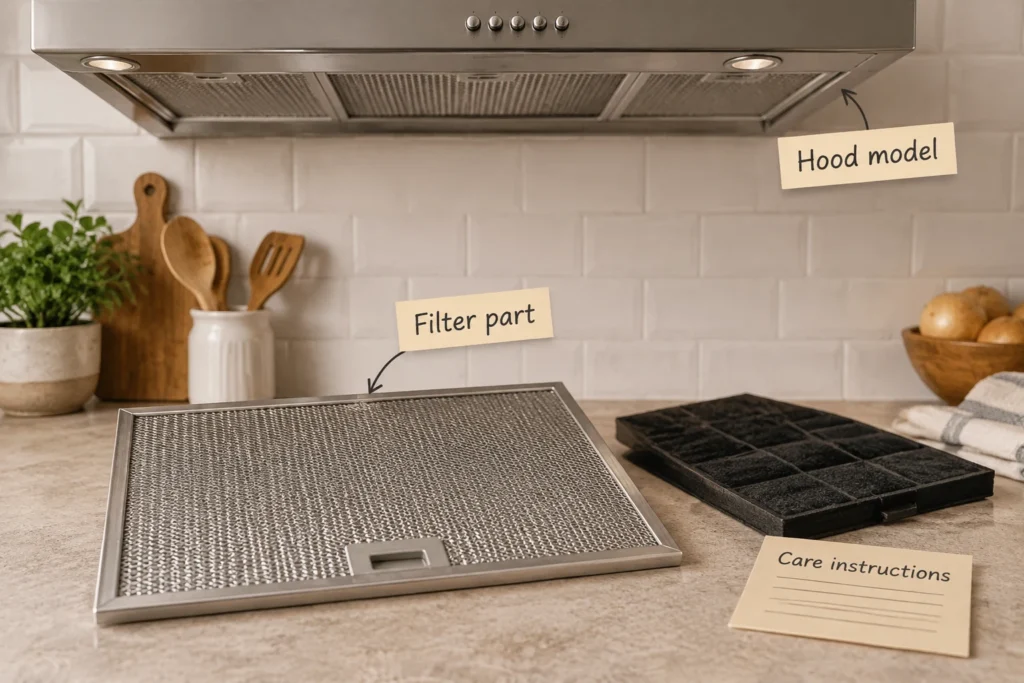
Obtain the model number of the range hood and filter if possible and check the filters against the instructions. Someone may have used a different filter assembly from the one specified and/or replaced the hood assembly with a different one. Find out if the hood exhausts the air outside or if it returns the air to the kitchen.[1][3]
A grease filter catches grease and a charcoal filter controls odors. Odor control is done with a media that may be sandwiched between a grease filter, or in a combination filter with a grease filter, or clipped onto the grease filter. Recirculating the air in the kitchen does not filter the cooking emissions.[1][3][4]
Picture me clearing a kitchen sink of dishes so I can soak the metal filter. I notice a dark pad clipped onto the filter. I'm annoyed that I had to rearrange the sink to make space for the filter, but at least I checked the part number before washing it. Replacing a filter that is designed to be washed is not a good thing.
| What you find | What changes the treatment |
|---|---|
| Mesh or metal baffles with no odor media | Wash only by the method permitted for that filter. Metal construction alone doesn't establish dishwasher compatibility. |
| A charcoal pad attached behind metal mesh | Check each component separately. Broan's documented attached charcoal filters must not be immersed or dishwashed. |
| Metal and charcoal enclosed in one cartridge | The whole assembly may be nonwashable. Summit's HRTXFILTERSET is an aluminum-mesh-and-charcoal example that requires replacement. |
| A long-life or regenerable charcoal filter | Some are washable, including Elica CFC0038699. Use the actual part's washing, regeneration, drying, and eventual replacement instructions. |
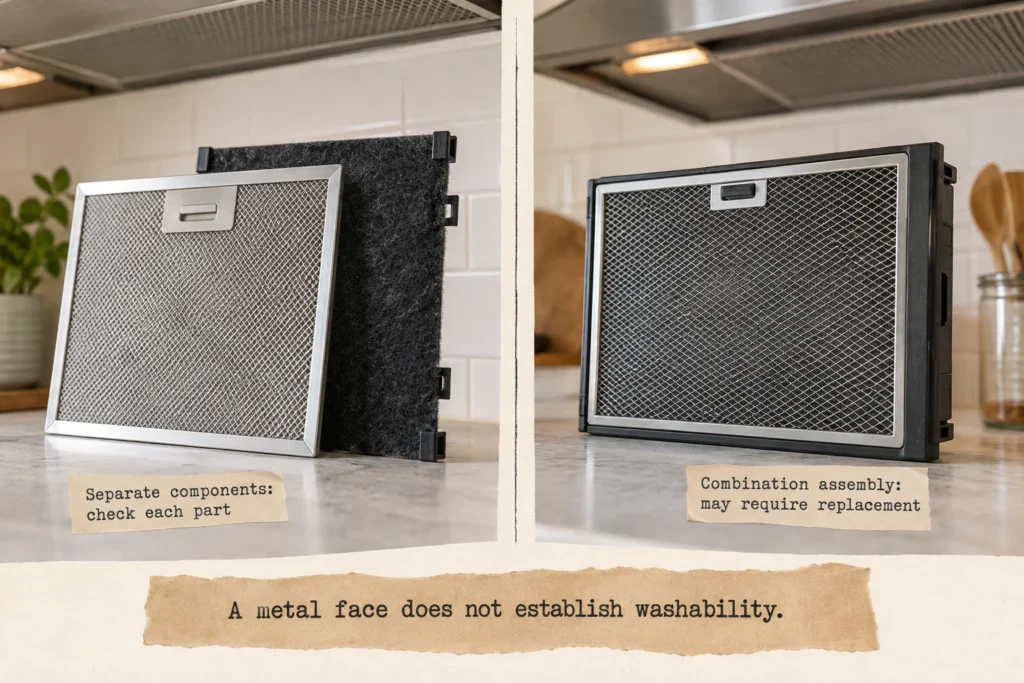
Don’t forcefully separate layers. If you can’t identify the part that was installed, leave it dry until you can consult the care instructions for that part. Elica’s current CFC0038699 page indicates that the part is washable, however, it doesn’t provide the complete regeneration procedure (temperature and time) to verify if it’s safe to use an oven treatment. Without the complete information, it’s not recommended to do an oven treatment.[3][5]
For washable metal, start gently
It’s not uncommon to find conflicting advice for dishwasher cleanings. GE states in its manual that the grease filter can be cleaned in the dishwasher, and Cyclone states in its manual that its mesh filter (CY917R) cannot be cleaned in the dishwasher. Both manuals can be correct for their respective filters. I’d choose to wash the grease filter manually if there are no instructions against it.[1][2]
The following steps outline Cyclone’s method of washing the grease filter. This method uses warm soapy water and a soft-bristle brush and should only be performed if the care instructions for the grease filter allow it.[2]
- Make sure the cooktop and the hood are turned off and cooled down. Disconnect the hood’s power at the accessible outlet or breaker and remove the filter. While supporting the frame, release the latch that holds it in place. Take a picture of the filter in its original position and lift it out.
- Follow the instructions to remove the odor media, if it can be removed separately. Submerge the metal part in warm water with a permitted mild detergent. Let it soak until the grease is softened or for the time indicated in the care instructions, if provided.
- Gently brush the mesh or baffle channels with a soft brush, and do not use an abrasive pad.
- Thoroughly rinse all fresh water, including the channels and frame, to remove all soap scum and soap build-up. Allow the filter to drain and dry completely before reinstallation.
- Make sure each component is repositioned to its original orientation and that the latch is engaged. Make sure the filter is supported and not sliding out before reconnecting power.
Is it still greasy? Check the filter material and coating against the degreaser label for compatibility and contact time. Bosch says Cyclone is compatible with a diluted degreaser. Simple Green's FAQ states that 10 minutes is a contact time limit for unpainted or unprotected aluminum, and states to thoroughly rinse the filter. This is a contact time limit, not an invitation to soak the filter for 10 minutes.[2][7]
I wouldn't soak the filter with any of the other cleaners Bosch mentions excluding; oven cleaner, boiling water, and strong bases and acids. You want the grease gone, not a second problem with the filter. Spraying a cleaner into a control should be avoided. Keep to one cleaner at a time.[6]
Clean doesn't have to mean shiny
Grease and larger particles should be removed and sticky deposits should be gone. Channel meshes and supports should be clear. The filter should be completely dry, intact, and fully secured. Bosch states slight discoloration of the interior of the dishwasher does not affect it's function, therefore it is clean and ready to use.[6]
Use a different approach for issues like torn meshes, separated layers, severe corrosion, a bent frame, or a failed latch. Stop cleaning and seek the right replacement filter or repair for the part’s retaining hardware. The assembly probably won’t fit or stay supported. Don't run the hood with a loose filter or routinely without its required grease filter. Cooking grease can still ignite even if the fan sounds normal.[6][9]
Black charcoal media filters don’t give you a verdict for a replacement. Use the actual indicator of the part. Summit specifies replacement of HRTXFILTERSET every 6-12 months, based on usage. Elica specifies replacement of CFC0038699 every 2 years. Replace the filter every 2 years based on the usage of the part.[3][4][5]
When the filter is clean but the kitchen isn't clearing
Did performance deteriorate after you last cleaned it? Odor in recirculating air means that the grease filter is dirty, or the motor is starting to go bad. Turn off the power and recheck the assembly’s orientation, supports, and latch before jumping to conclusion that something is broken. Check if the media is due for replacement. Smell alone can't tell you if the motor is failing.[1][4][5]
I'd like to know if capture has always been bad on the front burners, or if it's recently become worse under similar conditions. Those are different clues. Published data on installed outdoor-exhaust devices have shown that capture depends on airflow and the design of the burner. For most of the devices in the study, better back-burner capture was noted. Using a burner that is further under the hood may help, if feasible, but that is not an adequate test of ventilation adequacy.[8]
If capture is still weak after appropriate maintenance, do not use degreaser and have the hood assessed. GE’s ventilation troubleshooting guide lists a number of causes for reduced airflow including duct obstruction, damper behavior, and insufficient replacement air. If fumes are escaping, it is difficult to tell which of these is the case. To test the ventilation system, an assessment of the airflow, including the exhaust path, is warranted. This may also help identify the root cause of reduced airflow. Escaping fumes may help the technician identify the root cause, but further diagnostics maybe needed.[1][8]
Sources and references
- GE Appliances: GE under-cabinet hood owner's manual, document 49-2001095 Rev. 0; filter care page 7 and troubleshooting page 21
- Cyclone Range Hoods: Cyclone CY917R Use and Care Guide
- Summit Appliance: HRTXFILTERSET replacement-filter instructions
- Broan-NuTone: How to Install Replacement Charcoal Filters, document 99044725B
- Elica: Long Life Filter mod20 CFC0038699
- Bosch: Extractor hood instructions, document 9001104371_D
- Sunshine Makers, Inc. / Simple Green: Simple Green aluminum compatibility FAQ
- Lawrence Berkeley National Laboratory; published in Indoor Air: Performance of Installed Cooking Exhaust Devices (2012-06)
- U.S. Fire Administration: Pictograph: Keep Cooking Equipment Clean