

You can often remove a small mold patch from an intact hard surface with detergent and water, then dry it completely. But first, you need to know where the moisture came from, whether it’s controlled, and whether you can take the exposure precautions. I’d pause before scrubbing a leak-damaged wall or asking someone vulnerable to mold exposure to do the cleaning. A small mark doesn’t necessarily mean a small problem.[1][2]
EPA says householders can handle areas smaller than about 10 square feet in most cases, roughly a 3-by-3-foot patch. Count all the affected surfaces, not just the most noticeable spot. That guidance helps you judge the work involved; it doesn’t guarantee safe exposure. EPA’s separate building-remediation guidance explicitly says its area categories aren’t health-effect thresholds.[1][10]
What would make me leave the patch alone?
According to the CDC, people with allergies, asthma, COPD, lung disease and/or immune suppression should not participate in mold removal. An N95 will not alleviate the risk. There are also vulnerable populations that should be removed from the area and/or have the work done for them. This may also be a reason for requesting a mold assessment by a professional for a small area of mold.[2]
- If there was sewage or water that was contaminated involved, and there is also mold, a professional should be called to remove the mold as they are experienced with the hazards of contaminated water.
- If there is a large area of mold, perhaps exceeding 10 square feet, and/or several smaller mold areas, a professional should be called.
- You are concerned about possible mold in your HVAC system, including potential intake mold. Don’t run the system while awaiting assessment: a contaminated system could spread mold. Cleaning the vent face will not address what may be in the HVAC system.
- If walls are soft, swollen, peeling or rippling, have a musty odor with no visible source, or if you suspect there is mold behind the walls, request a moisture and/or materials assessment. Do not remove or peel coverings, and do not open the wall yourself. Concealed growth can spread beyond the wall and then you will have no assessment.
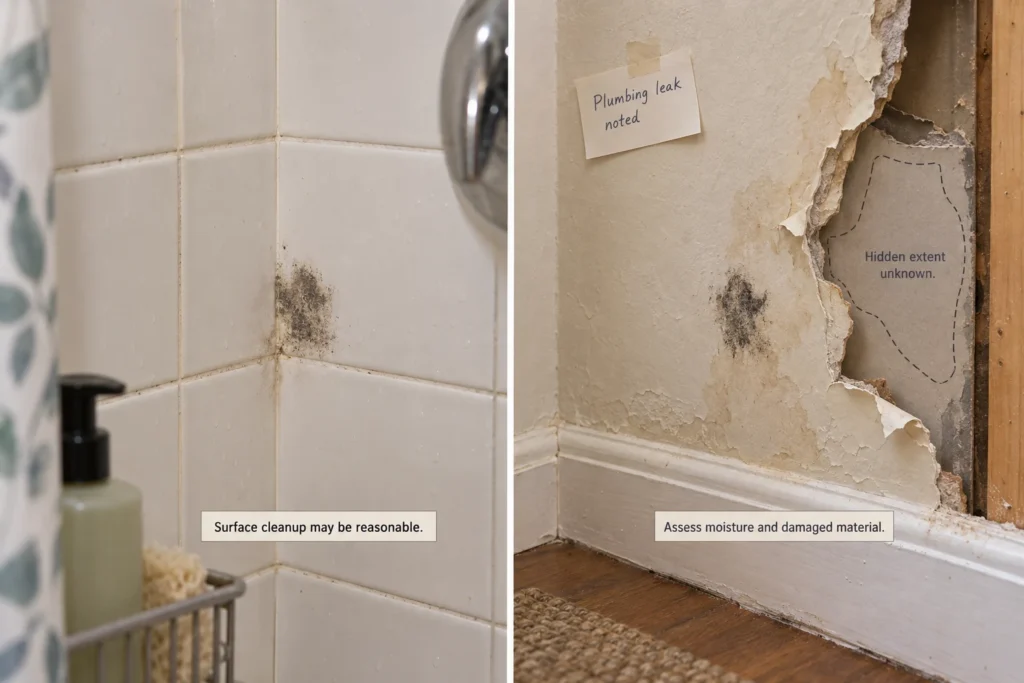
Imagine I’m reaching around the shampoo bottles to wipe a small patch beside the tub. The cloth is in hand, but the paint above the patch has curled away from the wall. I remember there was a report of a leak in the upper story. I’m annoyed to set everything down without cleaning the bathroom. The correct thing to do is report this to management, and photograph the damage.
Cleaning a small section of a surface does not tell you if there is mold behind a covering. The presence of mold does not tell you the level of danger that the mold presents. Visible mold in a home does not need testing to address.[3][4]
Is the material actually cleanable?
If mold is on a hard, non-porous surface, it can be removed with soap and water. For moldy porous materials, the mold can be throughout the structure of the material and can not be removed. This is the case with some building materials, like ceiling tiles, carpet, and drywall. Moldy ceiling tiles and drywall may need to be removed.[1][4]
Porous doesn’t automatically mean disposable. Some wood and valuable belongings can be recovered, depending on their condition and how deeply they’re affected. I wouldn’t throw out a sound wooden item solely because it isn’t glass, but I also wouldn’t soak or sand it as a household mold remedy. For a valuable item, ask a restoration specialist about recovery before choosing removal or replacement.[1][10]
The finish matters, too. For example, Kohler’s acrylic-module care document 1013851-5 prohibits abrasive cleaning and certain chemicals, including sodium hypochlorite, the active ingredient in chlorine bleach. That’s a specific product instruction, not a rule for every acrylic tub. It illustrates why a bottle labeled “mold remover” isn’t permission to use it on your shower.[6]
Clean the surface without adding a new problem
When dealing with a hard surface, there are less restrictions, and the EPA’s detergent and water method would be more appropriate. The CDC says that either a diluted bleach solution or detergent can be used, but the EPA recommends against routine biocide use. You don’t need to totally sterilize the room.[1][2][7]
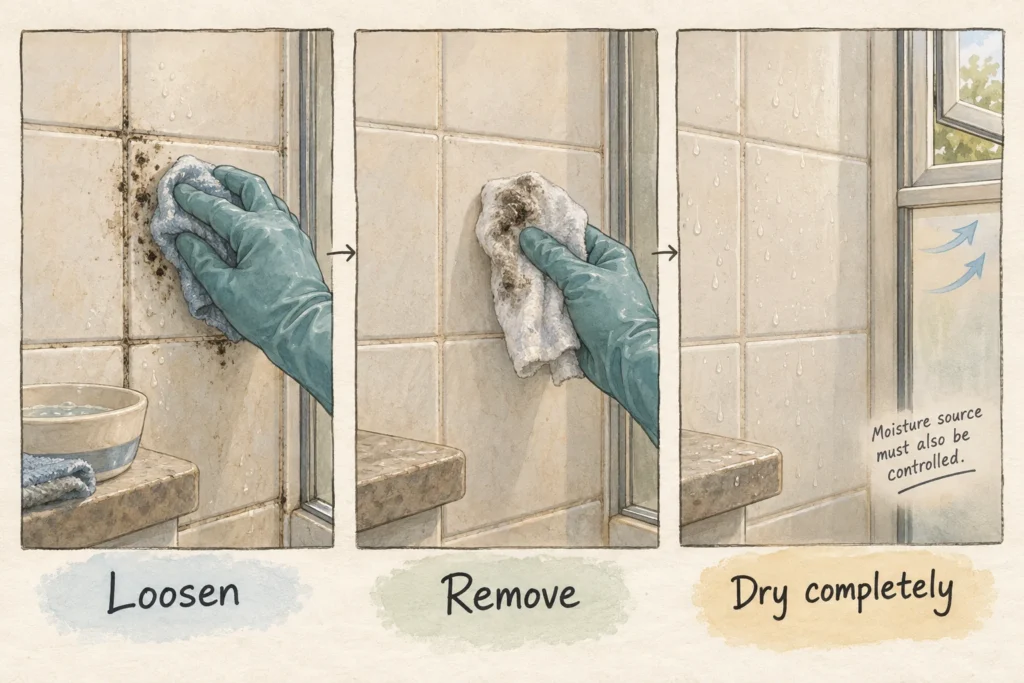
- Deal with the moisture source. If a leak is still feeding the area, arrange repair, a wipe-down won’t solve it. For ordinary shower wetting, allow for complete drying after cleanup and subsequent use.
- Use a NIOSH approved N95 respirator, a pair of gloves, and eye protection. Fit the respirator snugly. Use outdoor air for ventilation, and make sure the air is not directed at the mold.
- Clean with a small amount of detergent in water, using a soft cloth or brush, if your surface can tolerate it. Scrub the growth off, or wipe it away with the cloth, without soaking adjacent wall surfaces or other absorbent materials.
- After growth and cleaner residue have been removed, wash away the residue with a damp cloth, rinings the surface as needed. Make sure the surface is totally dry before painting or caulking.
Two or more cleaners or bleach mixed with a cleaner can produce dangerous fumes. If these symptoms occur, you should stop using the cleaner, leave the area, and get medical help. Mold may not cause these symptoms. Toxic substances can build up in your body and make you sick even if you can’t see or feel mold. Cleaning up the mold does not mean the room is now safe to use.[2]
If you rent, report the moisture, not just the spot
Take photographs of the mold and other damage. Notify your landlord or property manager of the location, approximate size, when you first saw it, any history of leaks, and if it has returned after a previous cleaning. State what you’d like done to evaluate the material and to stop the moisture issue. Be specific. For example, “please send mold spray,” is not as effective as “please inspect and address the damp, peeling wall.”
There are varied routes for reporting and enforcing landlord’s obligations to maintain your rental property, free of dangerous conditions, depending on your location. In NYC, HPD suggests you notify your landlord of the condition and to use the 311 service if the issue remains. In other places, contact your local code-enforcement agency for information on your complaint process; what is applicable in NYC may not be applicable to you.[9]
A lighter stain isn’t the finish line
After the surface has dried, look for any regrowth, and check for a musty odor. Test for a corrected moisture problem and check for water damage. Sometimes discoloration won't go away, so keep in mind that just because there is a discoloration on a surface, it doesn't mean there is still growth behind it.[1][8]
Mold will return on a surface that stays wet. It doesn't always mean there is a hidden leak. There is a chance that adequate moisture control is not being done. It is better to call in an expert to assess the situation rather than buy a stronger cleaner. Dry surfaces do not always mean that the wall behind it is completely dry.[4][8]
Sources and references
- US Environmental Protection Agency: Mold Cleanup in Your Home
- Centers for Disease Control and Prevention: Mold Clean Up Guidelines and Recommendations (2024-02-16)
- CDC National Institute for Occupational Safety and Health: Mold, Testing, and Remediation (2025-02-25)
- US Environmental Protection Agency: Mold Course Chapter 3: Finding Mold and Moisture
- US Environmental Protection Agency: Mold Course Chapter 9
- Kohler: Care and Cleaning Instructions, document 1013851-5
- US Environmental Protection Agency: Should I use bleach to clean up mold?
- US Environmental Protection Agency: Mold Course Chapter 7: Evaluating the Remediation
- New York City Department of Housing Preservation and Development: Indoor Allergen Hazards
- US Environmental Protection Agency: Mold Remediation in Schools and Commercial Buildings Guide: Chapter 5