


Obviously greasy dishes are problematic. A few heavily soiled bowls or pans suggest checking spray access and cycle choice first. If separated dishes or an entire rack failed, look at shared conditions such as spray-arm clearance and detergent release. I would use the pattern to look for the issue, not to say the pump or heater is broken.[2][3]
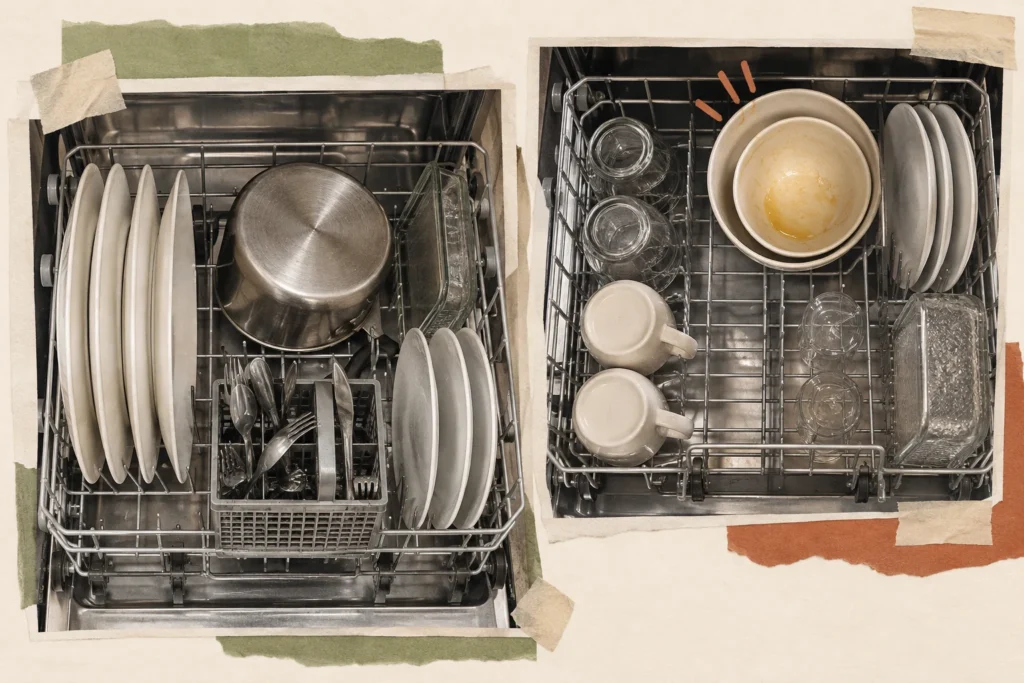
Handwash what you need to now. You don’t want to have to wait for another unchanged cycle to get dinner. Be warned, you may not be able to identify the residue by touch, so persistent slickness may need a different diagnosis.
Look at the failed dishes before rearranging them
| What you notice | What I’d check first |
|---|---|
| A few nested or crowded items | Whether another dish shields the dirty surface from spray. |
| Mostly heavily soiled cookware | Whether the selected cycle suits that soil and the cookware. |
| A whole rack or separated items | Spray-arm clearance, detergent release, and shared wash settings, not just spacing. |
Picture me unloading an imagined dinner load: the plates look clean, but two stacked bowls leave oil on my fingers just as I’m trying to serve leftovers. I’m annoyed enough to restart the machine. Then I notice the bowls’ hidden surfaces and change my plan: separate them before blaming the whole dishwasher.
Those shielding surfaces are problematic even if the spray arm is free to move. Bowls nested together can shield water from other bowls. A spoon hanging down from the rack can also block a spray arm. Turn the machine off and check clearance for the spray arm by using your model’s rack layout and see if the arm is catching on anything. Remove the item in the arm’s path.[3]
Don't always assume that a load is bad just because the whole load failed. Look at the detergent dispenser first. A large single item can get lodged in the dispenser and obstruct the opening, or it can get in the way of the water spray access and thus, spray the detergent. LG documents obstructions of dishware and rack positioning, although their instructions on rack positioning aren’t consistent across units. That’s why I’d look into this simple solution first before assuming widespread grease on machine parts. One large item in an incorrect position can obstruct numerous items and possibly fail a load of dishes.[7]
When the problem is spread through the load
A short cycle choice isn’t necessarily the wrong choice. The cycle chart for your model should tell you if the cycle is allowed for a greasy cookware load, and if greasy cookware is allowed at all. Detergent also needs attention. Use fresh automatic-dishwasher detergent, in the prescribed amount, for your model and your water hardness. I’d check that first before making any changes. Extra detergent won’t tell you why the first load of dishes failed.[1][2]
Nor would I turn up the water heater just because the plates feel oily. The temperature of water entering the machine and its programmed wash temperature are different things. The Bosch SHP65CM5N manual, for example, lists a cold-water supply and a maximum hot-water inlet temperature of 140°F, and warns that tablets may not dissolve in short cycles. That isn’t a temperature target for your dishwasher. The useful details to find for your model are its permitted inlet conditions and which cycles work with your detergent format.[1]
A clogged removable filter is worth checking, but I wouldn’t take this apart. Some Whirlpool models allow owners to remove the filter, while others do not. Identify which design your model has before removing anything. If removal is allowed, rinse the filter and clean it with a soft brush. Do not use a wire brush or scouring pad. Check the filter is seated and locked in the position your model requires. A filter dropped into place isn’t necessarily installed correctly, and pump covers aren’t the next thing to take apart.[4][5]
Give the next load a job
Skip another load if you see leaks or heavy suds. Stop running the dishwasher. For heavy suds, make sure the product used is not automatic dishwasher detergent, and do not add any more detergent or run the cycle again. For a leak or broad pooling, get help for that leak or drainage before attempting to clean again. A small amount of water pooled in the filter area is considered normal by Whirlpool, and rather than just saying “water remains,” indicate where the water is pooled. These observations do not identify the root cause of the problem.[6]
You can also perform a test-load after correcting what you can see, and load the comparison compartment with a moderately filled load of greasy dishes. Scrape off food scraps and don’t handwash away the soil you want to test. Leave the spray paths and dispenser clear, choose an appropriate cycle for the soil and setting, and note the detergent. The purpose of this load is to determine if the dishwasher is able to perform its normal job with the soil conditions present, not to just give dirty dishes another ride.
You can do this test a few times to try different settings.[2][3][4]
If the dishes come out clean, you can extract some combination of loading, settings and/or detergent that worked. This doesn't tell you which correction/adjustment you made that resolved the issue or to rule out an intermittent fault.
If the dishes still come out greasy, the same rack still fails, or an unobstructed dispenser still retains detergent, I'd request service as opposed to just running loads. Take the model number, affected locations, cycle, and detergent along with the comparison load result to service, that would be more useful than saying "it doesn't clean" to the service tech, to help validate an internal part failure.[2][7]
Sources and references
- BSH Home Appliances Corporation: Bosch SHP65CM5N Use and Care Manual (2023-08-21)
- Whirlpool: Why is my dishwasher not cleaning dishes properly?
- Whirlpool: Properly Loading a Dishwasher
- Whirlpool: Cleaning the Filter, Dishwasher
- Whirlpool: How to Clean the Dishwasher Filters
- Whirlpool: Not Draining, Water Remain at End of Cycle, Dishwasher
- LG Electronics: Dispenser Does Not Open Completely (2019-01-22)