

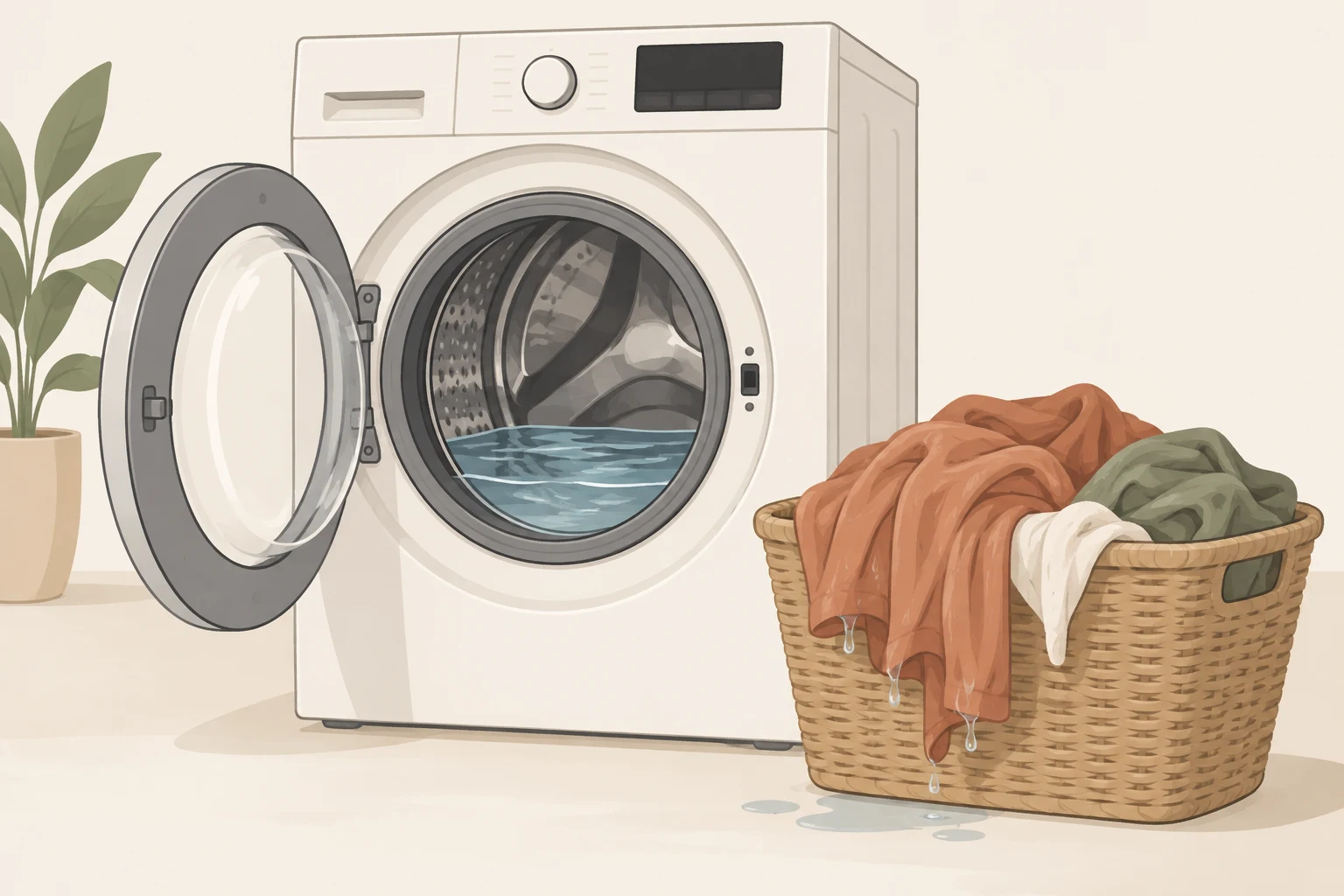
Don't restart the wash cycle right away. Clothes that drip wet after washing can result from lower spin settings, an uneven load, or a drainage/spin issue. Eliminate standing water in the tub first, then note down any error code. If neither of these indicates a persistent error, fix an identified setting or load issue and attempt one reload and re-extraction. Continuously wet laundry in an appropriate load calls for assistance.[1][3]
Standing water and errors come first
Water that remains in the tub is not the same as water that remains only in laundry. If the washer did not drain sufficiently, it may not even attempt to spin, so rearranging laundry won't fix that problem. Standing water indicates a need to troubleshoot the drainage rather than identify a failed pump. Exhausting visible standing water eliminates improper settings or load balance as the problem, but does not guarantee unrestricted drainage.[3][6]
Take a picture of the error before clearing it, then consult your model's error reference for that exact error code. Drain, door, balance, and sud errors have different suggested actions; the same error code on identical Samsung washers may indicate different problems depending on model. Adhere to the suggested action instead of assuming any error allows for a re-spin. A sud error can affect spin performance if excess suds are present, or even pause the cycle under some circumstances.[4][5]
Consult the model's drainage instructions to see if they either allow for user-serviceable troubleshooting or require professional service if water is still present. Household draining recommendations, potential warranty impact of hot-water variations, and instructions on what can be accessed by the user are not universally designed to say "clean these filters." Don't force open the washer door, disconnect any hoses, or open cabinet panels to salvage this wash load.[6]
Separate settings from load trouble
| Observation | What it suggests | Useful next check |
|---|---|---|
| Low or no spin was selected | More retained moisture may be intentional. | Verify the cycle’s spin behavior and the garments’ care limits. |
| A tiny load, one bulky item, or tangled bedding | The washer may have reduced or skipped spin because it could not balance. | Check the model’s load-composition and redistribution guidance. |
| One item is much wetter than others | Fabric retention or load imbalance is possible; this alone does not identify the cause. | Compare fabric type, tangling, and whether the item dominated the load. |
| Different suitable loads repeatedly finish soaked | A one-load imbalance explanation becomes less persuasive. | Document the cycle and warnings and request performance troubleshooting. |
Just because your cycle completed doesn't mean it tried to extract at the higher speed. Many washers link cycle type to spin speed instead of providing a dedicated spin control. The Whirlpool error manual referenced above mentions a soak cycle that fully drains but doesn’t spin. Verify what your chosen cycle is actually programmed to do before deciding wet clothes were caused by a malfunction.[2]
Speed isn't always the answer. If you fixed something that was causing the washer to spin at a lower speed, then the higher speed should extract more liquid. However, if the washer never reached that higher speed due to load imbalance, then increasing speed alone won't fix it. Load size is another factor; Samsung recommends slower speeds for small or bulky loads. How the load fits, what is being washed in the load, and any fabric softener used are more important than choosing "high" just because it's there. Dumping in a bath towel to weight the load is not universally helpful.[1][3]
If your laundry is soaking wet, it doesn't mean the load is balanced. One heavy or twisted-up article of clothing can cause the washer to either slow down spin rates or skip spinning altogether. One overly soaked t-shirt does not mean your load is unbalanced. What you put in the washer and how well it can be rearranged according to the manual are better determinants than picking the wettest laundry. Spin style and load size may have restrictions too.[3][6]
When one recovery attempt is useful
Only one reload should fix an identified issue: either your spin cycle was set improperly then adjusted without going beyond fabric settings, or you found the load was uneven then properly redistributed it. Double-check what operation your machine uses to extract water before running the wash again. Some washers have separate rinse cycles that also won't spin. Know your machine's settings.[1][2][3]
“It’s still soaking wet but my kids' sheets don't spin properly” may become: I don't see any water just sitting in the tub. There are no pending errors after restarting. My cycle setting should have spun but used a low spin setting. The clothes I'm washing are heavy and bed sheets bunch up easily. Due to all of the above, I think my laundry didn't spin because it was unbalanced. Since my model allows me to reopen the washer, I'll rearrange the load and try extracting again. Unfortunately, the laundry is still dripping wet.[3][6]
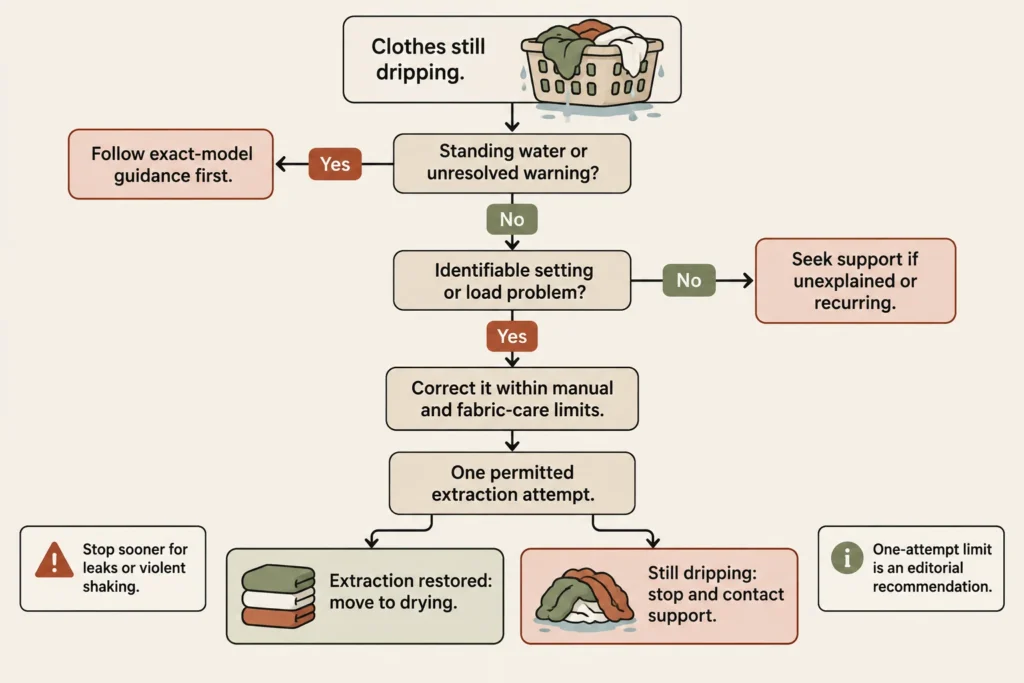
Obviously, if it's still wet after correcting what you think is the problem, there is a problem. Limit this advice to one reload if you think you corrected the issue. This isn't intended to apply to every brand's washers; it's a rule to stop trying before making the problem worse. Leakages, excessively violent washer movements, and errors indicating service are all reasons to not reload. Success is when it spins properly and the laundry isn't dripping, meaning it's sufficiently damp for what you washed and what cycle you used.
A load that remains soaked after correcting and reloading, or wet loads that consistently fail the same way across multiple acceptable loads, should be checked either by a professional or through manufacturer troubleshooting if available. Know what cycle and spin settings were used. Knowing the exact model of washer you have can help determine if it's drained correctly. Note if water remained in the tub and what error showed, if any. Tell them you've isolated the problem to draining and spinning, not heating or tumbling.[1][4][6]
Sources and references
- Whirlpool: Wet Clothes at the End of the Cycle, Washer
- Whirlpool: Use & Care Guide, document W10740536 Rev. A
- Samsung: Samsung washing machine spins poorly
- Samsung: Samsung washing machine information and error codes
- GE Appliances: Washer, Clothes Still Wet After Spin Cycle is Complete
- Bosch: Why are my Clothes Soaking Wet After Washing?