

A clean lint screen only checks one part of your dryer. In a vented dryer, a restriction farther along the exhaust path can leave clothes damp, despite plenty of heat. Wetter laundry, unsuitable settings, or a sensor cycle ending too soon can result in repeated cycles. If yours is ventless, the moisture removal system requires a different set of tests. I would be more concerned with the type of dryer and what changed, as opposed to an additional hour on the timer.
Picture me, in an imagined laundry evening, reaching for the start button while a damp bath mat holds up the school clothes behind it. I'm annoyed enough to add another cycle automatically. Then I remember that this same load used to finish without the extra round. I leave the button alone and note what changed. The pile still needs drying, but another restart won't explain the delay.
Where does your dryer send the moisture?
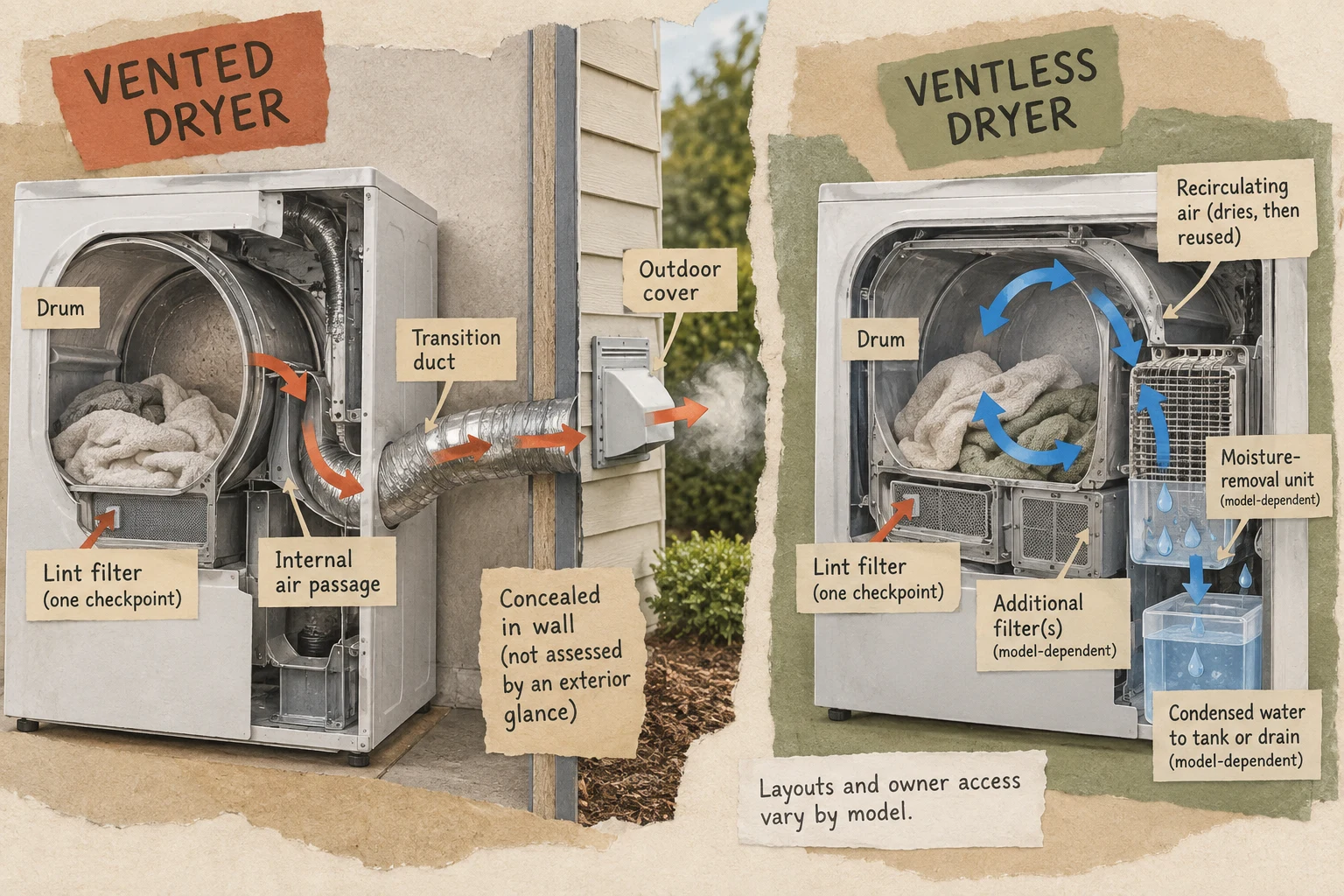
A vented dryer expels moist air via a duct to the outside. The lint screen is in this duct. It will not show you condition of passages and connectors behind the machine, and the ducts in the building. Heat can help evaporate the water, but air needs to move the moisture away. More time on heat won't help if there is a clog.
Dryers with condensers and heat pumps, as an alternative to vented dryers, remove moisture by condensing it and retain the moisture in the exhaust air. Heat pump dryers recirculate air and remove water to a tank or drain.
What changed matters more than the number of minutes
Give more weight to “this dryer takes longer than my old one” than “I need two cycles to dry the towels.” Starting condition of the fabric and load, as well as the settings can affect drying time. Some heat pump dryer settings can leave you feeling like you are doing something wrong, by taking too long. There is no drying time that can give you a definitive answer that something is amiss with the machine.
Keep the load check short. Is the washer leaving clothes unusually wet? Are there towels mixed in with shirts? Is the drum just too full? For more on why clothes might still be wet after a wash cycle, check out [Why Are My Clothes Still Dripping Wet After the Washer Finishes?](https://cleanhomeroutines.com/clothes-dripping-wet-after-washer-finishes/). For room to tumble and sorting, check out [Load Laundry for the Dryer, Not Just the Washer](https://cleanhomeroutines.com/load-laundry-for-dryer-not-just-washer/). You don’t have to overhaul your entire laundry routine just because of a single bad load.
Also separate a cycle that reports normal completion too early from a machine that unexpectedly shuts down. A very small sensor load may not contact the moisture sensors reliably; deposits on accessible sensor surfaces can also affect operation. Check the model's minimum-load guidance and permitted sensor-cleaning method. An unexplained shutdown isn't something I'd dismiss as a picky sensor.
For a vented dryer, look without taking anything apart
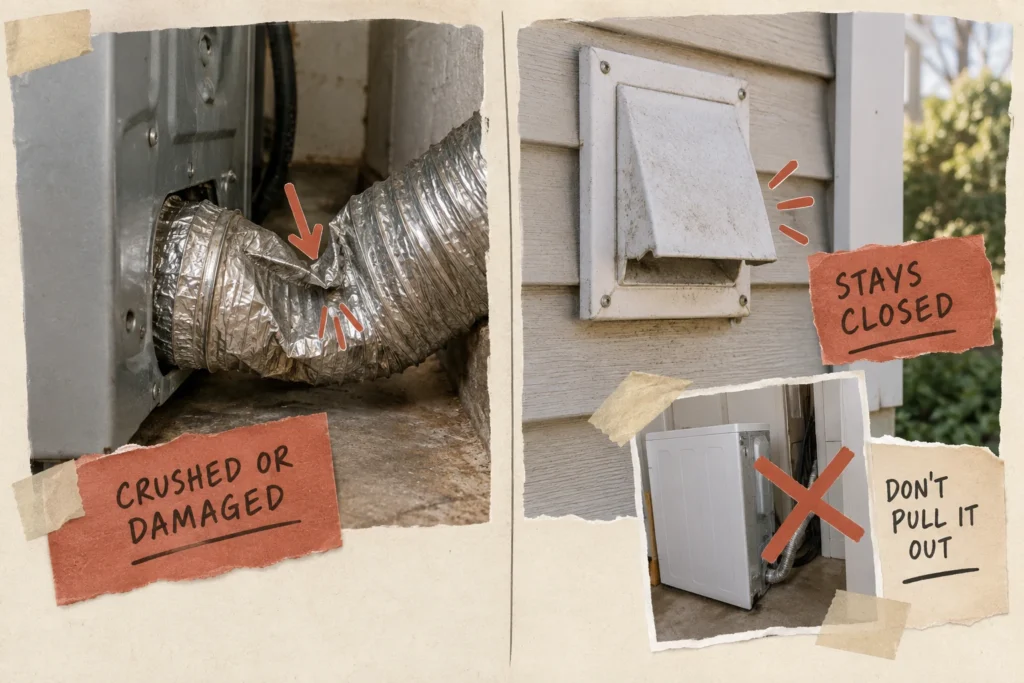
The U.S. Fire Administration treats lint-filter care and vent care as separate jobs. It recommends checking for crushed or damaged venting and whether the outdoor cover opens during operation. Limit your observations to what's already safely accessible. Don't pull the machine out, disconnect ductwork, climb to a roof outlet, or run with the exhaust disconnected.
| Accessible clue | What it tells you | Useful next move |
|---|---|---|
| Visible connector is crushed or damaged | The exhaust route needs attention; you haven't assessed the hidden duct. | Request vent or installation assessment rather than moving the dryer yourself. |
| Outdoor cover stays closed during otherwise normal operation | An exhaust or cover problem is possible; the observation doesn't locate it. | Stop further comparison runs and request vent assessment. |
| Outdoor cover opens | Some outward flow is present, not proof of adequate airflow or a clear duct. | Don't use this alone to dismiss persistent slow drying. |
| An existing airflow or vent alert appears | The model has flagged a condition that needs its specific interpretation. | Record the exact message and request the assessment described for that model. |
Observe an exterior cover only when doing an otherwise appropriate drying cycle and when there are no obvious signs of a blockage or damage. Do not start a drying cycle to check for blockages. This is particularly true if the cover is on the exhaust.
Even the screen deserves one distinction. Removing loose lint is not the same as removing residue that obstructs the mesh. Whirlpool’s W11045671B guide addresses clean-up of screen residue separately. Use the washing method allowed for your model and dry the screen prior to reinstalling it. This may resolve a filter issue; however, it does not answer the question of hidden venting.
Ventless maintenance isn't one interchangeable cleaning job
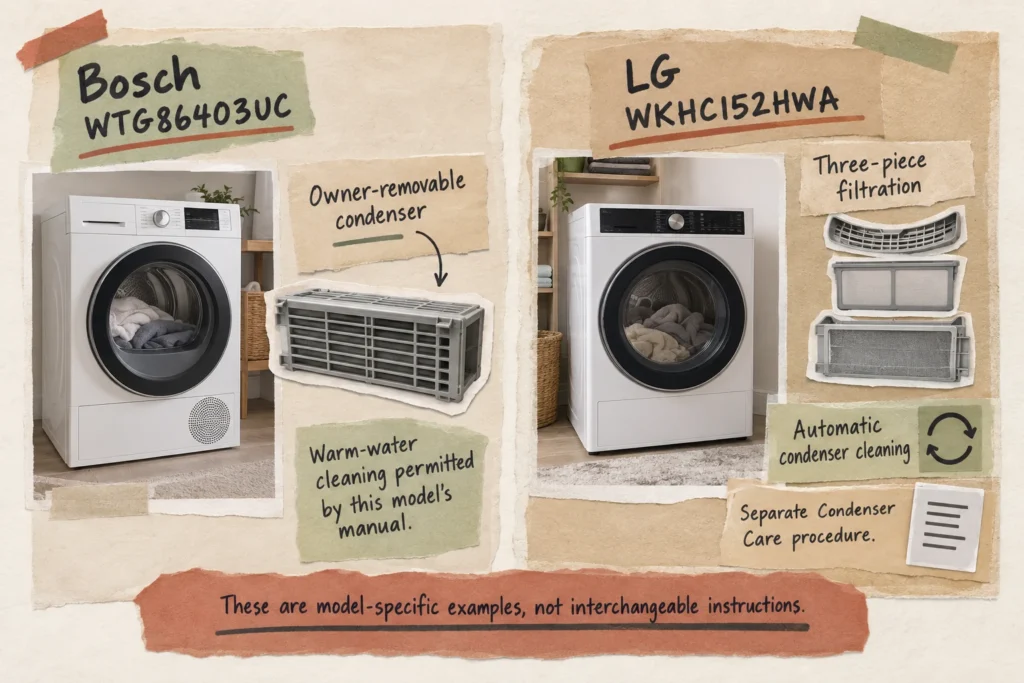
Now I will include the specific model and not just a ‘clean the condenser’ tip. The Bosch WTG86403UC model permits removal of its condenser for clean up with warm water approximately once a month, under normal conditions. It also states that room temperatures outside of 59-86°F may also cause a long drying time. These conditions and permissions belong to this model and not all ventless dryers.
The LG WKHC152HWA model has an automatic condensers, three-piece filtration and a separate Condenser Care procedure. This is also not a removable condenser. Check all filters named for your model, keep the room air inlet clear, and attend to the tank/drainage messages, as directed for your model. Don't open the cabinet or reach into a heat exchanger that isn't designated for owner cleaning.
Choose the help that matches the clue
Visible damage to a vent, a closed exterior cover, or an airflow alert indicates that an evaluation of the vent is necessary. Lack of heat on a heated cycle or persistent trouble after permitted ventless maintenance indicates appliance service is warranted. Turning of the drum in a dryer does not confirm that the dryer is heating. It is possible that the vent may be blocked and the appliance is not working. The presence of these issues are more directional as to why service is being requested rather than which part has failed.
Request a management assessment for rental units, shared exhaust, or inaccessible installations. Provide the full model number. If performance changed, explain the type of load being used, cycle being run, and any alerts. Discuss any heat or odor being present and say that you are no longer using the appliance. This may provide more help to the next person than stating “the screen is clean.”
Sources and references
- U.S. Fire Administration: Clothes Dryer Fire Safety
- U.S. Department of Energy: Energy Saver Guide, laundry section (2022)
- Whirlpool Corporation / Maytag: Electronic Dryer Use and Care Guide W11045671B
- BSH Home Appliances / Bosch: Bosch WTG86403UC Use and Care Manual
- GE Appliances: Dryer, Taking Too Long to Dry Clothes or Not Drying at All
- LG Electronics: LG WKHC152HWA 2024 Owner's Manual (2024-01-22)
- ENERGY STAR: Heat Pump Dryer
- GE Appliances Factory Service: Why Does My Dryer Keep Shutting Off?