

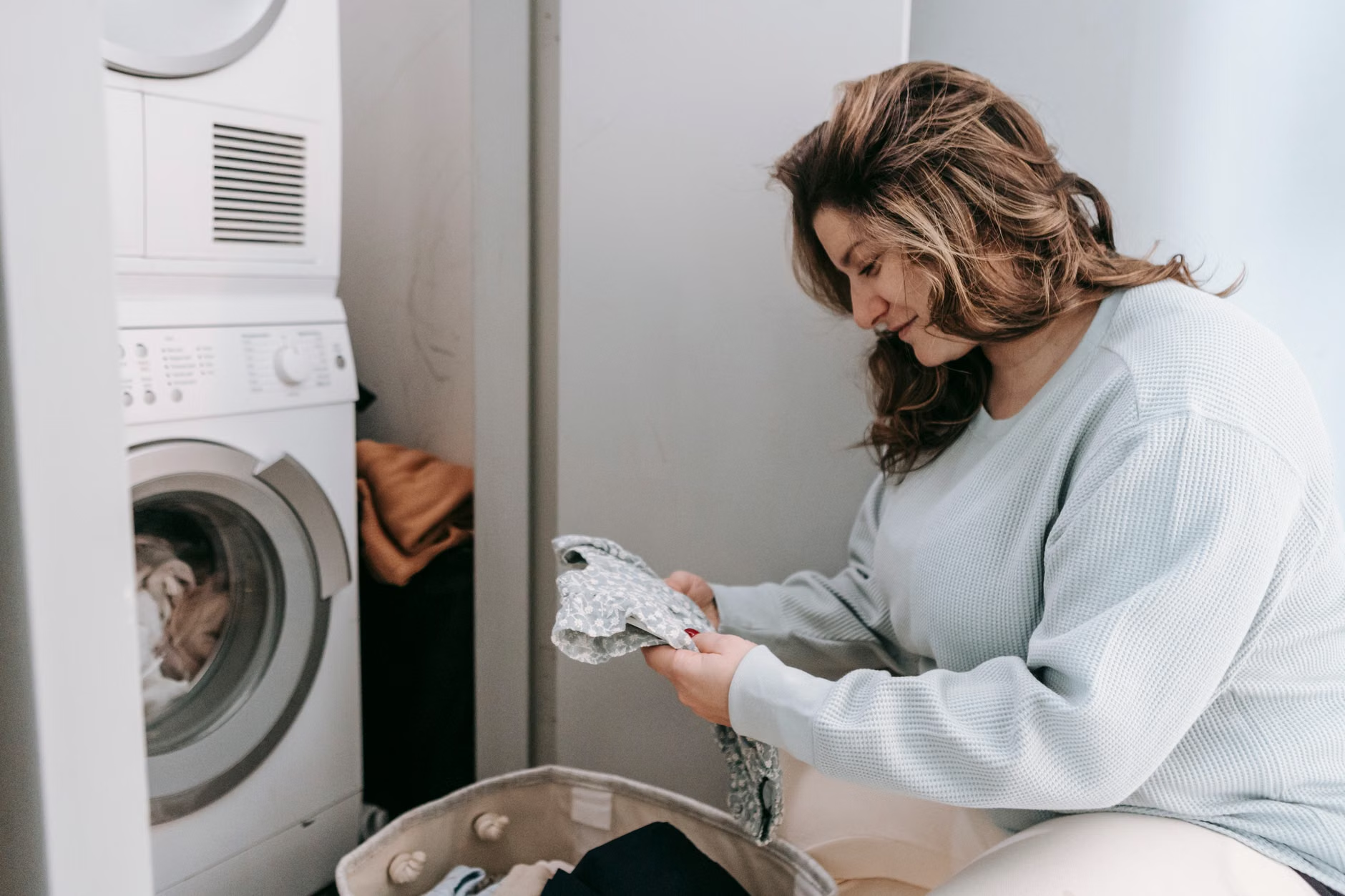
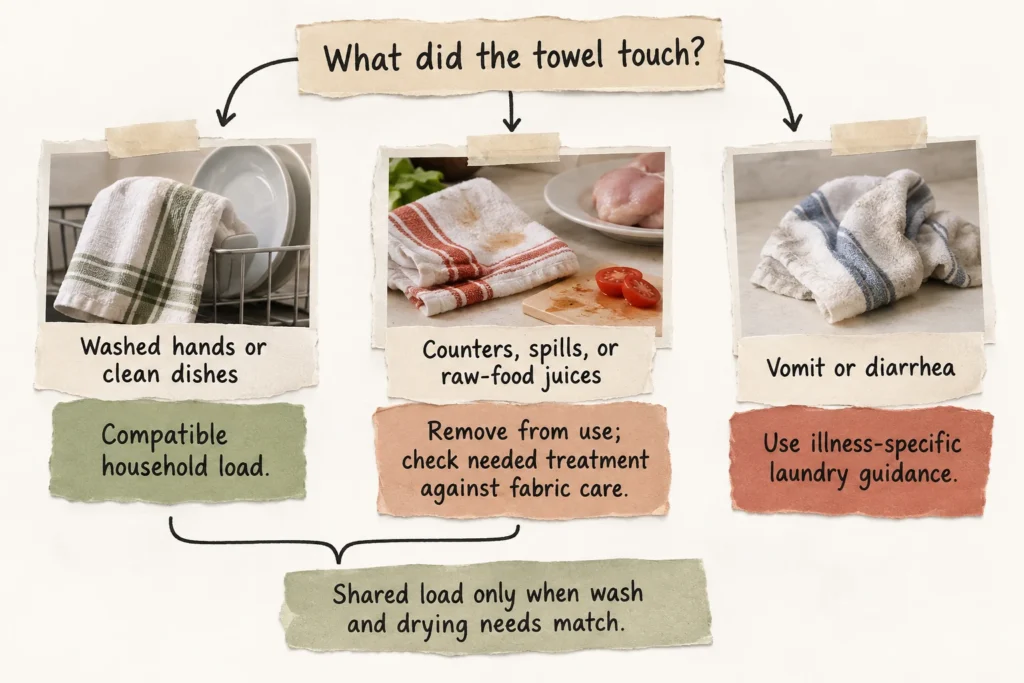
Yes, towels that are only used to dry hands or to clean dishes can be washed with the rest of the household towels. I'm not running a separate load for those towels. A cloth that has cleaned up raw meat juices or soil or has cleaned up vomit or diarrhea needs a different decision.[1][5][7]
I'm getting this answer from CDC household laundry guidance and sorting advice from fabric manufacturers. This is not a kitchen-towel mixing rule from the USDA or proof of no risk. What is important is if everything in the load can get the wash it needs.[1][5]
The towel’s job matters more than its address
Picture me holding two hand drying towels next to a waiting load of sturdy, similar colored cotton clothes. Adding a third load means I have to make an extra trip downstairs. Since the towels and the clothes can take the same wash and both are drying fabrics, I can combine the loads. The cloth that has cleaned up raw chicken stays out.[1][5]
Dishcloths and towels used to dry dishes or plates are not the same as the towels used to clean up raw meat. The USDA recommends washing dishcloths frequently on a hot cycle. The University of California Cooperative Extension also recommends replacing a cloth that has cleaned up meat juices. Replacing means not using the cloth to clean anything else and reaching for a different cloth, not getting rid of the cloth.[2][3]
Handle a known raw food cleanup cloth differently than normal drying towels until you decide what, if anything, to do differently with its care. That different treatment will help prevent it from being used or ignored in the regular pile. As for what it is washed with, if it tolerates hot wash like some drying towels, then that’s what it should be washed with. The reviewed food-safety guidance does not dictate a kitchen-only load, so it is really up to your discretion. I’d be hesitant to promote it to a “drying towel” if it has a history of raw-food contact, as it may have a multipurpose history.[2][3][5]
Vomit or diarrhea contamination falls outside this ordinary-load advice. Handle those items promptly, wear gloves, and don’t shake them. Use our [vomit- and diarrhea-contaminated laundry guide](https://cleanhomeroutines.com/clean-vomit-diarrhea-laundry-without-spreading-contamination/) for the illness-specific washing and drying instructions.[7]
A separate load doesn’t fix a care-label conflict
There is a possibility that food safety and care of towels can conflict. Williams Sonoma’s Classic Logo towels are 100% cotton, yet their care directions specify warm washing and non-chlorine bleach only as needed. “Cotton” doesn’t mean that towels can be washed with hot water and chlorine bleach.[2][4]
I would replace the raw-food spill towels for dishes and food contact towels, and make warm-only towels available for drying, rather than use them for food-contact and raw-food spill towels and guess that their normal wash is good enough. The raw-food spill towels should not be used for dishes either. Raw-food spill towels are better off not being used at all until hot-wash-compatible towels are purchased. Disposable towels can also be used for raw-food spills until then.[2][3][4]
For your regular mixed load, match temperature, cycle, colors and soil level. Heavy soil can justify a separate load, and lint-shedding towels are not good with lint-catching clothes. Other reasons to separate things are not applicable to the kitchen load.[1][5]
Leave space for the clothes to tumble and be mindful of the load limit. There is no specific towel count for an optimal wash. Towels need not be washed with sanitizer and/or bleach just because they are kitchen towels.[1][5]
Finish the wash before calling the towel ready
Follow the instructions on the towel to dry it completely. In a mixed load, check the towels rather than assuming they are dry because the shirts are. Wash your hands after handling the laundry, and clean the laundry basket and the place where the towels are stored.[1]
Always wearing a freshly washed and completely dried towel is nice. I like to judge towels by how they were treated and how completely they dried. Towels only dried washed hands or dishes are good to use and do not need a separate load.[1][5][6]
Sources and references
- Centers for Disease Control and Prevention: When and How to Clean and Disinfect Your Home (2025-01-31)
- USDA Food Safety and Inspection Service: Cleanliness Helps Prevent Foodborne Illness
- University of California Cooperative Extension, Master Food Preservers of El Dorado County: Cleaning & Sanitizing the Home Kitchen (2026-04)
- Williams Sonoma: Williams Sonoma Classic Logo Towels, Use & Care
- Whirlpool: Whirlpool Front-Loading Washer Owner's Manual W10656460B
- Journal of Applied Microbiology; record hosted by National Library of Medicine: Impact of wash cycle time, temperature and detergent formulation on the hygiene effectiveness of domestic laundering (2014-10-13)
- Centers for Disease Control and Prevention: How to Prevent Norovirus (2025-01-13)