


When dust accumulates faster in one room, look where dust collects and reappears. Clean some sample surfaces and change one or more likely sources or routes. Then, over equal periods of time, compare the two. I would do this before I bought an air cleaner: what matters is figuring out what reduces the need for repeat work, not what kind of device I should buy to possibly resolve an unknown issue.
Imagine I’m wiping a bedside table again while the dresser down the hall still looks fine. I’m annoyed enough to start browsing air cleaners, then notice that the table sits beside the window I open every afternoon. I close the shopping tab instead. That window hasn’t confessed to anything, but it gives me one inexpensive change to try.
Follow the location and timing, not the color
Shelf dust and dust along a walking route are very different starting points. Large particles can collect along paths or on furniture via one of many possible routes. You can't just look at a deposit to tell what its size is or what it is made of.
Consider if accumulation predominates on a window, bed, or air grille, if it happens after airing out the room, making the bed, or running a particular device. Compare similarly placed surfaces. For example, a dark bedside table, when placed in sideways light, can demonstrate dust more readily than a pale dresser.
| What you notice | A modest response | What it doesn’t prove |
|---|---|---|
| More accumulation near a frequently opened window | Try a comparable period with that window closed, if comfort and necessary ventilation allow. | A difference suggests the opening matters; it doesn’t identify outdoor particles. |
| Dust returns after bed-making or activity around upholstery | Vacuum one accessible nearby reservoir using the textile’s approved method; leave other routines unchanged. | Activity may redistribute old dust. It doesn’t prove the fabric is shedding. |
| Deposits appear while an ultrasonic or impeller humidifier runs | If optional, pause its use for a comparison; check its water and maintenance requirements. | A pale deposit alone doesn’t identify minerals or rule out another source. |
| Dust gathers on an air grille | Distinguish an intake return from a supply outlet; clean the accessible grille face and check owner-serviceable filtration. | A dusty return doesn’t establish dirty ducts. Particles visibly blowing from a supply deserve a separate assessment. |
The bedding possibility deserves some restraint. A chamber study using an artificially dust-loaded mattress showed that movement can lift settled particles back into the air. That supports a mechanism, not a diagnosis of your bedroom. A room can repeatedly redistribute a reservoir of dust without continuously producing new material.
Humidifiers are also leads. Particularly, both ultrasonic and impeller models can disperse minerals from their water. The EPA recommends using low-mineral water, like distilled water, for humidifiers to help lessen this. Evaporative and steam humidifiers do not disperse substantial minerals. Cleaning or replacing water of a humidifier does not replace regular cleanings of the device.
Give one small change a fair comparison
Pick two convenient locations, possibly a bedside table and a shelf located away from the suspected pathway. Dust these areas with a soft cloth using the finish’s recommended cleaning method. The EPA recommends dusting using a slightly damp cloth to avoid releasing dust into the air. Finishes that allow this method are to be slightly damp, not wet. Ethan Allen allows using a slightly damp, lint-free cloth on their wood furniture. This should not be taken as permission to damp-wipe sensitive or electronic items.
Capture an image of dusty spots after an interval in which the problem is normally evident. If the problem usually appears after three days, take a picture of the spots after three days of your normal routine. Clean the spots, and change only one variable for the next three days. Take an image of the spots after the three days, keeping the same lighting and angle as before. Don’t close the window, wash the curtains, and add a new purifier all at the same time. You’d have no way of knowing which effort made the difference.
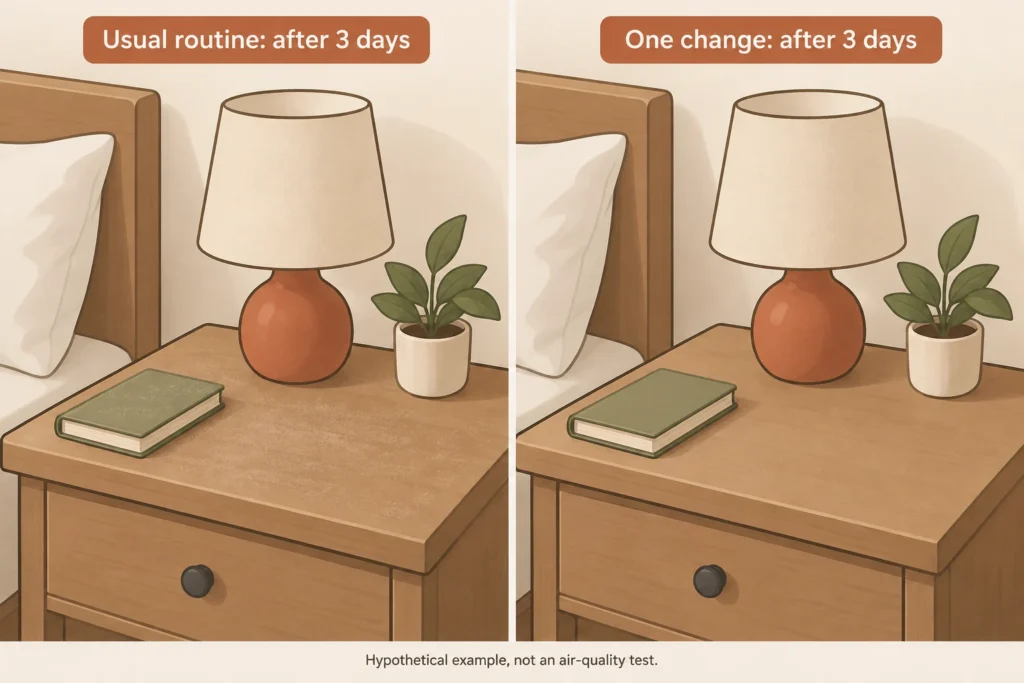
There are many reasons to keep small changes that don’t prove what the dust contains. If no changes are noticeable, I would look into that lead. Heating and cooling schedules, as well as the use of a particular room, can throw off the comparison. Keeping all of this in mind, perform repeat tests to compare differences. This is more of a practical method for judging the work being done, rather than an air quality test.
Check the filter without redesigning the HVAC system
Return grilles are, by design, dirty air returns. EPA does not support routine duct cleaning and a single dirty return grille would not warrant a replacement. Knock off the dirt you can reach without going into the ductwork. It is best not to obstruct airflow by, for example, sealing off return grilles, or by using register filters to catch dirt.
Replace owner-accessible filters according to manufacturer’s instructions as supplied with the equipment. Equipment shut down may not be required for all systems, or it may be shut down in a different manner than specified in the instructions. Make sure the filter is installed to seal completely and that the airflow arrow points in the direction specified. Air filters, like all mechanical parts, have a finite life. When filters are made of media which is designated as reusable, the filter can be washed and dried as specified before reinserting into service.
Relying on a "more is better" theory for filter replacements is not supported; the system must be able to support additional airflow resistance. If you are required to remove more than the specified number of service panels for filter access, that should be left to maintenance. If you can see particles blowing out of a supply air outlet, that is reason for concern and an HVAC professional should be called.
An air cleaner answers a different question
A portable air cleaner cleans particles in the air that it comes into contact with. Larger particles tend to settle before that happens. That’s why a dusty shelf doesn’t mean air filtration has failed. Likewise, a cleaner shelf doesn’t mean improved air quality, lower allergens, or absence of harmful particles.
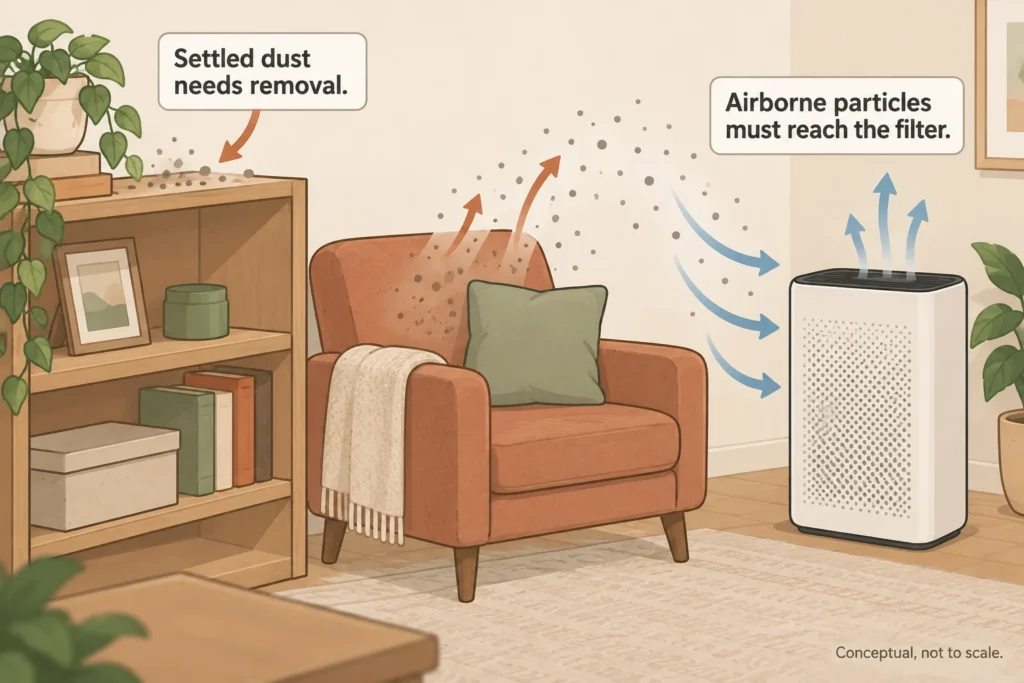
Particle filtration is determined by the clean air delivery rate (CADR) and the recommended room area. A 10-by-12-foot room is 120 square feet; high ceilings and connected spaces need additional consideration. Find a model that is comfortable running. Lower fan speeds means less air is filtered. Keep the intake and outtake unrestricted. Avoid using devices that produce ozone.
There’s one important exception to casual dust trials: debris associated with disturbed old building materials, deteriorating paint, or renovation work. Don’t dry-brush, sand, or run an ordinary vacuum over suspect material. Keep activity away from it and contact the property manager or an appropriately qualified assessor; appearance can’t rule out asbestos, lead, or other hazards.
For normal recurring dust, I’d hold off on the purchase of air filtration equipment until you find out whether a minor change reduces the build-up of dust. You don’t need to know the composition of every dust particle to know that less work is better.
Sources and references
- US Environmental Protection Agency: Sources of Indoor Particulate Matter (PM)
- US Environmental Protection Agency: Residential Air Cleaners: A Technical Summary, Third Edition (2018-07)
- US Environmental Protection Agency: Guide to Air Cleaners in the Home
- Indoor Air; indexed by the National Library of Medicine: Characterizing particle resuspension from mattresses: chamber study (2014-09-12)
- Carrier: AC Filter Replacement Guide
- US Environmental Protection Agency: Use and Care of Home Humidifiers
- US Environmental Protection Agency: Should You Have the Air Ducts in Your Home Cleaned?
- Ethan Allen: Ethan Allen Use & Care