

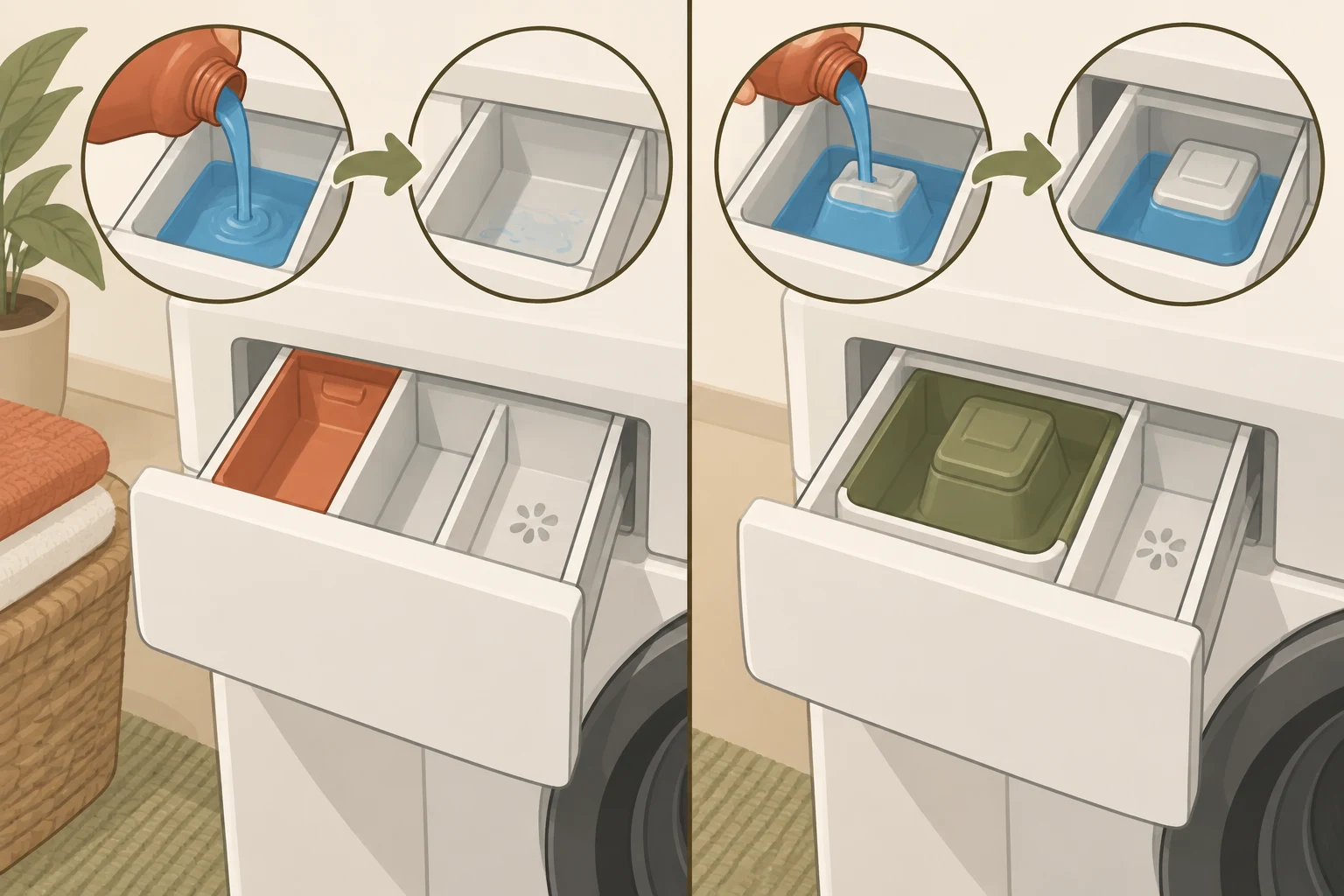
Detergent can end up in a washer’s drawers due to a number of issues such as the wrong compartmental setup, product buildup or dispensing problems. However, before you assume any of these, you should first check if that compartment is supposed to empty. A washer with a multi-load reservoir will intentionally hold onto some detergent for subsequent loads. A washer with a single-load compartment will empty the compartment. However, some models with single-load compartments will intentionally leave behind a small amount of water, which can also contribute to buildup. I would explore these distinctions before either purchasing more detergent or scheduling a service call.
The drawer alone will not be able to tell you how much detergent made it into the load or if the clothes were sufficiently cleaned. However, the drawer will be able to point you in the right direction on your next step. For example, it could tell you that you have a buildup of product and need to remove and clean parts of the washer.
Is this a dose for one wash or detergent stored for several?
“Automatic dispenser” is an ambiguous name. It can refer to either a conventional dose release drawer or a bulk reservoir. Look at the dispenser diagram for your model. The word “automatic” by itself doesn’t explain it’s behavior.
A full bulk reservoir indicates that detergent is present, not that the washer is set to use it. Samsung separates bulk dosing from concentration settings. Whirlpool lists disabled bulk dosing as a reason their machine may not dispense. Therefore, I would check those controls before assuming stored detergent is a fault.
Turn off bulk dosing on your control so you don’t use it in conjunction with single dose. Also, don’t expect a drop in reservoir level after one wash to indicate that all the detergent was used; there isn't a set amount that determines this.
Water left behind isn’t the same as detergent left behind
You may not need a perfectly dry drawer. LG documents that a small amount of water can remain after a cycle; this is good news if you've been trying to get rid of every last drop.
Something other than a normal, finished cycle deserves a second look. Note what remains, and which compartment contains it. Clear liquid does not mean it is only water, and there is no universal ‘acceptable’ depth. The main reassuring point in the design of your model is to show how residual water is modeled, and your observation is aligned with that.
Match the product to the compartment and its inserts
A main-wash, prewash, and softener compartment are different, and are not interchangeable. Check your drawer diagram against the product and cycle/option you have selected. Product remaining in a compartment scheduled to disperse product is different from product remaining in a compartment not scheduled to disperse product.
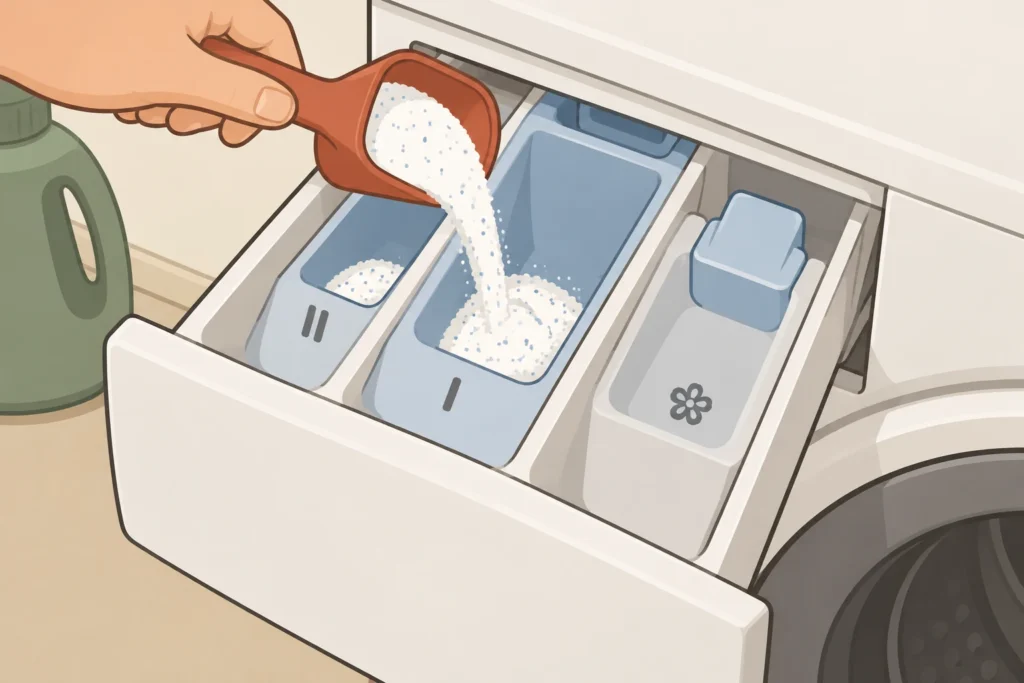
The arrangement of the inserts is important as well. In the LG WM8900HBA-family manual, the liquid detergent cup is to be removed for powder use; LG states powder will not disperse with the cup fitted. Other washers may use a flap or other mechanism. This is one place a nearly identical looking drawer can give you the wrong answer.
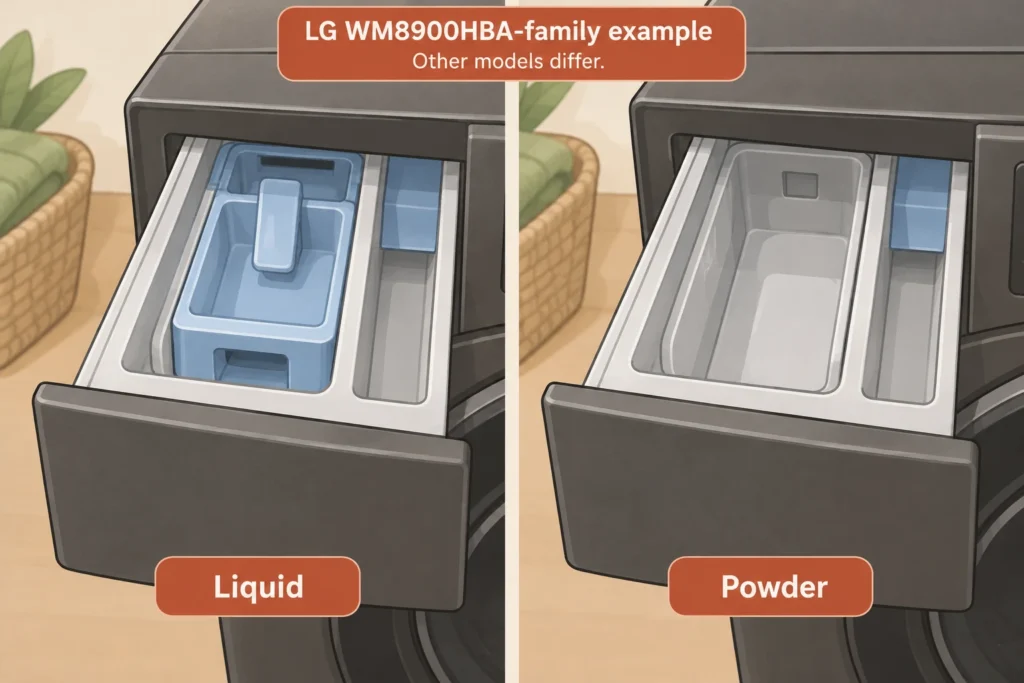
Imagine I’m looking at a little mound of powder in that LG drawer while the laundry basket blocks the doorway. I’m annoyed enough to start shopping for liquid detergent and then notice the liquid cup is still fitted. I’d put the shopping list aside, correct that documented setup and clean the permitted parts, then judge the next completed wash. A different bottle wouldn’t answer the actual question.
Use the dose indicated by your washer’s conditions and your load, within the compartment limits. The MAX line is a ceiling and not a target; Samsung warns that going over it can cause premature release. For automatic liquid-only reservoirs, don’t substitute powder or use your own concoctions. The washer’s product requirements and the detergent’s concentration both play a part.
Laundry pacs normally go in the drum along the clothes, not in an ordinary detergent drawer. Tide makes an exception for washers with a pac dispenser designed by them. Always check both your washer’s diagrams and the pacs’s package, don’t assume any compartment will do.
Clean only the parts your washer lets you remove
Dispensing can be disrupted by buildup. Pieces put back in the wrong position can also cause issues. If you see deposits, cleaning the dispenser may help. However, that doesn’t mean you should always pull harder on a stubborn drawer. For Whirlpool machines, removable drawers are the only parts that the user can remove. Turn the washer off, disconnect the power if that is specified for your model, and follow Whirlpool’s release method for owner-removable parts only.
Even the cleaning liquid for the drawer may vary. Whirlpool allows the use of mild soapy water for cleaning the removable drawer. LG manual used in this case says to use water and a soft brush for the drawn out inserts and drawers. They may be using different equipment.
Remove cups and inserts and clean them as well, if needed. Seat the drawer fully. Once again, don’t go past the limits and don’t probe internal channels of the washer. For the parts you can’t clean, don’t attempt a generic cleaning tip. Those parts would require a vinegar soak, bleach treatment, or dishwasher cycle to be cleaned.
What would make me stop troubleshooting the drawer?
Consider installation if the washer was just moved or looks like it is tilted. Samsung says that an unlevel washer can impact dispenser siphons. Check the model’s leveling needs rather than guessing how to tilt it. If adjusting the installation means moving the heavy washer or breaking connections, that should be done by the installer or service person; there is no justification for moving hoses, breaking connections, or checking water pressure.
The next completed wash that utilizes the affected compartment is the best recheck. If the same build up happens again with proper setting and allowed cleaning or if several compartments have the same problem, I would contact service for the model rather than continuing to clean it. For bulk dosing, utilize the permitted settings and the manufacturer’s suggested indicators rather than taking a guess to see if the reservoir is empty.
Take the model number and a picture of the compartment, send a picture of the product and the dose, the cycle and dosing settings, and what you corrected. “Powder remains in the main-wash compartment after a completed cycle, with the documented powder setup” gives them a clear picture of the problem. You do not always have to identify a broken part in order to describe a problem.
Sources and references
- LG Electronics: LG WM8900HBA-family owner's manual, operation and dispenser maintenance
- LG Electronics: LG Washer, Water Left in Dispenser (2026-05-28)
- Samsung Electronics America: Dispenser drawer issues in Samsung washing machine
- Samsung Electronics America: Use the auto dispenser on your Samsung washing machine
- Whirlpool: Bulk Dispenser Not Dispensing
- Procter & Gamble / Tide: How to Use a Washing Machine: Frequently Asked Questions