

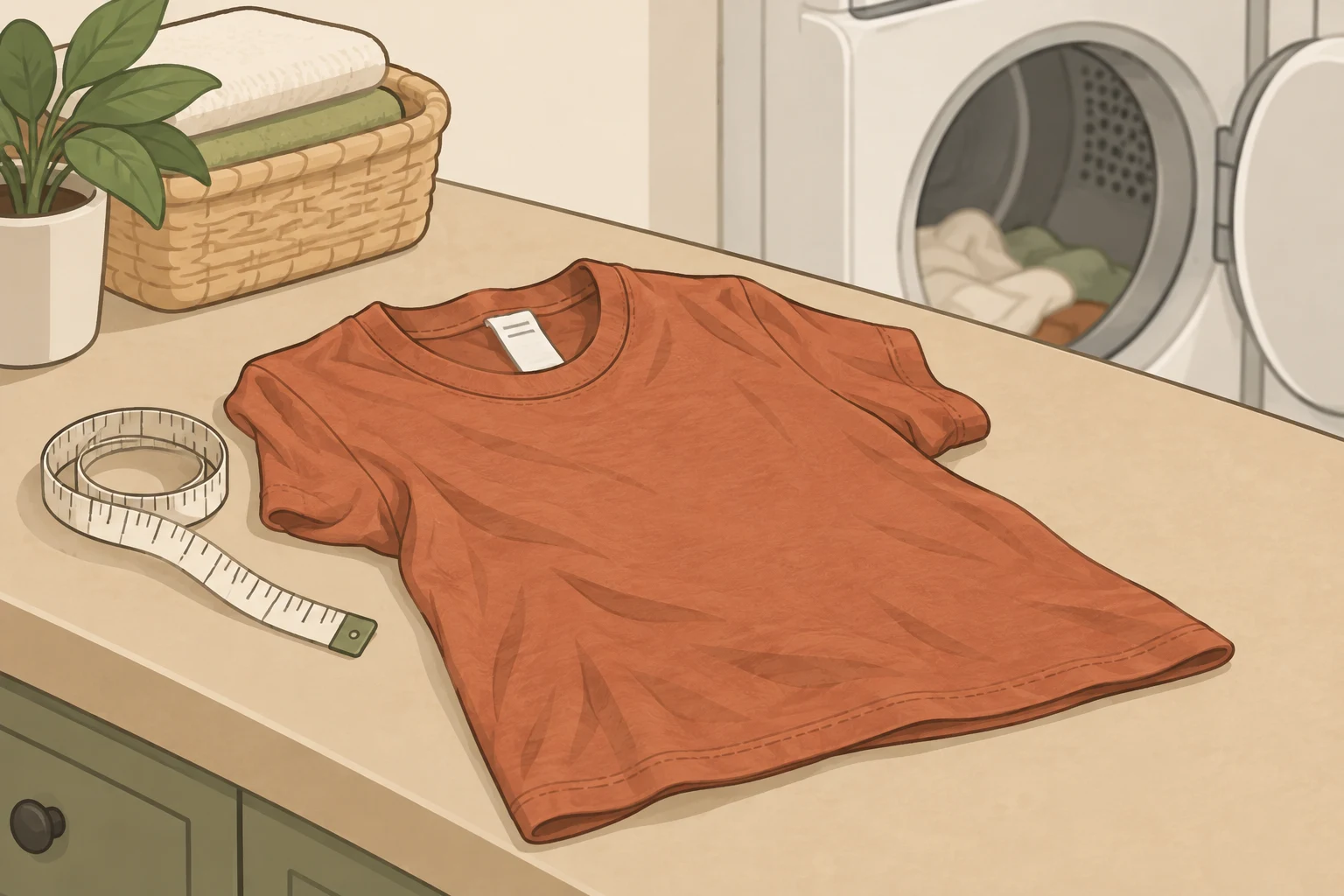
Clothes can shrink on a low heat cycle because there are other ways to alter the dimensions of a fabric. Cotton fabric can become more compact as its structure relaxes when it is subjected to laundering. Untreated wool can felt as a result of mechanical action of washing and tumbling. There are effects of low heat that can’t be removed by taking clothing out at low heat. I take out of rotation a piece that I keep sacrificing to the supposedly gentler cycle.
Imagine I’m pulling a favorite cotton shirt over my head and finding that the hem no longer reaches my waistband. Low heat was supposed to be the careful choice. Annoyed, I consider an “unshrinking” soak. I set it aside and check the fabric and care label before adding yet another treatment.
Cotton can change shape without high heat
A cotton shirt is yarn that is arranged in a knitted loop or a woven structure, and then processed and finished. Tension left in the fabric during manufacturing can cause the fibers to be under tension. Relaxation shrinkage occurs when that tension is released in the fabric during a washing process. This can help explain why two shirts made of 100% cotton can behave differently. It also can help explain why an article of clothing made of 100% cotton can’t be restored to its original dimensions.
Here’s where the low-heat choice feels really unfair: Shrinkage can occur during unheated tumbling, according to Cotton Incorporated. A 2003 study also found that changes in dryer temperature did not affect the shrinkage of woven and single-jersey cotton fabrics. The study’s abstract also concluded that, during low-temperature drying, the additional shrinkage was due to the longer agitation. These results don’t necessarily mean that changes in dryer temperature are not important, but in the absence of more information, I would not take a chance with the low-heat cycle.
Wool felting is a different problem
Untreated wool has a surface scale which helps interlock with other fibers during wet mechanical action. This can lead to felted fabric. Shrink-resistant treatment changes the susceptibility of wool to felting, therefore the word “wool” alone does not determine machine washing tolerance of a garment.
Being machine-washable doesn’t guarantee tumble-drying. Woolmark states that wool sweaters should be dried flat. A small, dense, and matted sweater could felt, but touch can’t always distinguish normal changes in shape from felting. I wouldn
would not try to settle this uncertainty by pulling on the fabric.
What “low” actually promises
The garment’s label tells you if tumbling is allowed. The FTC’s ASTM care symbol chart tells you if there is a low heat tumble dry cycle, no heat tumble, no dry cycle, and dry flat. Low heat doesn’t mean no heat, so tumble drying is still not permitted. Synthetic and blended fabrics also shouldn’t be assumed to have a free pass, their care limits also apply.
What about the machine? Well the default temperature of a cycle named “Low Heat Normal” is Medium, and I would say that would be easy to miss. That example is from a single Whirlpool dryer cycle guide, and is by no means a description of your dryer, but it is a reason to check your model’s guide and see what is actually being selected. Separate selections can be made for the temperature, time and automatic dryness. Low temperature doesn’t mean a low finish.
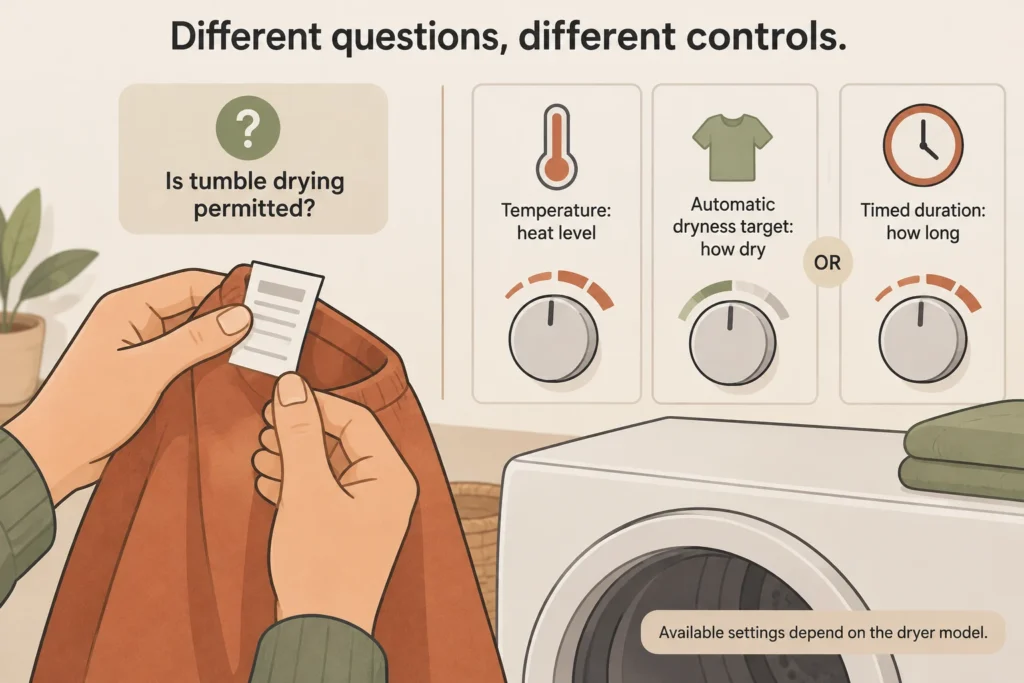
Even if “Low” is selected, this doesn’t guarantee all the clothing is exposed to the same conditions. GE notes that many other factors can affect conditions. Lower heat can comply to a garment’s heat limit, but this doesn’t mean shrinkage is eliminated.
Measure the change, not just the fit
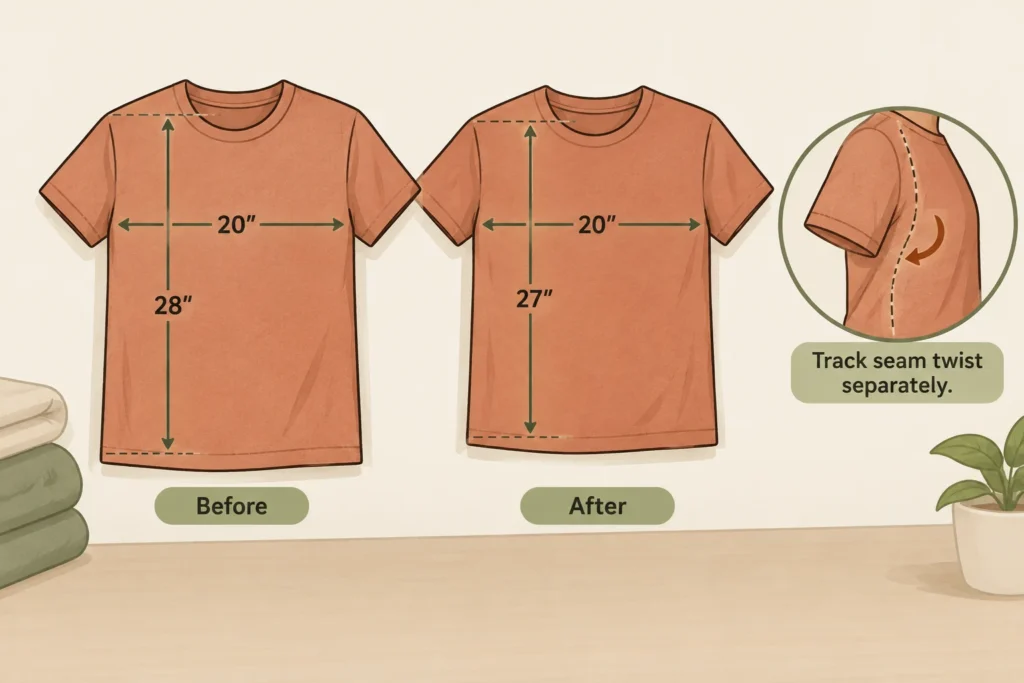
I would believe you if you said the fit has changed. As for where, a shirt can shrink lengthwise, but not width. A twist in the side seam can distort the neckline and armholes. It is impossible to make a shirt that is perfectly balanced, because some parts can shrink lengthwise while others can shrink width wise. Measuring clothing is done by tracking length, width and skew because they are not the same thing.
You can take that idea back home without making your laundry turn into a science fair project. Lay the completely dry garment out flat and don't stretch it. Take a picture of where the tape is placed, then measure the body length from a fixed shoulder point to the hem and the width from the underarm points. If sleeve length bothers you, include that as well. After the care is complete, compare those landmarks to see if the seams were twisted. Again, this is a personal record at home, not a standardized test for textiles.
For illustration, a body length changing from 28 inches to 27 inches is a loss of 1 ÷ 28 × 100, or about 3.6% in length. It says nothing about width unless you measured that too. If you didn't measure the dimensions before, you can start measuring the dimensions now. However, you won't be able to definitively say why/how the dimensions changed (was it the washer, dryer, both?) and you can't go back in time to see the original dimensions. Just because you find something after it goes through the dryer, doesn't mean the entire change happened there.
Protecting the fit you still have
Not all cotton shirts deserve the dryer. According to the American Cleaning Institute, if your cotton knit labels give the OK for tumbling, remove them slightly damp, and reshape and finish flat instead of completely drying in the dryer. Again, this is preventative. Don’t expect your shrunken shirt to magically grow again. Washing conditions matter, as changing the dryer conditions leaves the previous steps of laundering untouched.
With flat drying wool, don’t hang it wet, as the weight of the wool can stretch and distort the knit. The Woolmark Company states that slight corrections of out-of-shape areas is allowed, however, this is different from pulling a compacted sweater back to its original shape.
I also wouldn’t recommend the “universal” conditioner or baby shampoo soak. While this may prevent the dryer from further shrinking the fabric, this method is risky and unpredictable, and can make the fabric extremely misshapen and wide. If gentle reshaping begins to pull seams or stretch the fabric beyond its original shape, stop.
If following care instructions didn’t work in your favor, take pictures and measurements and save the labels. Go to the retailer and explain your issue. Don’t always immediately turn to the internet for solutions.
Sources and references
- The Journal of the Textile Institute; University of Greater Manchester repository: Higgins et al., Effect of Tumble-drying on Selected Properties of Knitted and Woven Cotton Fabrics, Part II (2003)
- Cotton Incorporated: A Guide to Improved Shrinkage Performance of Cotton Fabrics, ISP 1009 (2004)
- The Woolmark Company: Machine Washable Wool
- The Woolmark Company: How to Dry a Wool Sweater
- GE Appliances: Dryer, Explanation of Dryer Temperatures
- Whirlpool: Stacked Laundry Center Cycle Guide, W11784845 Rev. A
- Federal Trade Commission; ASTM: ASTM Guide to Care Symbols
- American Association of Textile Chemists and Colorists: AATCC Introduces the Skew & Shrinkage Template
- American Cleaning Institute: Laundering Problems & Solutions