

Separately clean the body and the removable lid parts, let them dry completely and then reassemble. If a musty smell is persistent on the body after washing, look closely at the seal grooves, straw connections and drinking passages. Don’t just look at the shiny interior. There may be residue trapped somewhere or maybe water is trapped somewhere.[1][2][4]
Before you reach for strong smell treatment, look to see if there is trapped or missed residue.
Mustiness may be caused by different factors, such as mold or other organisms. Deodorizers may make the bottle smell better, but that doesn’t necessarily mean the bottle is safe for use.[6]
Look beyond the part you can easily scrub
The body has one open cavity and the lid has several contact surfaces. Washing the outside of the lid may not reach the contact surfaces. Closing everything while wet may limit the drying of trapped water.[2][4]
Imagine I’m at the sink, annoyed that yesterday’s bottle is back for another wash. The interior looks spotless, but water drips from the lid when I turn it over. I put down the bottle brush and look up the lid diagram instead. That changes the job from scrubbing the same accessible surface to finding what I’ve missed.
Find the lid’s name before taking it apart
The diagram that pertains to your exact lid is the most useful. Look at what seals and mechanisms the diagram shows coming out. A straw that pulls free doesn’t tell you whether the spout above it also comes out.[2][4]
For instance, Hydro Flask’s Flex Straw Cap has a removable, red, sealing ring. However, in Contigo’s Ashland guide, the silicone spout is mentioned as being nonremovable and not to pull or rotate the spout shield. I would take Contigo’s word for it, even if the lid appeared to come apart in a different way in a video. A fixed part isn’t always uncleanable, but trying to remove it can make things worse.[2][4]
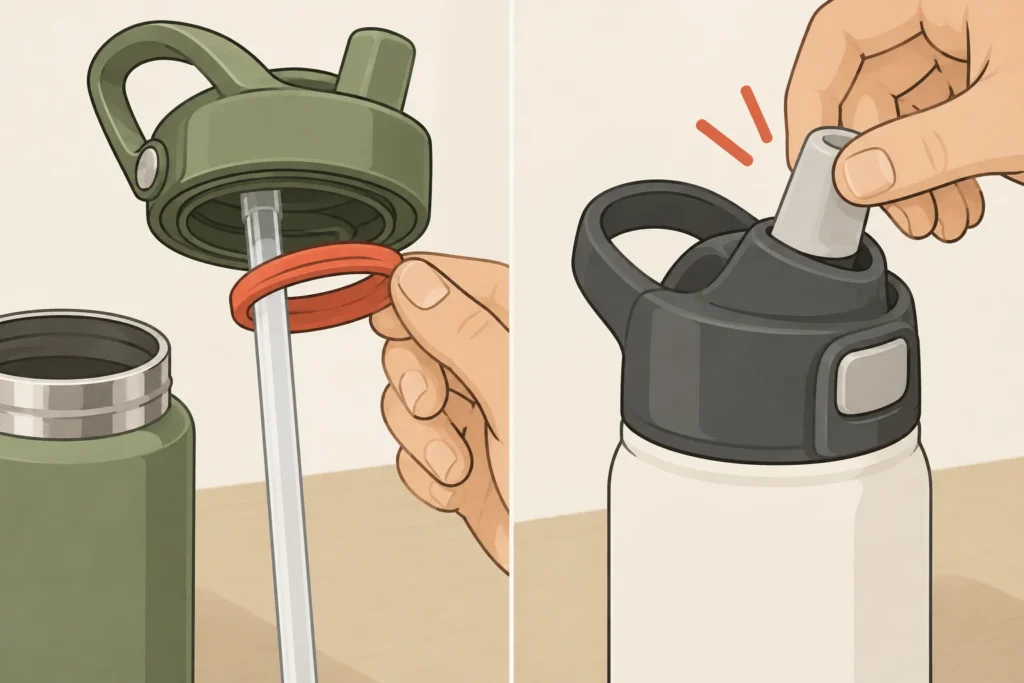
It's permissible to take something apart and to wash something separately. Hydro Flask suggests putting the Flex Straw Cap components on the top rack. Owala’s FreeSip Twist suggests hand washing the base and lid and gives dishwasher advice for other components. Other components say, “hand washing recommended” but don’t mean “dishwasher prohibited.” Also, these instructions do not cross over to other models.[2][3]
Give the hidden surfaces a proper wash and dry
The parts that allow hand washing can be done using dish soap, warm water, and a clean, nonabrasive brush. Attend to the places that a quick swish of the dishwasher misses. This includes the shoulder of the bottle and threads, and the sides of removable seals. Give special attention to straw connectors and the grooves. To access drinking pathways or valves, use only the shown access or positions. Then, rinse away the loose residue and soap.[1][2][4]
Keep all of the removable parts separated and dry on a clean rack. Keep the opening of the bottle unobstructed. The outside of the parts can feel dry, but water can remain trapped in a seal groove. Give the seal grooves and other tight spots time to completely dry before reassembling.[1][2][4]
Look for water before counting down a drying time. Store the empty bottle with its lid off to avoid trapping moisture.[1][2][4]
Replace only what you can’t maintain
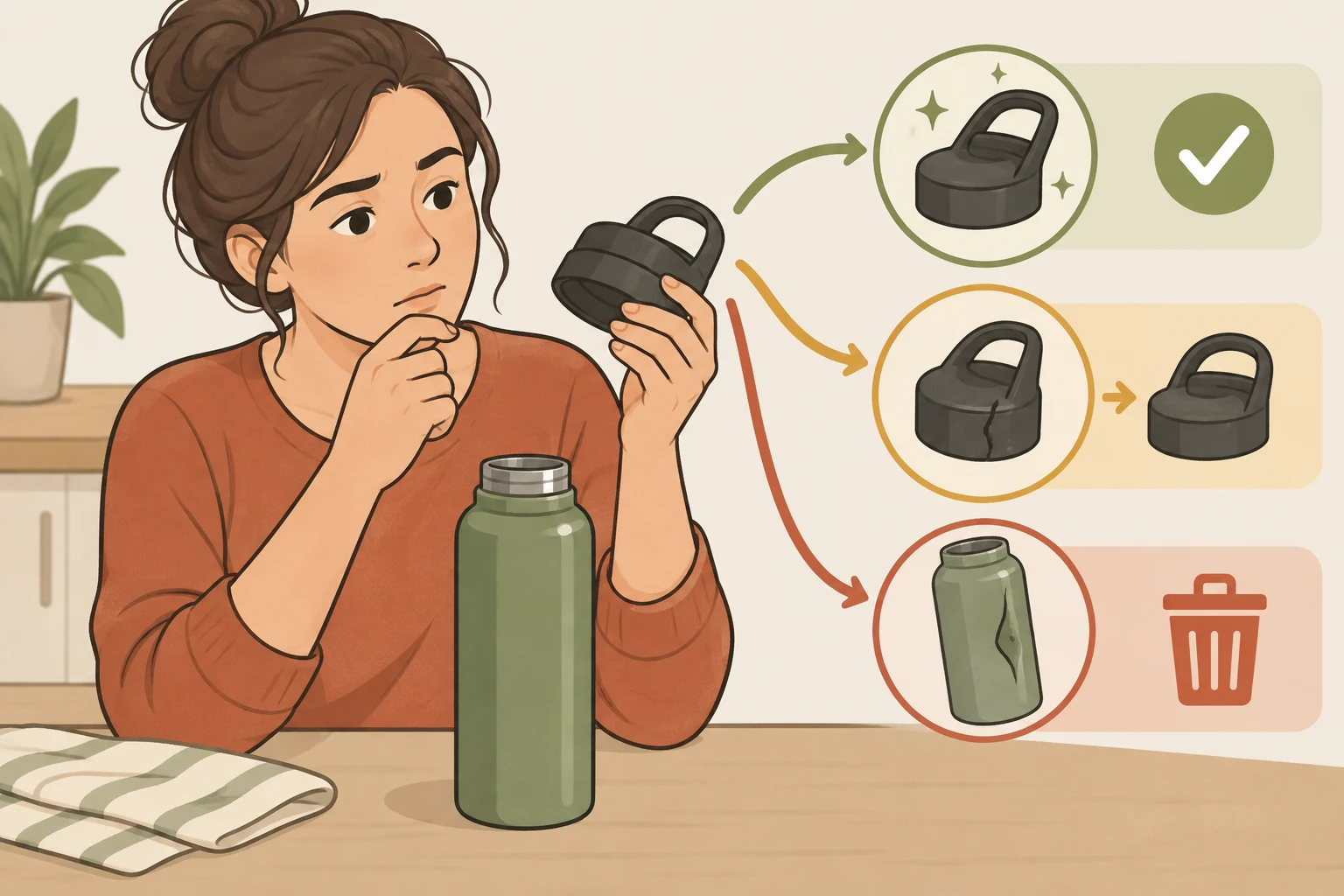
If a thorough cleaning removes the residue and the part is able to dry completely, and everything is able to be reassembled and the bottle is able to function correctly then you are able to continue using it. I wouldn't replace an entire bottle because the lid requires more attention.[4][5]
Tears in the seal or other residue beyond the reach of documented cleaning is different. You should not use a part that has an uncleanable damage. The smallest component that is able to be used in place of the lid should be used, or the entire lid should be replaced if the inner piece is not able to be used. Owala does sell replacement lids, straws and gaskets, however the listing does not verify fit or availability.[4][5]
Retire the bottle if there is damage to the bottle body that affects its care or use, or if no maintainable compatible drinking assembly is available. Odor without visible residue is less conclusive; after an acceptable clean and dry, its cause may remain unresolved. The best practical approach may be to replace the affected part. This doesn't prove the odor means there is a danger. I wouldn’t ask you to keep washing the same part without better access or a new reason to believe there is a different result.[4][5]
Sources and references
- Tasmanian Department of Health: Water Bottle Hygiene
- Hydro Flask: How to Clean Your Flex Straw Cap (2024-08-28)
- Owala: FreeSip Twist Cleaning Instructions
- Contigo / Newell Brands: Ashland Care and Use Instructions
- Owala: FreeSip Replacement Parts
- Centers for Disease Control and Prevention: Preventing Drinking Water-Related Illnesses (2024-05-21)