

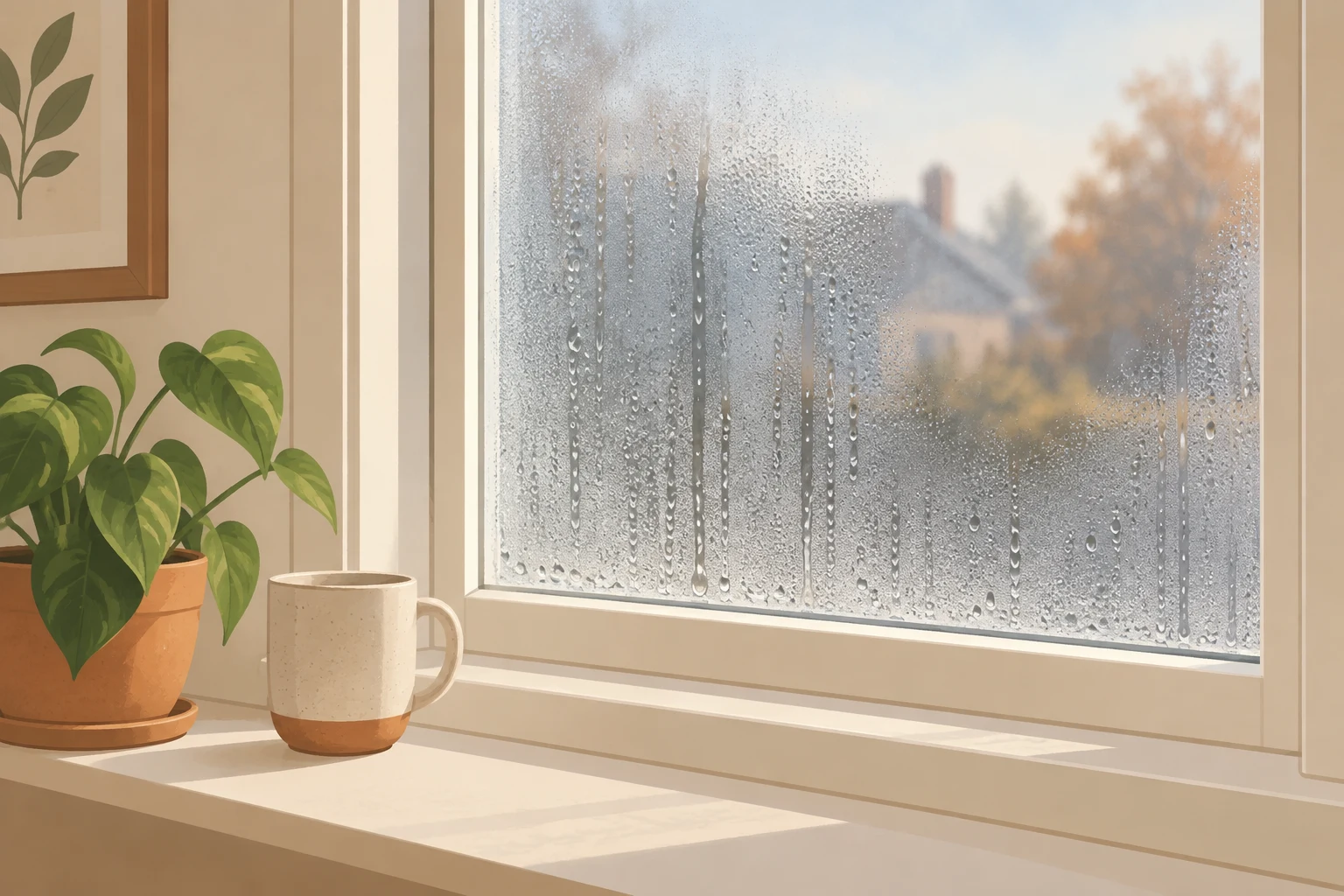
Just because your windows are wet doesn’t mean your house needs a dehumidifier. Room-side window condensation occurs due to the temperature difference between the indoor and outdoor air. Exterior window condensation or dew typically means no change is needed inside. Condensation between the panes of your windows means the window needs to be replaced. Persistent window wetness, especially when paired with damaged window trim or walls, requires an investigation; unless the room humidity seems extremely high.[1][4][5][6]
Locate the water before treating the room
Using a dry cloth, wipe a small area on the room-facing glass. Disappearing water drops indicate moisture on the room side, but an unchanging patch does not mean trapped moisture. Dew can look the same on the other side of the glass from indoors.
Take pictures of the outdoor surface only if you can reach it without leaning out or climbing. Otherwise, take pictures of the haze and see if it clears as outdoor conditions change.
| Moisture location | What it suggests | Useful response |
|---|---|---|
| Room-facing glass | Indoor air is contacting glass cold enough for water vapor to condense. This alone does not prove window failure. | Reduce avoidable moisture, improve room-air access to the glass, and compare the pattern. |
| Outdoor-facing glass | Exterior dew can form when the glass falls below the outdoor dew point, often overnight or in the morning. | Observe whether it evaporates during the day. Lowering indoor humidity is not the relevant treatment. |
| Inside the sealed gap between panes | Moisture in an insulating-glass unit usually indicates a failed glass seal. | Arrange window assessment after confirming the location and window construction. |
A separate storm window provides an exception. The space between a storm window and the original window is not the sealed space in an insulating glass unit. Condensation can occur in that larger space, and on the glass in the space as well. Before diagnosing that you have a failed seal, determine if you have sealed multi-pane glass, a separate storm window, or both. Persistent moisture in a cavity requires a construction-specific evaluation to identify the source, rather than an automatic diagnosis.[6][8]
Exterior dew may affect one pane of a unit but not its neighbor. It may also evaporate as the environmental conditions change. That uneven pattern does not always represent a defect, and exterior condensation does not always indicate an energy-performance issue.[5]
A reasonable humidity reading can still leave cold glass wet
Condensation occurs when a surface is at or below the dew point of the air in contact with it. The same indoor air can dry a warmer window and condense on a colder one. In addition to the humidity in the air, the construction of the window, the outdoor temperature, and the air circulation in the room can all play a role in where the condensation occurs.[4][7]
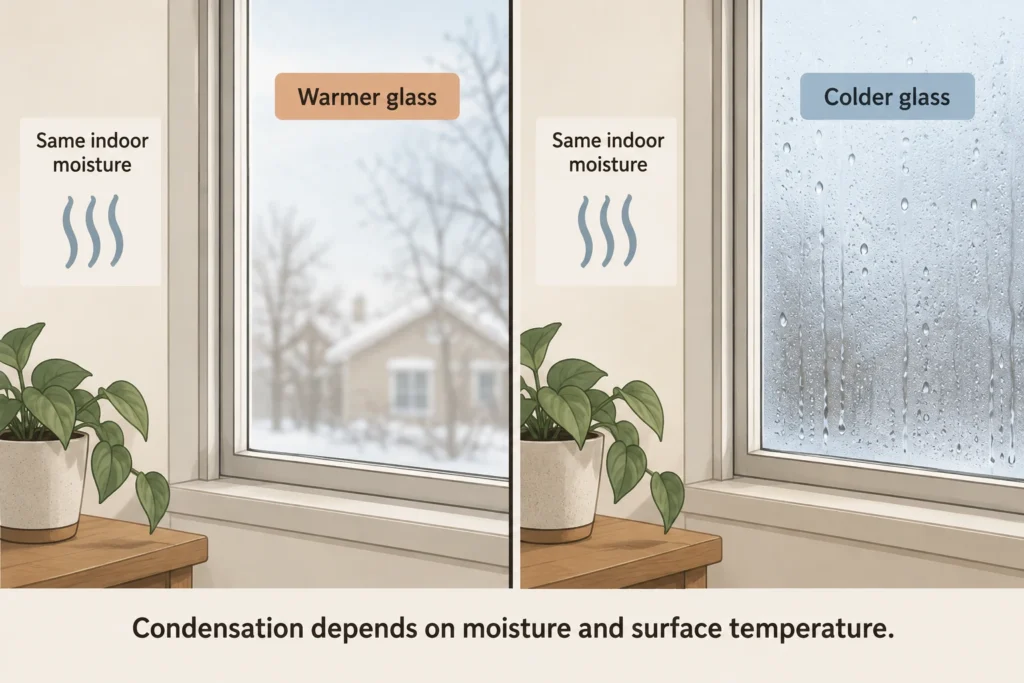
EPA recommends keeping indoor relative humidity below 60%, ideally between 30% and 50%, as general moisture-control guidance, not a promise of dry windows.[1]
I've found that their cold-weather guidelines offer 35% indoor humidity at 20°F outside as an example of a lower limit. How low humidity must be still depends on the glass, the room temperature, and local conditions. Don't over-dry the whole house to satisfy one stubborn window.[3][4]
Use a basic humidity meter to take readings of relative humidity and room temperature near the time moisture appears. Take the readings in the room and not pressed against the glass or next to a heater or shower. A midday reading may miss a rise in relative humidity that occurs at night or after a shower. Even a good representative reading in the room, cannot tell you the glass temperature, detect hidden moisture, or exclude the presence of a leak.
Read the pattern alongside weather and room use
A few windows have droplets on the inside during cold spells and that shared indoor moisture warrants addressing first. Indoor moisture that builds up after showering or cooking or after drying indoor laundry supports the case. It doesn’t prove all affected windows are sound. Shared indoor moisture and glass that is too cold can happen at the same time.[3][4]
One exception is not evidence of a rule, especially when examining a single example. A single repeated condition may have a closed shade, less air movement, different glazing, and/or be in a colder location. However, the presence of repeated wet locations on surrounding walls, the association of moisture with rain, and decay around an opening may indicate water entry and a building condition problem. The path of moisture may not always be discernible, and one can’t always say for certain that if there is a leak that it will show itself at a particular time.[3][4][7]
Keep a brief record of the window and the surface affected by condensation, the time, the room relative humidity and temperature, outdoor conditions, recent moisture producing activities, and if coverings were open. Photographs of the affected glass and adjacent wall or sill are always useful. It is more beneficial to keep a record of these than to only indicate that condensation reoccurred on the window.
Try modest changes before buying equipment
When you have confirmed room-side condensation, begin with a moisture source that is timed appropriately. Use exhaust ventilation that discharges outdoors during moisture producing activities, decrease humidifier output if it is not needed, or move indoor laundry drying if it is located in the affected room and an alternative drying space is available. These correct the condensation problem; wiping the glass does not.[2][3]
Open your blinds or curtains enough to let room air reach your windows, and keep your furnishings from blocking heat or air flow. This can help warm the glass-facing area, but moving air is not the same as removing moisture. If the room is still damp despite using your exhaust fan, look into that ventilation problem separately, as assuming that longer fan use will dry the room is not correct.[2][4]
An open window can help dry a room if conditions allow. Outdoor air may be too humid and add even more moisture to the room. A dehumidifier can be a good option if the readings show that the indoor environment is too humid, and source control and ventilation can’t effectively manage it. A dehumidifier can’t remove dew from the exterior of windows, moisture that accumulates between the panes of windows, or water that enters the building through the windows.[2][5][6]
Use a soft, absorbent cloth to dab up as much of the dry droplets and collected sill water as possible. This limits the continued wetting of the nearby finishes. This protective task is separate from troubleshooting. A freshly wiped window does not indicate that the cause has also changed. If there is peeling paint, swollen trim, or a wet wall, this should not be treated as a harder cleaning job.[1]
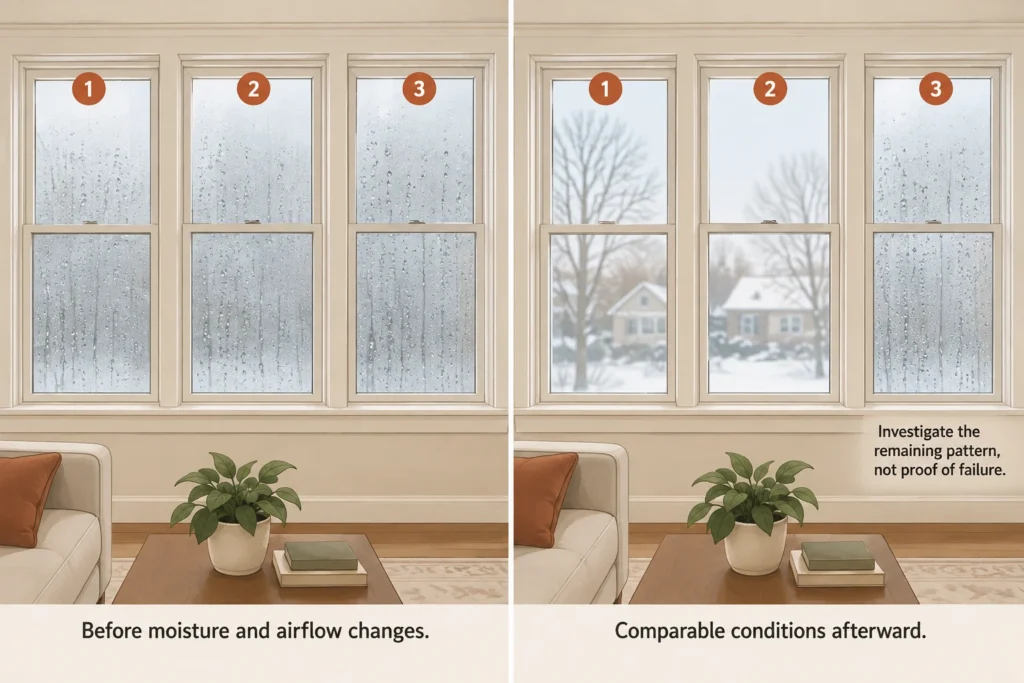
Looking for the least number of affected panes, least amount of water, smaller wet area, and/or less frequent wiping is the correct way to compare similar windows based on outdoor temperatures, the room’s use, heating, and position of covering. A warmer day tells you little.
Keep a low-burden change if it helps, without assuming humidity was the only cause. For example, if most of the windows improve but one remains wet, focus on that one window instead of increasing whole-house drying.
When the evidence points in two directions
Imaging a house with three wet bedroom windows after showers on cold mornings. One of the windows was recently cleaned. The worst morning happened after overnight rain. Recent cleaning doesn’t explain where the water is coming from or why it returns. Rain is ambiguous, as it can be accompanied with colder glass or water entry. The first piece of useful evidence is that indoor window panes are wiped and that a wipe clears condensation from all three window panes, confirming that the water is room side condensation.
Let’s say shower exhaust and leaving the curtains open lower the humidity reading in the morning and leave two windows mostly dry during comparable cold weather. The third gets wet. That response supports keeping the moisture changes, but it doesn’t prove the third window is defective. If the surrounding trim of that window (along that edge) gets a new damp, raw area during a rain and the other windows don’t get that, then the next decision changes: report the localized dampness and request an assessment. Further dehumidification isn’t going to solve the uncertainty of water entry.
When wiping has reached its limit
Don't wait for a household humidity trial to report water leaks or damage to surrounding building materials. Report water entry or repeatedly wet wall areas, swollen or softened trim, peeling finishes, or mold growth. Confirmed moisture in sealed insulating glass also requires a window assessment. Just because moisture is confirmed in the insulating glass does not necessarily mean the entire window must be replaced. The service needed would be dependent on the window and its condition.[1][3][6]
When there’s localized persistent moisture without damage, take photos and send observation records after adequate changes to the source and airflow. The landlord or assessor should review the window assembly and materials adjacent to it for cold surfaces, installation issues and where water is entering, not to confirm that the room is humid. Identify and distinguish sealed glass from a storm window cavity. Don’t remove trim, drill glass or caulk an unidentified water path as a diagnostic experiment.[7][8]
Send written notices about leaks, damage, and mold to your landlord and keep photos and records of their responses. If issues remain unresolved, contact your local housing authority to file a moisture or housing-maintenance complaint. There are local processes for resolving these complaints.
In New York City, HPD directs tenants to report leaks or mold to their landlords and use 311 if the situation remains unsafe. This is local procedure and not a nationwide reporting process.[9]
Sources and references
- U.S. Environmental Protection Agency: A Brief Guide to Mold, Moisture and Your Home
- U.S. Environmental Protection Agency: Mold Course Chapter 9
- U.S. Environmental Protection Agency: What are the main ways to control moisture in your home?
- Andersen Corporation: Condensation on the Interior of Window or Patio Door Glass
- Andersen Corporation: Condensation on the Exterior of Window or Patio Door Glass
- Pella Corporation: Frequently Asked Questions About Windows
- U.S. Department of Energy: Guide to Energy-Efficient Windows
- U.S. Department of Energy, Building America: Measure Guideline: Wood Window Repair, Rehabilitation, and Replacement
- New York City Department of Housing Preservation and Development: Indoor Allergen Hazards (Mold and Pests)