

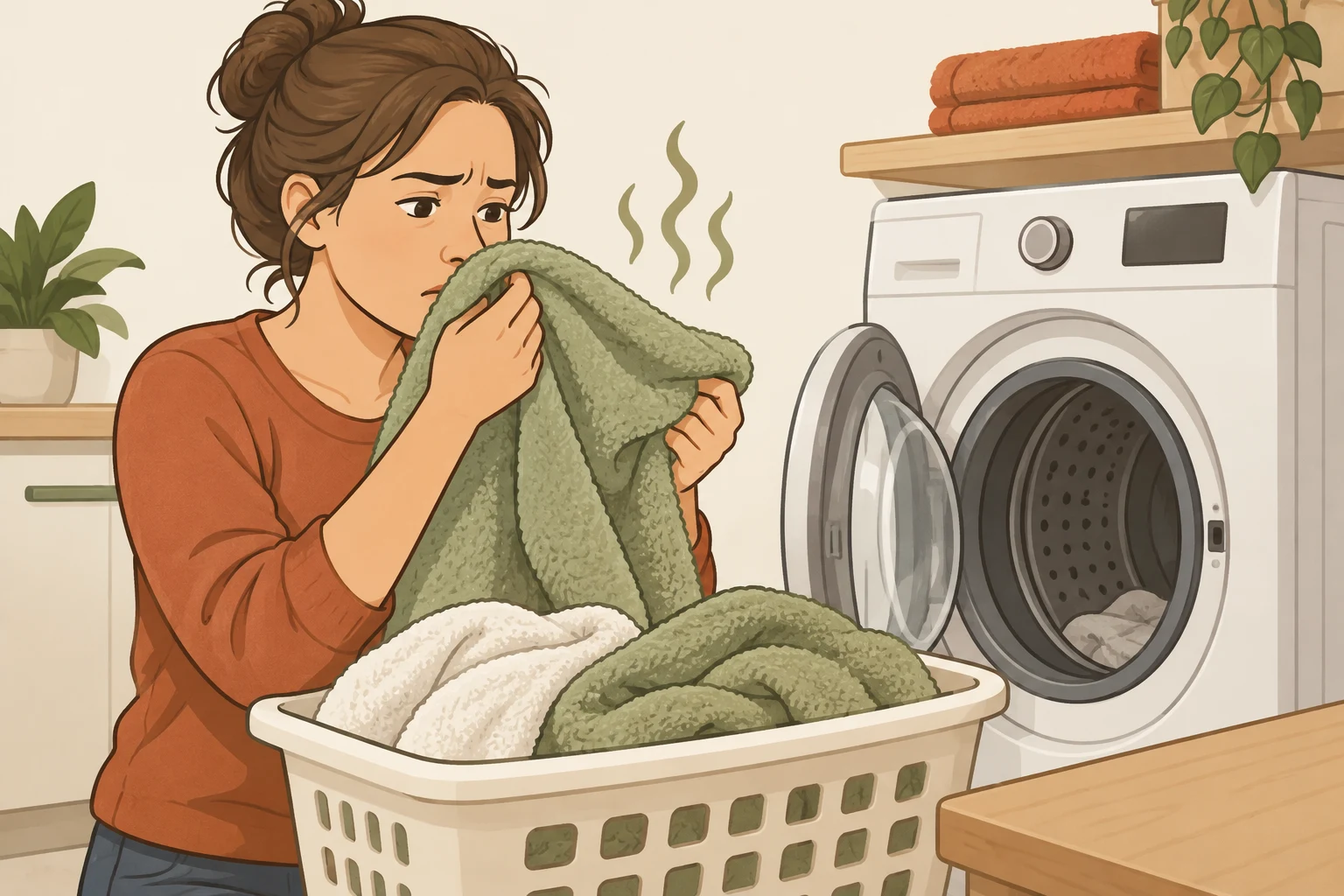
If your towels smell sour as they finish washing, consider what happened to the towels before they were washed, your washer settings, and your washer itself. First, consider if any of the loads before or after the towels had an odor. I wouldn’t consider stronger chemistry at this time. That makes your next wash more purposeful.
There are differences between the odor you notice at the time of unloading, and odor on towels that have been sitting wet all night. There’s also the issue of laundered towels that smell fine after washing and drying but develop an odor when stored, as covered in the post “When Laundry Smells Fine Until You Put It Away.” Later drying conditions or the environment of your closet can’t explain an odor that is already present at the time of unloading.
What else comes out smelling?
If your normal loads of laundry don’t smell, consider the history of the towels and the loads you washed with them. Were the towels left in a damp heap? Were the towels packed more tightly than your clothes? Damp towels or clothes can harbor odor causing microorganisms. Extended use of the machine recommends spreading damp towels to dry before putting them in the hamper to prevent microorganism growth.
If different loads also smell, focus on your washer and settings. “Sour” doesn’t mean that your laundry isn’t hygienic. If several loads come out smelling bad, it doesn’t mean for certain that your washer is broken. In a similar vein, several loads coming out smelling sour doesn't mean for certain that your washer is working properly.
Give the next towel wash a reason to work
Picture me, in an imagined laundry-room moment, yanking a sour towel from a quick wash load. The bathroom has no clean spare. I’m irritated enough to add more detergent. Instead, I set the bottle down, and took another approach to the problem. With a short cycle, a change is needed, not a larger splash.
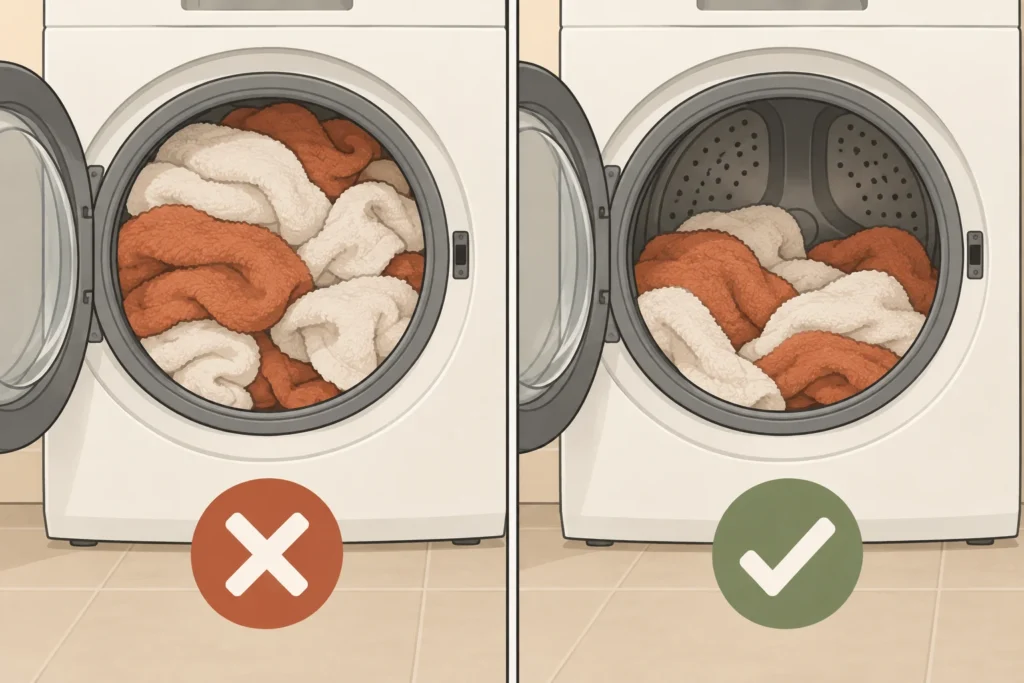
Detergent distribution and rinsing can be obstructed by packed loads. Load towels loosely within your model’s loading parameters and split an overpacked load into smaller, balanced loads. Choose a cycle intended for that fabric and soil level. In the case of GE’s GFW550, Quick Wash is described for small, lightly soiled loads, not every quick load you want to finish.
Measure detergent based on load size, soil, and the type of water your washer uses. You should use automatic dispensing for concentrated detergents. Don’t always assume less detergent is better. Visible detergent residue and excessive suds warrant a review of the dose and rinse. A sour smell alone does not warrant an extra rinse.
Follow the care label for the towel. For example, Brooklinen’s Super-Plush towels say to wash cold and to not use bleach. So, I can’t say to wash towels hot and to use bleach based on them being ‘cotton towels’ alone. The brand also says not to use fabric softener, because it can reduce absorbency.
When the washer deserves attention
Towel-only odor does not always mean the towels need to be washed. It’s more likely needed when scheduled maintenance is due, build up is present on washer surfaces, the washer is empty and other loads also have an odor, and the dispenser is also dirty. For a front loading washer, also check the accessible folds of the gasket for build up. To clean these, use the method described by the manufacturer. Running the maintenance cycle is fine, but using a mixture of products to clean the washer is not.
A washer’s self clean cycle is not always a good towel wash. GE’s self clean cycle says to have an empty drum. So, the washer’s treatment to clean the towels is not the same as using hot water and bleach to clean towels.
Investigate if there are issues with draining or spinning instead of repeating cycles if there is standing water or wet towels. Towels can hold a lot of water and a load of towels can be dripping, but don't send the towels straight to the dryer. Repeated cycles can lead to odor and if the water is not draining or the drain hose is kinked that can cause odor as well. Certain models have different areas that can be accessed to fix these issues and the service manual has the dimensions for that model. There can also be odor after maintenance checks. Sometimes the odor can be coming from the stand pipe and in that case a plumber should be called.
When doing the corrected towel wash, check the odor and make sure to unload the washer and dry it right away. If the odor is gone then towels should be dried completely. If the odor is still there, don't continue to run that same load. If the towels are still holding the odor it is probably still affecting other laundry.
Sources and references
- GE Appliances: GE washer owner’s manual, 49-3000368 Rev 0
- Whirlpool: Preventing Detergent from Re-depositing on Clothing
- Brooklinen: Care Guide
- Applied and Environmental Microbiology; Abney and colleagues: Laundry Hygiene and Odor Control: State of the Science (2021-06-25)
- University of Missouri Extension: How to Prevent and Remove Mildew, Home Methods
- GE Appliances: Front Load Washer, Odor in Tub